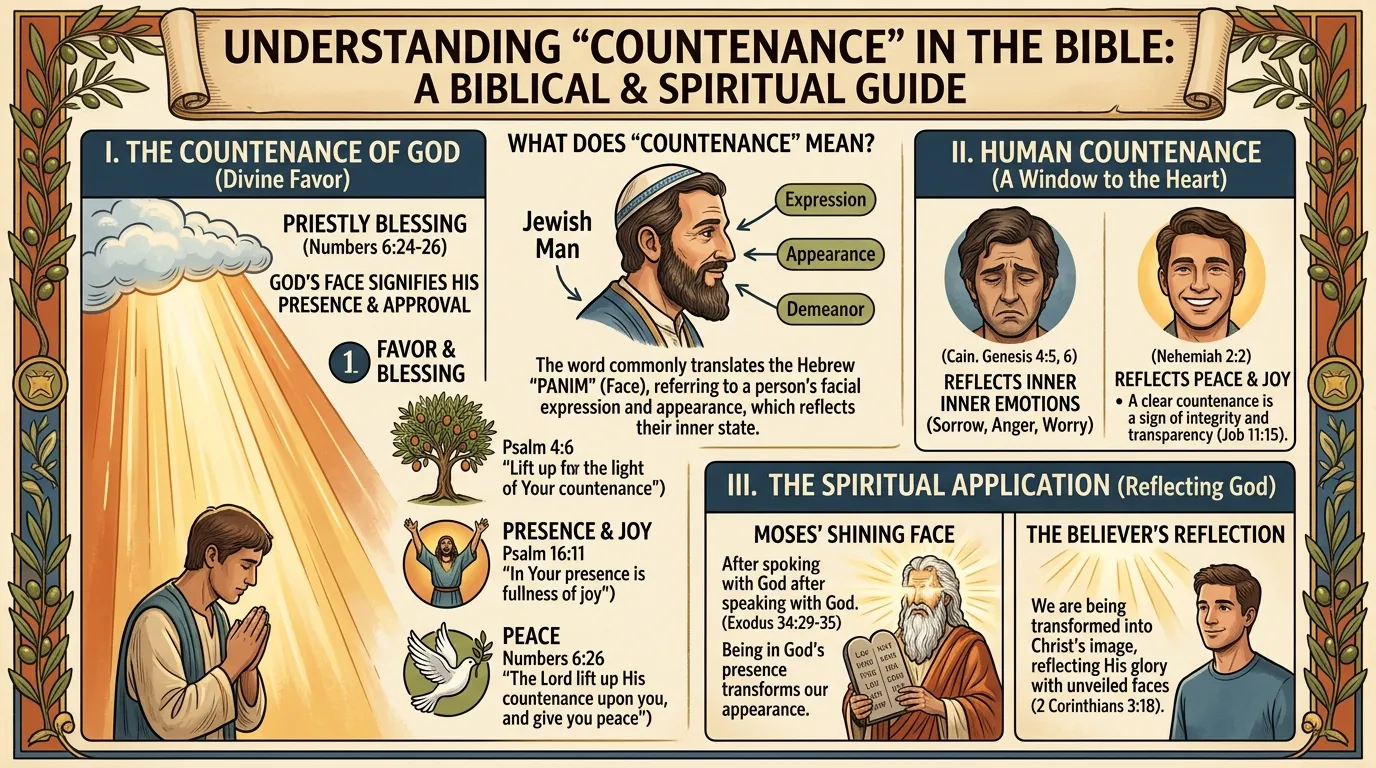
“The Lord bless you and keep you; the Lord make his face shine upon you and be gracious to you; the Lord lift up his countenance upon you and give you peace.” These words — the Aaronic blessing, spoken over Israel for three thousand years — contain the Bible’s most important use of the word “countenance.” But what does it mean for God to lift His countenance? Does God have a face? And what does our countenance — the look on our own faces — reveal about our hearts?
The Hebrew word behind “countenance” is panim, which literally means “face” — and, by extension, “presence.” This double meaning unlocks everything. In the Bible, someone’s face is never just a face. It is the window of the heart and the sign of relationship. To see a face is to be present with a person. To hide a face is to withdraw. The Bible’s teaching on countenance is really a teaching on presence: God’s presence with us, and the presence of our hearts made visible.
Panim: Face as Presence
Panim is one of the most frequent words in the Hebrew Bible, and its range is remarkable. It means the face, but it also means the front, the surface, and — crucially — presence itself. When Jacob wrestles at Peniel (“face of God”) and says, “I have seen God face to face, and yet my life is delivered,” he is claiming something extraordinary: direct presence with God, and survival.
The most theologically loaded use is “the face of God” as His manifest presence. Moses asks to see God’s glory, and God replies, “You cannot see my face, for man shall not see me and live” — yet He promises, “my presence will go with you.” The paradox is deliberate: God’s face is both the supreme blessing and the supreme danger, because God’s unveiled presence is unbearable to sinners and irresistible to saints. The whole Bible moves between these poles, from the hiding in Eden to the promise of Revelation: “They will see his face.”
When the Aaronic blessing asks God to “lift up his countenance,” it is asking for the favorable, attentive presence of God — the face turned toward us, not away. The opposite is the hidden face: “Hide not your face from me,” the psalmists plead, because God’s averted face means judgment, abandonment, darkness. Countenance, in the biblical sense, is relational before it is physical. It is about which way God is facing.
The Shining Face: Moses and the Glory
The most dramatic countenance in the Old Testament belongs to Moses. After forty days on Sinai in God’s presence, he comes down with his face shining — so radiant that the people are afraid to come near, and he has to wear a veil. His countenance has absorbed something of God’s glory the way the moon absorbs the sun’s light. He did not generate the radiance. He reflected it.
Paul seizes on this in 2 Corinthians 3 and turns it into the charter of Christian transformation. The glory on Moses’ face was fading — that is why the veil was needed, to hide the fact that it was diminishing. But the new covenant brings an unfading glory: “We all, with unveiled face, beholding the glory of the Lord, are being transformed into the same image from one degree of glory to another.” The Christian’s countenance is meant to do what Moses’ did — reflect God’s presence — but permanently, from the inside out.
This reframes the whole idea of a “good countenance.” It is not about attractiveness or cheerfulness as personality traits. It is about exposure. The face shines when it has been in the presence. Moses’ radiance was the afterglow of forty days with God. No shortcut exists: the shining face is the receipt for time spent in the light.
What Our Faces Betray
The Bible is equally frank about human countenances — and what they reveal. The first mention comes early and darkly: Cain’s “face fell” when God rejected his offering. God asks, “Why are you angry, and why has your face fallen?” The fallen face is the visible symptom of the inward state: resentment, jealousy, the heart turning sour. God reads Cain’s face the way we read weather — and He warns him that sin is crouching at the door.
The pattern repeats. When Jacob notices “that Laban did not regard him with favor as before” — literally, that Laban’s face was not with him as formerly — he knows the relationship has shifted before a word is spoken. Nehemiah’s “sadness of heart” shows in his face before the king, and the king notices: “Why is your face sad, seeing you are not sick?” Faces testify. They are witnesses we cannot silence.
Proverbs makes this a principle: “A glad heart makes a cheerful face, but by sorrow of heart the spirit is crushed.” The Hebrew psychology here is holistic — heart and face are one system. You cannot compartmentalize indefinitely. What fills the heart eventually surfaces on the countenance. This is both a warning and a comfort: a warning to those nursing bitterness, a comfort to those whose joy in God will, in time, show.
The Countenance of Christ
The Gospels give us glimpses of Jesus’ face, and each one is revealing. At the Transfiguration, “his face shone like the sun” — the Sinai glory, now unveiled and permanent, belonging to Him by nature rather than by reflection. The disciples see what Moses only borrowed: the countenance of God Himself, shining from within.
But there is another face of Christ the Gospels will not let us forget: the face that was struck, spit upon, and mocked. “They struck his face.” Isaiah had prophesied it: “I hid not my face from disgrace and spitting.” The shining face of the Transfiguration and the marred face of the Passion belong to the same person — and the marred face is the price of our access to the shining one. Because His face was hidden in judgment, ours can be lifted in grace.
After the resurrection, the disciples recognize Him — and sometimes do not. Mary mistakes Him for the gardener until He speaks her name. The Emmaus disciples’ “eyes were kept from recognizing him” until the breaking of bread. The resurrection countenance is both continuous and transformed: the same Jesus, now shining with the glory of the new creation. It is a preview of what Paul promises us: the transformation from one degree of glory to another, until our faces too reflect what we have beheld.
The King’s Face: Favor and Life
Wisdom literature uses countenance politically: the face of the king means favor, and favor means life. “In the light of a king’s face there is life, and his favor is like the clouds that bring the spring rain.” To stand in the light of the king’s countenance is to live under his approval; to lose it is to wither. The proverb is practical advice for courtiers, but it doubles as theology: if a human king’s face can mean life, how much more the King’s?
Esther’s story turns on this imagery. To approach the Persian king unsummoned is to risk death — “except the one to whom the king holds out the golden scepter.” Esther approaches, the scepter is extended, the face is favorable, and a nation is saved. The scene is a parable of prayer: we approach the throne of the universe’s King, and the scepter — grace — is extended. “Let us then with confidence draw near to the throne of grace.” The countenance we seek is not turned away. In Christ, the King is already smiling.
Seeking the Face: The Practice
The Psalms turn all of this into a practice with a single repeated phrase: “Seek his face.” “You have said, ‘Seek my face.’ My heart says to you, ‘Your face, Lord, do I seek.'” To seek God’s face is to seek His favorable presence — not His hand (His gifts) but His face (Himself). It is the difference between using God and knowing Him.
The practice has a promise attached, and it is the greatest promise in Scripture: “Blessed are the pure in heart, for they shall see God.” And beyond that, the final promise of the Bible’s final chapter: “They will see his face, and his name will be on their foreheads.” The story that began with hiding from God’s face in Eden ends with seeing it forever in the New Jerusalem. Every seeking of the face now is a rehearsal for the seeing then.
So what does “countenance” mean in the Bible? It means presence made visible — God’s favorable nearness shining on His people, and His people’s hearts shining back. It is the Aaronic blessing’s deepest request: not just blessing, not just keeping, but the lifted face, the shining face, the face that means peace. “The Lord lift up his countenance upon you” — there is no greater thing to ask, and no greater thing to receive.
The word’s range — from a face to a presence, from anatomy to theology — is mapped in the article on countenance, a useful companion to the biblical study of faces, presence, and glory.