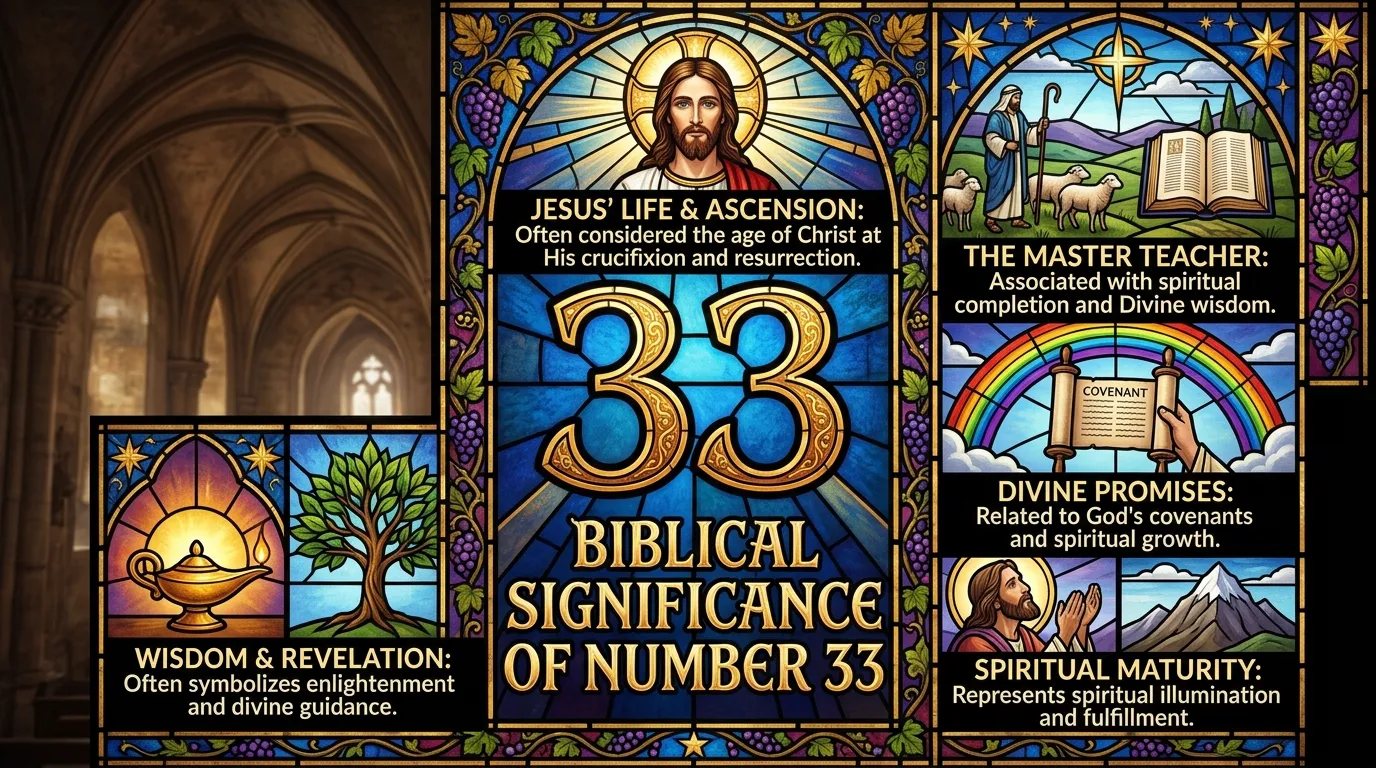
The number 33 appears in the Bible the way a minor character appears in a great novel: briefly, at decisive moments, easy to miss. Scripture never explains the number. No verse says “thirty-three means such-and-such.” But the moments where 33 surfaces are not random — they cluster around the formation of Israel, the establishment of David’s kingdom, and the life of Jesus. This article traces those moments honestly, distinguishing what the text states from what tradition has added, and asking what the pattern — if it is a pattern — might teach.
The approach here is deliberately historical rather than mystical. Instead of asking “what is the secret meaning of 33,” we will ask “where does 33 show up, and what was happening there?” The answers turn out to form an arc: a family, a kingdom, and a King.
Thirty-Three Souls: The Family That Became a Nation
The first 33 in Scripture comes in Genesis 46, as Jacob’s family descends into Egypt. The chapter lists the descendants by mother, and of Leah — Jacob’s first wife — it concludes: “These are the sons of Leah, whom she bore to Jacob in Paddan-aram, together with his daughter Dinah; altogether his sons and his daughters numbered thirty-three.”
Thirty-three people. That is the seed of a nation that will become millions. The list is painstaking — every name recorded — because God is in the business of counting His people. He counts them going into Egypt, He counts them in the wilderness censuses, and Jesus will later say the very hairs of our heads are numbered. The 33 of Genesis 46 is not symbolic. It is a census. But it teaches something the symbolic readings miss: God deals in particulars. He does not save humanity in the abstract. He saves Leah’s thirty-three, name by name.
There is a quiet encouragement here for anyone who feels like a small number. Thirty-three souls in a caravan, surrounded by the greatest empire on earth, looked insignificant. Four centuries later their descendants walked out as a nation that would change the world. God has never needed large beginnings. He has always preferred them small.
Thirty-Three Years in Jerusalem: The Kingdom Established
The second 33 is David’s. Second Samuel records: “At Hebron he reigned over Judah seven years and six months, and at Jerusalem he reigned over all Israel and Judah thirty-three years.” Thirty-three years with the ark in the city, the kingdom united, the borders secured, the psalms being written. The Jerusalem reign is the golden age — the period every later king will be measured against.
David’s thirty-three years matter because Jerusalem matters. The city David captured from the Jebusites becomes the city of God — the place of the temple, the place of the prophets, the place where, a thousand years later, another King will ride in on a donkey. David’s reign establishes the pattern: one king, one capital, one God. The prophets will spend centuries promising that the pattern will return in a greater David, an eternal kingdom, a new Jerusalem.
Notice what the number frames: not David’s private life but his public reign. The thirty-three years are the years of the kingdom, not the shepherd boy or the fugitive. Scripture’s numbers often work this way — they measure eras, not essences. The significance is in what happened during the years, not in the digits themselves.
Thirty-Three Years: The Tradition About Jesus
The third 33 is the most famous and the least certain. Luke tells us Jesus was “about thirty years of age” when He began His ministry. The Gospels describe at least three Passovers during that ministry. Tradition, doing the arithmetic, concludes He was about thirty-three at the crucifixion. The church has repeated this for two millennia — medieval art, hymnody, and preaching all assume a thirty-three-year-old Christ on the cross.
But honesty requires the qualifier: Scripture does not state His age at death. “About thirty” plus “at least three Passovers” yields an estimate, not a datum. Irenaeus, writing in the second century, even argued Jesus was closer to fifty, appealing to John 8:57 (“You are not yet fifty years old”). The tradition of thirty-three is reasonable and ancient, but it is tradition, not text. A responsible article says so plainly.
What is certain is the shape of the life, whatever its exact length: roughly three decades of obscurity, three years of public ministry, one week that changed history. If the thirty-three figure is right, then Jesus died at the age when David’s Jerusalem reign was just hitting its stride — the King of kings finishing in three years what took David thirty-three to build. The parallel is suggestive, not doctrinal. But it is the kind of suggestion that makes you think, which is all a number can rightly do.
The Arc: Family, Kingdom, King
Step back and the three occurrences form a sequence. Thirty-three souls go down to Egypt — the family. Thirty-three years David reigns in Jerusalem — the kingdom. Thirty-three years, by tradition, Jesus lives — the King. Family, kingdom, King: the story of redemption in three numbers, each one marking a stage in God’s plan to bless the nations through Abraham’s seed.
Is the sequence intentional? We cannot know. The biblical authors do not flag it, and building doctrine on unflagged patterns is exactly how numerology goes wrong. But as a devotional observation — a way of noticing how the story rhymes — it has value. Scripture is full of such rhymes: the first Adam and the last, the exodus and the return, David’s sufferings and Christ’s. Whether or not anyone intended the 33s to rhyme, the story they belong to certainly does.
How the Tradition Shaped Christian Art
The traditional thirty-three years of Christ left a mark on Christian culture far beyond the church’s preaching. The most famous example is Dante’s Divine Comedy: each of its three canticles — Inferno, Purgatorio, Paradiso — contains exactly thirty-three cantos, with one introductory canto bringing the total to a perfect hundred. Dante, writing at the height of medieval faith, structured his vision of the afterlife around the years of Christ’s earthly life. Every reader who descends through the Inferno’s thirty-three cantos is, knowingly or not, walking a path measured in the years of Jesus.
This is how tradition works at its best: not as a rival to Scripture but as a response to it. Dante did not claim the Bible teaches that hell has thirty-three divisions. He took the church’s cherished memory of Christ’s thirty-three years and built a cathedral of poetry on it. The number became a vessel for devotion rather than a code to crack. That is the right relationship between tradition and text — the text governs, the tradition adorns.
Other examples abound. Medieval churches were sometimes built with thirty-three columns or windows. Hymns counted the years. The point was never numerology; it was remembrance. A church that cannot remember how long its Lord walked the earth is a church that has forgotten something precious. The tradition of thirty-three, whatever its historical precision, kept the humanity of Christ — His real, countable years — before the eyes of the faithful.
Honest Limits
Several cautions are in order, because the internet’s treatment of 33 is among the least careful in all of biblical numerology. First, the Bible never assigns 33 a symbolic meaning. Claims that it means “promise,” “spiritual perfection,” or “the divine” are inventions — sometimes pious, sometimes commercial, always unbiblical. Second, the Jesus-at-33 figure is traditional, not textual; anyone who builds a teaching on it should say so. Third, sightings of 33 in daily life — on clocks, receipts, addresses — are not messages. They are prompts at best, coincidences at worst.
The deeper question is why we want numbers to mean things. Often it is because we want guidance without the hard work of wisdom — a sign instead of a Scripture, a shortcut instead of a search. But God has not left us without guidance. He has given us His word, His Spirit, and His church. Numbers can decorate the journey. They cannot direct it.
What the 33s genuinely offer is simpler and better: three snapshots of God’s faithfulness across the centuries. He counted Leah’s children. He established David’s throne. He sent His Son in the fullness of time. The God of the thirty-threes is the God who keeps His promises on schedule — whether the schedule involves thirty-three souls, thirty-three years, or thirty-three years of a life that saved the world.
Those interested in the number’s wider cultural footprint — from its mathematical properties to its appearances in religion and lore — can consult the overview of the number 33, keeping in mind that Scripture’s own testimony is always the surer ground.










