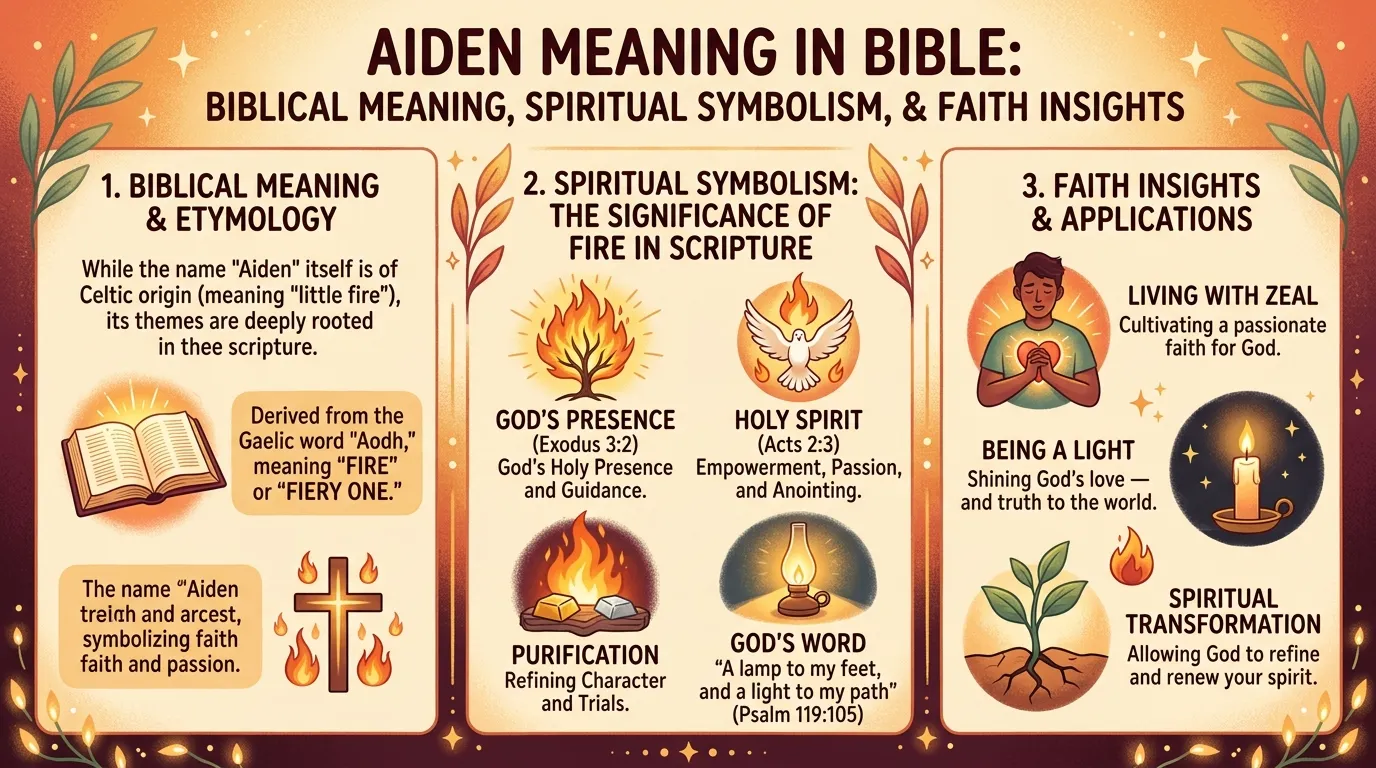
Aiden is not in the Bible. That is the first thing to say plainly, because many articles about the name imply otherwise. No Aiden appears in any genealogy, no prophet bears the name, and no concordance lists it. But the question most people are really asking — “Does this name connect with anything true in Scripture?” — deserves a better answer than a flat no. Aiden comes from the Irish name Aodh, meaning “fire” or more precisely “little fire,” and fire is one of the Bible’s great images of God Himself.
So the honest way to handle this name is in two parts: what the name actually is, and what the Bible says about the thing it names. The first part belongs to Irish history. The second belongs to Scripture. Keeping those two parts distinct is what separates careful thinking from wishful thinking — and it is exactly what this article will do.
Where Aiden Really Comes From
Aiden is the anglicized form of the Irish Aodhán, a diminutive of Aodh, an old Irish word meaning fire. Aodh was also the name of a Celtic sun god, which is why some name books add a mythological footnote. The name traveled through Ireland and Scotland, crossed the Atlantic with immigrants, and exploded in popularity in the English-speaking world in the late twentieth and early twenty-first centuries. Today it ranks among the most common boys’ names in the United States.
None of this is biblical. It is Irish, and there is nothing wrong with that. The Bible never requires names to come from Hebrew or Greek. Many beloved Christian names — Patrick, Bridget, Kevin, Aiden — come from the languages of peoples who later embraced the gospel. A name’s worth is not measured by its presence in a concordance. It is measured by the life of the person who carries it and the truths that life can point to.
Why Fire Matters in Scripture
If Aiden means “little fire,” then the biblical conversation starts with fire itself, and Scripture has a great deal to say about it. The first great fire in the Bible is the burning bush. Moses sees a bush that burns without being consumed, turns aside, and hears the voice of God. Fire here is the presence of God — holy, awesome, and strangely gentle, since the bush is not destroyed. The God who is a “consuming fire” is also the God who can dwell in the middle of the flame without burning up what He touches.
Then there is the pillar of fire. When Israel leaves Egypt, God goes before them in a pillar of cloud by day and a pillar of fire by night, giving them light. Fire becomes guidance — the visible sign that God is leading His people through the dark. For anyone named Aiden, that is a rich image: a little fire that lights the way for others, a life that helps people find the path when the night is dark.
On Mount Sinai, God’s presence descends in fire, and the whole mountain trembles. At the dedication of Solomon’s temple, fire falls from heaven and consumes the sacrifice. On Mount Carmel, Elijah prays and fire falls, and the people cry, “The Lord, he is God!” Again and again, fire in Scripture is the signature of God’s nearness — His holiness made visible, His power made undeniable.
Fire That Refines and Fire That Empowers
But biblical fire is not only about spectacle. The prophets use fire as an image of refining. Malachi says the coming messenger will be “like a refiner’s fire,” purifying the sons of Levi as gold and silver are purified. Peter writes that trials test faith “as fire tests” gold. Zechariah promises that God will bring His people “through the fire” and refine them. A little fire, in this biblical sense, is not destruction — it is purification. It burns away what is worthless and leaves what is precious.
Then comes Pentecost, and fire becomes personal. Tongues of fire rest on each of the disciples, and they are filled with the Holy Spirit. John the Baptist had promised that Jesus would baptize “with the Holy Spirit and fire.” At Pentecost the promise lands. Fire is no longer only on mountains and altars; it rests on ordinary people. The image fits the name beautifully: Aiden, a little fire, kindled by a great one.
There is a warning in the imagery too, and honesty requires mentioning it. Fire in Scripture also judges. Sodom, the sacrifices of idolaters, the “unquenchable fire” of Jesus’ warnings — fire is the Bible’s image for what happens when holiness meets unrepentant sin. A name connected to fire should carry both sides: warmth and warning, comfort and conviction. The God of the burning bush is also the God of Sinai.
What This Means for the Name
So what can a Christian say, truthfully, about naming a child Aiden or carrying the name? First, that the name is not biblical in origin, and there is no need to pretend it is. Second, that its meaning — little fire — opens a door to some of Scripture’s most powerful imagery: God’s presence in the bush, His guidance in the wilderness, His refining work in believers, and His empowering Spirit at Pentecost.
Parents who choose the name can pray these images over their child: that he would know the God who appears in fire, be guided like Israel by the pillar, be refined rather than consumed, and carry the Spirit’s flame to others. That is not superstition. It is the ordinary Christian practice of taking a good thing — a name’s meaning — and filling it with prayer.
And for anyone who bears the name, the fire imagery suggests a calling. John Wesley reportedly said he wanted to be “aflame” for God. The bush burned without being consumed because God was in it. A life can do the same: burn brightly with love, truth, and courage, sustained not by its own fuel but by the presence of God within.
The Small Fire of the Tongue
There is one more fire passage that belongs in any discussion of a name meaning “little fire,” and it is a sobering one. James writes, “How great a forest is set ablaze by such a small fire! And the tongue is a fire.” A little fire can warm a house or burn down a forest, and the difference is not the size of the flame but what it touches. James applies this to human speech: words are small, but their power is enormous. A careless sentence can destroy a reputation, a friendship, or a church. A gracious one can heal.
This gives the name Aiden an ethical edge that the warm imagery alone does not. To be a “little fire” in the biblical sense is to accept responsibility for one’s words. The same small flame that lights the way can also scorch. The prayer for anyone carrying this name might be twofold: burn brightly for God, and burn carefully among people. Let the fire refine rather than consume, warm rather than wound.
Unburned in the Furnace
Daniel 3 tells of three young men — Shadrach, Meshach, and Abednego — thrown into a blazing furnace for refusing to bow to an idol. The fire is stoked seven times hotter than usual. It kills the soldiers who throw them in. But the three walk around inside the flames unharmed, and a fourth figure appears with them, “like a son of the gods.” They come out without a singed hair, without the smell of smoke on their clothes.
The story is the burning bush in reverse: there, the bush burned and was not consumed because God was present; here, the men do not burn because God is present with them. Fire in Scripture is never merely a natural force. It is always, in the end, about who stands in it with you. For a name that means “little fire,” that may be the deepest biblical truth of all: the flame is safe only when God is in the middle of it.
Questions People Ask
Is Aiden a biblical name?
No. It is Irish in origin, derived from Aodh, meaning fire. It does not appear anywhere in Scripture.
Does the Bible say anything about the name’s meaning?
The Bible says a great deal about fire — God’s presence, guidance, refining, judgment, and the Holy Spirit — and those passages give the name’s meaning a rich biblical resonance, even though the name itself is not biblical.
Is it okay for Christians to use a non-biblical name?
Absolutely. Scripture nowhere commands that names come from the Bible. What matters is the faith of the family and the life of the child, not the etymology on the birth certificate.
For readers who want to explore the name’s background further, the history of the name Aiden traces its Irish roots and its remarkable rise in the modern English-speaking world.










