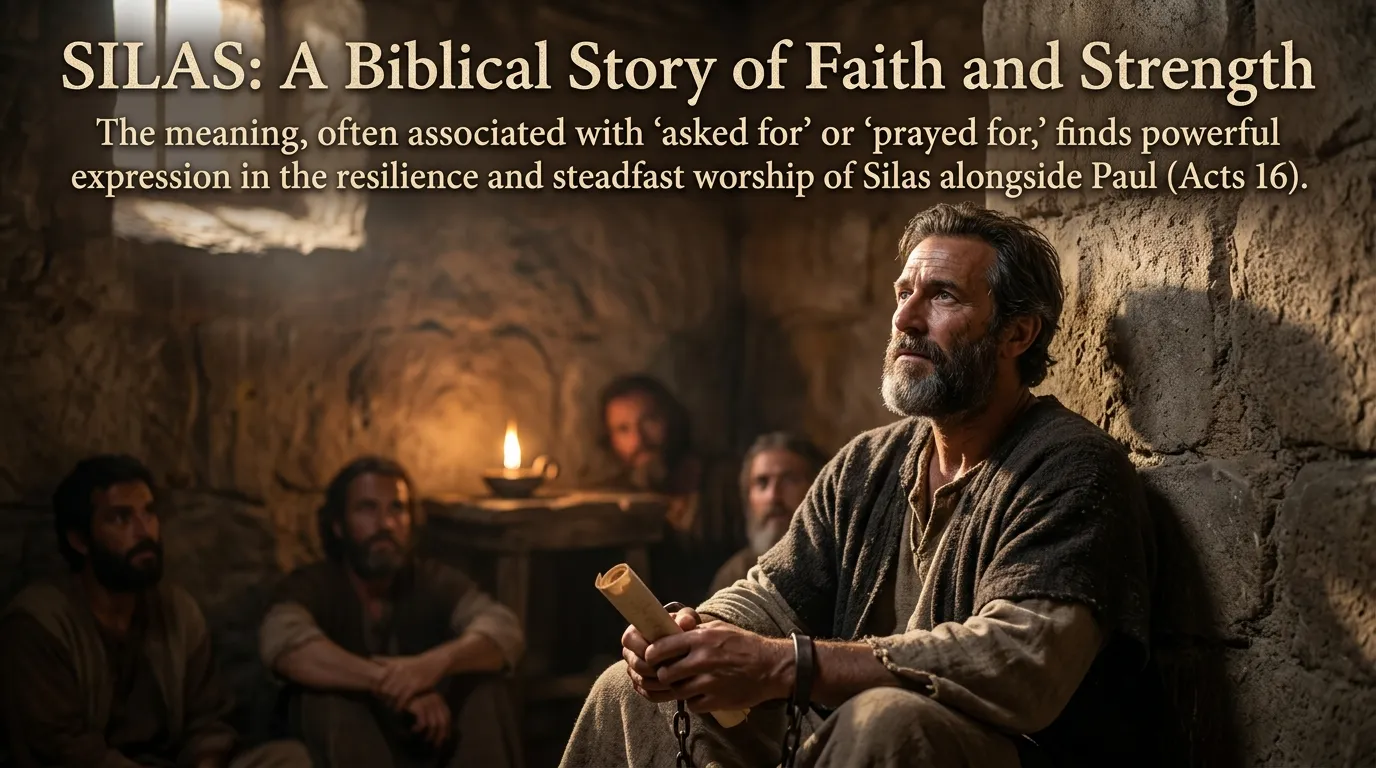
Everyone knows Paul. Almost no one knows Silas — and that is precisely what makes him worth knowing. For some of the most consequential years of the early church, Silas was the man beside Paul: beaten beside him, imprisoned beside him, singing beside him at midnight in a Philippian jail. He co-signed two New Testament letters. He carried the most important letter of the first century. He is called a prophet. And history has largely forgotten him.
That obscurity is not an accident to be corrected but a sermon to be heard. Silas is Scripture’s great portrait of the faithful second — the one who makes the hero’s work possible without becoming the hero. His name, his assignments, and his songs sketch a theology of hidden faithfulness that most believers need more than they need another hero story.
The Name
“Silas” is the Greek form; the Latin is Silvanus — the name Paul actually uses in his letters (“through us… Silvanus and Timothy,” 2 Corinthians 1:19; “Paul, Silvanus, and Timothy, to the church of the Thessalonians,” 1 Thessalonians 1:1; 2 Thessalonians 1:1). Silvanus derives from silva, Latin for forest or woods — “man of the forest,” “wooded one.” Peter uses the Latin form too, in the closing of his first letter: “By Silvanus, a faithful brother as I regard him, I have written briefly to you” (1 Peter 5:12).
That last verse is a quiet bombshell. Peter — the apostle to the Jews, the rock — regards Silas as the faithful brother through whom he wrote. Silas may have been Peter’s amanuensis, shaping the Greek of 1 Peter; he was certainly his trusted courier. So the “forgotten” man was trusted by Paul and Peter — the two pillars of the early church both leaned on him. Obscurity and indispensability, in one life. The forest-man’s name turns out to be prophetic in an unexpected way: like a forest, his work was everywhere and his profile was nowhere — the ecosystem the visible trees depended on.
The Letter Carrier
Silas first appears at the hinge of church history: the Jerusalem Council. When the apostles settled the explosive question of whether Gentiles must be circumcised, they sent the decision to Antioch — and they chose their couriers carefully: “it seemed good to the apostles and the elders… to choose men from among them and send them to Antioch with Paul and Barnabas. They sent Judas called Barsabbas, and Silas, leading men among the brothers” (Acts 15:22). Leading men. Silas was not a random volunteer; he was Jerusalem-church leadership, chosen to carry the most consequential letter of the first century.
And he was more than a mailman. “Judas and Silas, who were themselves prophets, encouraged and strengthened the brothers with many words” (Acts 15:32). Prophet — one who speaks God’s word to God’s people. When the letter was read in Antioch, Silas did not just deliver the decision; he ministered it, preaching and strengthening the church through the transition. The letter settled the theology; Silas settled the people. There is a whole ministry in that distinction — the ministry of the one who carries the message and tends the recipients.
The Prison Singer
Then came the assignment that made him immortal. Paul chose Silas for the second missionary journey (Acts 15:40), and in Philippi their preaching got them beaten with rods and thrown into the inner prison, feet in stocks (Acts 16:23–24). What happened at midnight is one of the New Testament’s defining scenes: “About midnight Paul and Silas were praying and singing hymns to God, and the prisoners were listening to them” (Acts 16:25).
Consider what singing required. Their backs were flayed. Their feet were clamped. They were in the dark, in a foreign city, for doing good. Every circumstance argued for despair, complaint, or at least silence. They sang — and the Greek implies they were singing to God, not performing for the prisoners, though the prisoners were listening. Worship in chains is faith’s purest form: praise with no reason except God Himself.
Then the earthquake, the opened doors, the unfastened chains (Acts 16:26) — and the scene’s true climax, which is not the miracle but the mercy. The jailer, ready to kill himself, hears Paul’s shout — “Do not harm yourself, for we are all here” (Acts 16:28) — and asks the question the whole book of Acts exists to answer: “Sirs, what must I do to be saved?” (Acts 16:30). By sunrise, he and his household are baptized (Acts 16:33). The midnight hymns did not just comfort two prisoners; they converted a family. Silas’s voice is in that song. We will never know which harmony line was his. Heaven does.
The Pen Behind the Letters
Silas’s third role is the most hidden and perhaps the most influential. He is named as co-sender of both Thessalonian letters — the earliest New Testament writings by most reckonings. Whatever Paul dictated, Silvanus stood behind. And Peter’s testimony — “by Silvanus… I have written” (1 Peter 5:12) — suggests his pen, or at least his partnership, shaped an apostle’s epistle. The man history forgot may have helped write the Scriptures history remembers.
This is the ministry of the amanuensis: the one whose handwriting carries another’s authority, whose craft serves another’s message, whose name appears in the greeting but never in the headline. It takes a particular holiness to pour your gifts into work that bears someone else’s name — and Silas did it for two apostles. The forest-man’s obscurity was not failure. It was vocation.
The Ministry of the Second Chair
Here is Silas’s sermon for the church today. Most believers will never be Paul — the headline, the pioneer, the name on the letter. Most will be Silas: the companion, the carrier, the singer in the second harmony, the pen behind the message. And Scripture insists this is not a lesser calling. It is the calling, for most of us, most of the time.
The second chair has its own virtues, and Silas displays them all. Loyalty: he stayed through beatings and prisons, never leveraging hardship into departure. Flexibility: prophet in Jerusalem, missionary in Philippi, courier for Peter — he served wherever the need was, under whoever led. Worship under pressure: the midnight hymns prove his faith was not circumstantial. Contentment with hiddenness: no record of Silas grasping for Paul’s spotlight, planting his own flag, or resenting his role. He simply served — and the church’s history is unthinkable without him.
Paul’s own theology blesses this ministry: the body has many members, “and the parts of the body that seem to be weaker are indispensable” (1 Corinthians 12:22). Silas is the living illustration — seemingly weaker, actually indispensable. Remove him from Acts 15–18 and the story collapses: no trusted courier for the decree, no companion for the second journey, no singer in the Philippian jail, no co-sender of Thessalonians, no pen for Peter.
“He Must Increase”
If Silas had a life verse, it might be John the Baptist’s: “He must increase, but I must decrease” (John 3:30). John spoke it about Jesus; Silas lived it about everyone. Beside Paul, he decreased. Beside Peter, he decreased. In the prison, in the letters, in the history books — always the second name, never the headline. And Scripture treats this not as failure but as the normal shape of faithfulness.
The New Testament even provides the negative example, so we know what Silas avoided. Diotrephes, in John’s third letter, “likes to put himself first” (3 John 9) — the church’s first recorded spotlight-seeker, who rejected apostolic authority and excommunicated the faithful. The contrast is deliberate and damning: the man who grasped at prominence is remembered as a warning; the man who released it is remembered as a blessing. Ambition builds monuments to itself. Faithfulness builds the church.
This is Silas’s final word to a platform-obsessed age. Visibility is not a measure of value — in God’s economy it is often the inverse. The forest-man’s obscurity was not a problem to be solved but a calling to be kept. “Well done, good and faithful servant” (Matthew 25:21) is spoken to servants, not celebrities — and the commendation is for faithfulness, not fame. Silas heard it. The second chair, faithfully occupied, turns out to be one of the highest seats in the kingdom.
The name Silas, then, means something larger than “man of the forest.” It means faithful presence: the one who shows up, sings at midnight, carries the letter, sharpens the pen, and never needs the credit. In a church age obsessed with platforms, Silas is a rebuke and a comfort — proof that heaven keeps careful records of servants earth forgets. The biblical and historical record of Silas is brief, but its lesson is long: the second chair, faithfully occupied, shakes prisons and writes Scriptures.










