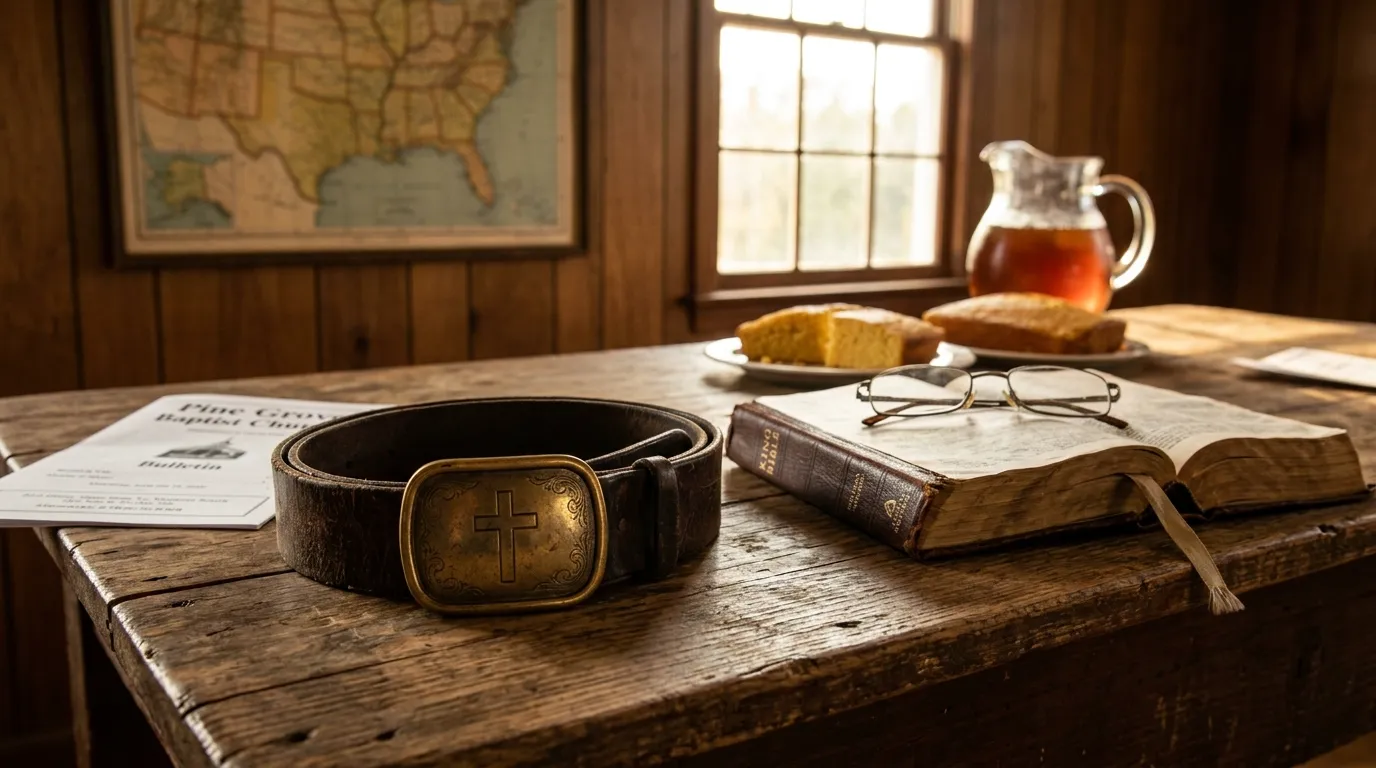
The phrase “Bible Belt” was coined as an insult. In the 1920s, the American journalist H. L. Mencken — a cheerful skeptic of religion — used it to mock the American South, a region he saw as backward in its enthusiastic Protestantism. The name stuck, the insult faded, and many Southerners eventually wore it as a badge of honor. Today it describes the swath of the southeastern United States where church attendance is high, Christian identity is assumed, and faith shapes public life.
Here is the honest starting point for a biblical article on the subject: the Bible Belt is not in the Bible. No verse names it, no prophet predicted it, and no apostle visited it. It is a twentieth-century cultural label, not a scriptural category. But the Bible does talk about belts — and it has searching things to say about religious regions, inherited faith, and the difference between living near the truth and living in it. The cultural belt and the biblical belt make a revealing pair.
Where the Name Came From
The Bible Belt, culturally speaking, runs roughly from Texas across the Deep South to the Carolinas and up into parts of the Midwest — the region where, for generations, Sunday church was the social default, preachers were community pillars, and biblical literacy was a point of pride. Revivals swept through it. Denominations planted deep roots in it. To this day it reports some of the highest rates of church membership and Bible reading in America.
None of that is bad. A region saturated with churches, Scripture, and Christian moral formation is, on its face, a blessing — the kind of thing missionaries pray for in unreached places. The question the Bible raises is not whether the Belt exists but what it produces: does proximity to faith create faith, or can it create something else — familiarity without transformation, religion without relationship? Scripture has a whole diagnostic toolkit for exactly this question, because Israel was, in a sense, the original Bible Belt: a nation saturated with the temple, the sacrifices, the Scriptures — and repeatedly rebuked for missing the God at the center of all of it.
The Belt Scripture Actually Describes
The Bible’s own belt is a piece of armor. “Stand therefore, having fastened on the belt of truth” (Ephesians 6:14). In Roman armor, the belt was not decorative — it cinched the tunic for battle and held the sword. Paul’s image is precise: truth is what holds everything together and what carries the weapon. A Christian without the belt of truth is a soldier with his tunic tripping him and his sword on the ground.
The image is older than Paul. Isaiah’s vision of the coming King: “Righteousness shall be the belt of his waist, and faithfulness the belt of his loins” (Isaiah 11:5). The Messiah Himself wears truth as a belt — righteousness holding Him together, faithfulness girding Him for action. The belt in Scripture is never about geography. It is about grip: what holds your life together when the battle starts. A region can be called the Bible Belt. Only a person can wear the belt of truth.
The Warning for Religious Places
This is where the Bible gets uncomfortable for Bible Belt residents — and for anyone raised in a Christian home, a Christian town, or a Christian culture. Jesus’ sharpest rebukes were not for pagans but for the religiously saturated: “This people honors me with their lips, but their heart is far from me” (Matthew 15:8). Lips near, heart far — the exact disease of inherited religion. You can know the hymns, vote the values, attend the church, and be distant from God. Proximity is not intimacy.
He said it to a church, too. To Sardis — a congregation with a fine reputation — the risen Christ wrote: “I know your works. You have the reputation of being alive, but you are dead” (Revelation 3:1). Reputation of life, reality of death: the Bible Belt’s nightmare verse. A region, a church, a family can maintain every outward form of faith while the inward reality has quietly expired. The forms are not the problem — Sardis was not rebuked for having a reputation. It was rebuked for having only a reputation.
The Old Testament makes the same diagnosis nationally. Israel had the temple, the priests, the festivals — the full apparatus — and God said through Isaiah, “Bring no more vain offerings… your new moons and your appointed feasts my soul hates” (Isaiah 1:13–14). Not because worship is bad, but because worship without justice and mercy is noise. A Bible Belt that produces churches but not transformed lives is Israel all over again: well-equipped and missing the point.
What Holds a Life Together
So what distinguishes the true belt from the cultural one? Scripture’s answer is stubbornly personal. “Your word is a lamp to my feet and a light to my path” (Psalm 119:105) — not “your region,” not “your heritage,” but your engagement with the Word, daily, personally. The belt of truth is fastened one morning at a time, in the actual reading and believing of Scripture — not in the demographic fact of living where Bibles are common.
And it is communal in the right way: “let us consider how to stir up one another to love and good works, not neglecting to meet together… but encouraging one another” (Hebrews 10:24–25). The verse the Belt knows well — but its point is stirring, not merely gathering. A church that gathers without stirring is a social club with hymns. The promise attached to real gathering is Christ’s own: “where two or three are gathered in my name, there am I among them” (Matthew 18:20). His presence — not the building, the budget, or the zip code — is what makes a gathering Christian.
The invitation, then, is not to abandon the Belt but to examine it — starting with the mirror. Cultural Christianity asks, “Do I live in a Christian place?” Biblical Christianity asks, “Is Christ my life?” (Colossians 3:4). The first question can be answered with a map. The second requires a cross, a confession, and a daily fastening of the belt of truth.
Gird Up: The Belt as Readiness
The biblical belt has one more meaning, and it is about readiness. On the night of the Exodus, Israel ate the Passover “with your belt fastened, your sandals on your feet, and your staff in your hand. And you shall eat it in haste” (Exodus 12:11). The belted waist was the posture of departure — dressed to move the moment God said go. Faith, from its first national meal, was a traveling faith: belt fastened, ready.
Jesus picks up the image for His followers: “Stay dressed for action and keep your lamps burning” (Luke 12:35) — literally, “let your loins be girded.” And Peter applies it to the mind itself: “gird up the loins of your mind, be sober-minded” (1 Peter 1:13, ESV footnote language reflecting the Greek). The belt of truth (Ephesians 6:14) is therefore not a static possession but a traveling posture: truth fastened on, mind girded, lamps lit, ready for the Master’s return or the neighbor’s need.
This is the examination the cultural Bible Belt — and every comfortable Christian culture — must face. A belt can be worn as decoration or as readiness. The region with the most churches per capita can also have the most fastened-and-forgotten belts: truth owned but not worn, Bibles shelved but not girded. The biblical belt asks a daily question, not a demographic one: are you dressed for action, or just dressed? The Exodus generation ate with belts fastened because they were leaving that night. The church is called to the same posture — in the world but packed, settled but ready, at home everywhere and at home nowhere, waiting for the word to move.
The Bible Belt is a real cultural phenomenon with a real history, and the faithfulness of generations within it is genuinely worth honoring. But Scripture’s verdict is clear: no region, heritage, or reputation can wear the belt for you. Truth must be fastened personally, daily, and honestly — or it is not a belt at all, just a nickname. The history of the Bible Belt as a cultural region is worth knowing; the Bible’s teaching on the belt of truth is worth wearing.










