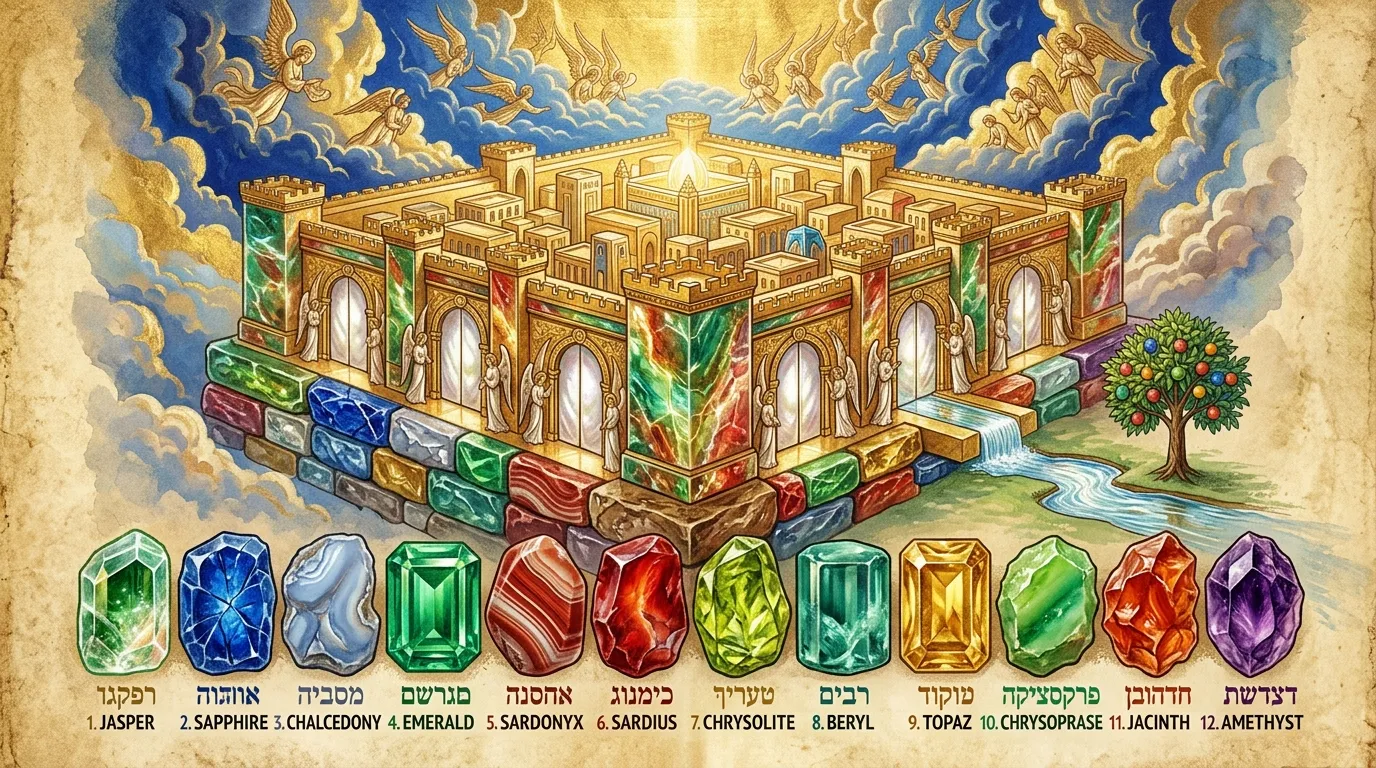
Come and walk the foundations. That is, in effect, what Revelation 21:19-20 invites: a slow circuit around the wall of the New Jerusalem, course by course, stone by stone, twelve foundations each faced with a different jewel. Jasper. Sapphire. Chalcedony. Emerald. Sardonyx. Sardius. Chrysolite. Beryl. Topaz. Chrysoprase. Jacinth. Amethyst. No other passage in Scripture names so many stones in one place. The effect is deliberate — John wants the reader to linger, to look, to feel the weight of glory course by course.
Before the tour begins, a word about the number twelve, because it governs everything here. Twelve foundations, twelve gates, twelve pearls, twelve tribes’ names on the gates (Revelation 21:12), twelve apostles’ names on the foundations (21:14). Scripture itself supplies the correspondence: the city’s architecture is the people of God rendered in stone — Israel and the Church, old covenant and new, built together into one dwelling. That is the text’s own symbolism, stated plainly, and it is as far as responsible interpretation goes. The Bible assigns no mystical power to the number twelve itself, and the cottage industry of numerology — hunting hidden codes in counts and measures — has no warrant here. Twelve means what Revelation says it means: the full people of God. Nothing more secret than that, and nothing less glorious.
The First Courses: Jasper to Emerald
The foundation list begins with jasper — the stone of God’s throne-room appearance (Revelation 4:3), the material of the city’s wall (21:18). To found the city on jasper is to found it on glory itself: the first thing you meet, going down, is the last thing heaven is about. Then sapphire — the stone of the pavement under God’s feet at Sinai (Exodus 24:10) and of the throne in Ezekiel’s vision (Ezekiel 1:26). The city’s base courses are throne stones. The foundation of eternity is not bedrock but the presence of God.
Third comes chalcedony (agate in some traditions), then emerald — the green of the rainbow around the throne (Revelation 4:3), the color of covenant mercy. The sequence reads like a creed in mineral form: glory (jasper), divine authority (sapphire), mercy (emerald). Before the tour has gone four stones deep, the city’s foundations have preached the character of its King.
The Middle Courses: Sardonyx to Beryl
Sardonyx — the layered stone, banded red and white — follows, then sardius (carnelian), the deep red stone of the breastplate’s first row. Red in Scripture is the color of sacrifice: the scarlet thread in the tabernacle, the blood on the mercy seat, the Lamb who was slain. That sacrifice is structural — not decoration on the city but foundation under it — is the gospel in architecture. The city stands because the Lamb fell.
Chrysolite (the golden-green stone, peridot in modern terms) and beryl complete the middle band. These are the stones of Eden’s inventory (Ezekiel 28:13) and of the breastplate’s rows — creation’s beauty and covenant’s remembrance, built into the wall. The middle courses say: this city remembers. It remembers the garden, the tribes, the promises. Eternity is not amnesia; it is memory perfected.
The Final Courses: Topaz to Amethyst
Topaz — the stone Job priced below wisdom (Job 28:19) — then chrysoprase, jacinth (the fire-colored stone), and finally amethyst, the royal purple. The wall’s foundations end where kingship begins: purple, the color of reign, closing the circuit. The last foundation stone of the eternal city is the color of the eternal King.
Read as a whole, the twelve courses tell a story from glory to glory: founded on God’s throne-presence, banded with sacrifice, jeweled with remembered covenant, and crowned with kingship. It is the biblical storyline — creation, fall, redemption, consummation — written in stone courses. John may not have intended every association, but the cumulative effect is undeniable: the foundations preach.
The Gates: Twelve Pearls
“The twelve gates were twelve pearls, each gate made of a single pearl” (Revelation 21:21). The gates deserve their own pause because pearls, unlike quarried stones, are grown — layer upon layer of nacre around an irritant, over years, inside a living creature. A pearl large enough for a gate is a biological impossibility and a theological statement: entrance to God’s city comes through transformed suffering.
The gates bear the names of the twelve tribes (21:12). Entry into the eternal city is through Israel’s story — through Abraham’s call, Moses’ law, David’s line, and the Messiah of Judah. The pearl gates are beautiful, but they are not generic beauty; they are the beauty of a specific redemptive history, grown the way pearls grow: through irritation endured until it becomes glory.
And the street: “pure gold, as transparent as glass” (21:21). Gold you can see through — wealth with nothing to hide, value without opacity. In the city, even the pavement preaches: transparency, purity, glory without shadow.
The Breastplate Connection
The twelve foundation stones deliberately echo the twelve stones of the high priest’s breastplate (Exodus 28:17-20). The parallels are structural: twelve stones, engraved/bearing names, representing the people of God, set in ordered rows. But the differences preach too:
- The breastplate was worn over a heart; the foundations are built into a wall. Intercession has become architecture. What the priest carried provisionally, the city embodies permanently.
- The breastplate entered the Holy Place once a year; the city is the Holy Place, with no temple inside it “because the Lord God Almighty and the Lamb are its temple” (Revelation 21:22). The mediation the breastplate pictured has given way to the presence it anticipated.
- The breastplate’s stones could be lost, captured, or buried with the exile; the foundations “will never be shaken” — the city is the realization of the unshakeable kingdom (Hebrews 12:28).
From breastplate to foundation: that is the direction of redemption. What was carried on a man’s chest in the old covenant becomes the ground under God’s people’s feet in the new creation. The stones have not changed their meaning — the people of God, precious, remembered, set in order. They have changed their permanence.
What the Jeweled City Asks of Its Readers
Revelation was written to churches under pressure — believers tempted to trade eternal glory for present relief. The jeweled city is, before anything else, an argument against despair and compromise: this is what you are waiting for; this is what faithfulness inherits. The detail is the pastoral point. A vague heaven (“a better place”) comforts vaguely. A city with twelve named foundations, pearl gates, and transparent gold streets comforts specifically — it gives the suffering imagination something solid to hold.
Three responses the passage invites:
- Hope with texture. When present life feels formless, return to the foundations. God’s future has courses you could count, colors you could name, a wall you could touch. Hope is not wishful thinking; it is architecture.
- Holiness with motive. “Nothing impure will ever enter it” (Revelation 21:27). The city’s beauty is inseparable from its purity. The vision does not merely promise a destination; it describes the character of those who belong there — and invites readers to become such people now.
- Unity with vision. Twelve tribes, twelve apostles, one city. The old divisions — Jew and Gentile, old covenant and new — are built into a single wall. Every fracture the church suffers now is a denial, in miniature, of the city it will inhabit.
No Temple in the City
The most startling sentence about the jeweled city is not about the jewels. “I did not see a temple in the city, because the Lord God Almighty and the Lamb are its temple” (Revelation 21:22). Every jeweled thing in Israel’s history — the breastplate, the ephod, the temple’s gold, the ark’s mercy seat — existed to mediate: to bridge the distance between a holy God and an unholy people. In the New Jerusalem, the mediation is over. The distance is gone. The jewels remain, but their job has changed: no longer bridging a gap, simply declaring glory.
And the city’s light: “The city does not need the sun or the moon to shine on it, for the glory of God gives it light, and the Lamb is its lamp” (21:23). Think about what that does to the foundations. Twelve courses of jewels, pearl gates, transparent gold streets — and no sun to make them sparkle. They shine by another light entirely: the glory of God Himself. The stones do not catch created light; they are lit from within by uncreated glory. Every gemstone sermon ever preached — beauty reflecting a greater Beauty — reaches its literal fulfillment here: the jewels finally shine with the light they always pictured.
The mineral identifications of the twelve stones are debated — ancient gem names rarely map neatly onto modern ones, and Wikipedia’s New Jerusalem article surveys the passage and its interpretive history for the curious. But the passage’s own meaning is not debated: the eternal city is founded on glory, gated with transformed suffering, and built — course by jeweled course — out of the people of God. Walk the foundations slowly. They were laid for you.










