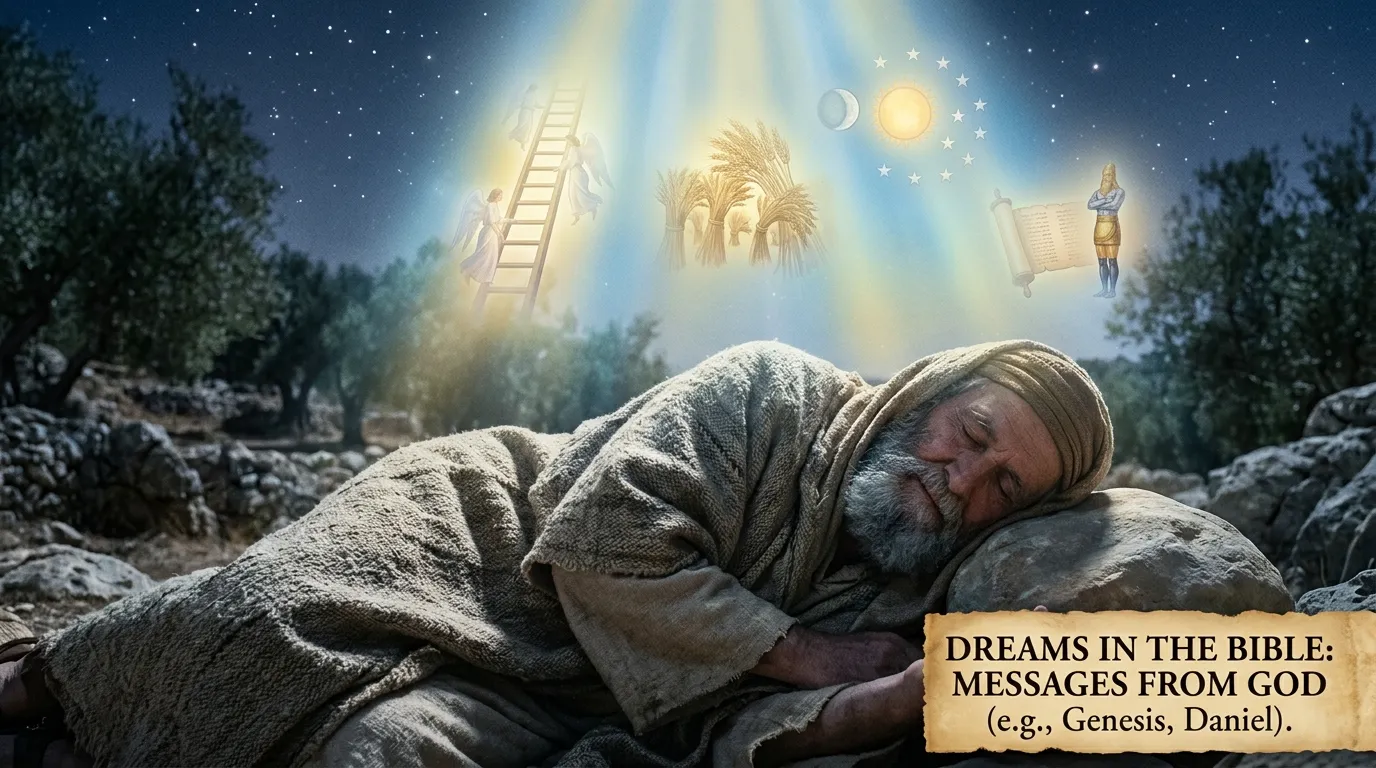
Joseph was seventeen when he dreamed that his brothers’ sheaves bowed down to his sheaf — and his life was never the same. The dream got him hated, sold, enslaved, and imprisoned. Then, thirteen years later, the same gift that caused his suffering became the instrument of a nation’s survival: his interpretation of Pharaoh’s dreams saved Egypt and his own family from famine (Genesis 37-41). No story in Scripture captures the Bible’s whole teaching on dreams better than Joseph’s — because it shows everything at once: God really does speak in dreams, dreams really can mislead, and the difference between the two is discernment, not excitement.
That threefold truth is the framework for everything the Bible says on the subject. Dreams in Scripture are neither dismissed as meaningless static nor embraced as nightly oracles. They occupy a middle space — honored as one of God’s many ways of speaking, tested like every other claim to revelation, and always subordinate to the written Word. To understand dreams biblically is to learn to hold wonder and wisdom in the same hand.
The Dreamers of Genesis: God Speaks in the Night
Dreams appear early and often in Israel’s founding stories, and a pattern emerges: God uses dreams to protect, direct, and reveal when His people cannot see the way forward awake. Jacob, fleeing his brother’s wrath, sleeps at Bethel with a stone for a pillow and dreams of a ladder between heaven and earth, with God at the top renewing the Abrahamic covenant (Genesis 28:12-15). He wakes terrified and worshiping: “Surely the LORD is in this place, and I did not know it” (28:16). The dream did not give him new theology; it gave him presence — the assurance that the God of his fathers was with the fugitive.
Abimelech, a pagan king, receives a dream that is pure warning: “Behold, you are a dead man because of the woman whom you have taken, for she is a man’s wife” (Genesis 20:3). He had taken Sarah innocently — and God intervened in the night to prevent the sin before it happened. Laban gets the same treatment when pursuing Jacob: “Be careful not to say anything to Jacob, either good or bad” (Genesis 31:24). These are not mystical puzzles; they are divine interventions, God steering history while men sleep. The dreamers did not seek these dreams. They received them — which is the first mark of the genuinely God-given dream: it comes as grace, not as technique.
Then Joseph — the Bible’s great dreamer — whose two dreams (the sheaves, the sun and moon and stars bowing, Genesis 37:5-11) announce his future so clearly that even his father rebukes him: “Shall I and your mother and your brothers indeed come to bow ourselves to the ground before you?” (37:10). The dreams were true. They were also terribly timed in the telling — a lesson every would-be dream-sharer should note. A true dream, announced without wisdom, can do real damage. Joseph told his; his brothers’ hatred curdled into a murder plot. The gift was genuine. The stewardship was seventeen years old.
Dreams That Moved Kingdoms
Joseph’s gift matured in prison, where he interpreted the cupbearer’s and baker’s dreams with the humble disclaimer that would define his ministry: “Do not interpretations belong to God?” (Genesis 40:8). Then Pharaoh dreamed — seven fat cows devoured by seven lean, seven full ears swallowed by seven thin — and none of Egypt’s magicians could interpret. Joseph’s reading (seven years of plenty, seven of famine, Genesis 41:25-36) was so evidently true that Pharaoh set a Hebrew slave over the empire. Dreams, interpreted by God, redirected the economy of the ancient world and preserved the covenant family through which Messiah would come. The stakes of dream-discernment could not be higher.
Daniel’s career runs on the same track. Nebuchadnezzar’s forgotten dream of the great statue (Daniel 2) — which Daniel both recounted and interpreted, proving the revelation was God’s, not guesswork — established that “there is a God in heaven who reveals mysteries” (2:28). The king’s second dream, of the felled tree, warned of his coming madness (Daniel 4). Daniel’s own night visions of four beasts and the Ancient of Days (Daniel 7) mapped the rise and fall of empires. In every case, the dream revealed what human wisdom could not reach — and the credit went relentlessly to God, never to the dreamer’s technique.
The New Testament continues the pattern at the hinge of redemptive history. Joseph, son of Jacob’s namesake, receives four guiding dreams: to take Mary as his wife (Matthew 1:20), to flee to Egypt (2:13), to return to Israel (2:19-20), and to settle in Galilee rather than Judea (2:22). The entire childhood of Jesus — the survival of the Messiah — was steered by dreams. The wise men were “warned in a dream not to return to Herod” (2:12). Even Pilate’s wife sent her husband an urgent message during the trial: “Have nothing to do with that righteous man, for I have suffered much because of him today in a dream” (Matthew 27:19) — a pagan woman’s dream testifying to Christ’s innocence at the very hour of His condemnation.
And the promise remains open: “your old men shall dream dreams, and your young men shall see visions” (Joel 2:28), quoted by Peter at Pentecost as the charter of the Spirit age (Acts 2:17). God has not retired the medium. But — and this is the turn the whole article has been building toward — the Bible is equally emphatic that not every dream is from God.
Not Every Dream Is a Message
Here is the necessary counterweight, and Scripture states it bluntly. “For a dream comes with much business, and a fool’s voice with many words” (Ecclesiastes 5:3) — the Preacher’s dry observation that dreams often reflect nothing more spiritual than a busy mind. “For when dreams increase and words grow many, there is vanity” (Ecclesiastes 5:7). The brain processes the day’s residue at night; most dreams are psychology, not prophecy. To treat every vivid dream as divine revelation is not spirituality. It is superstition with a Bible verse attached.
Worse, dreams can be counterfeited. Jeremiah confronted prophets who claimed divine dreams as cover for their own imaginations: “I have dreamed, I have dreamed!” — and God’s verdict: “they are prophesying to you a lying vision, worthless divination, and the deceit of their own minds” (Jeremiah 23:25-26, 32). Zechariah lumps “the diviners see lies… they tell false dreams” (Zechariah 10:2). And Deuteronomy gives the decisive test: even if the dream comes true, if the dreamer says “let us go after other gods,” you shall not listen (Deuteronomy 13:1-3). Accuracy does not authenticate. A dream’s origin is judged by its fruit and its fidelity to God’s revealed Word — never by its vividness, its emotional power, or the impressiveness of the dreamer.
This is why the New Testament’s standing order applies to dreams as much as to prophecies: “Do not believe every spirit, but test the spirits to see whether they are from God” (1 John 4:1), and “test everything; hold fast what is good” (1 Thessalonians 5:21). The Christian is not called to be credulous about dreams but discerning — open to God’s genuine voice, closed to every counterfeit, and humble enough to admit that most nights, the dream was just a dream.
How to Weigh a Dream
So a dream has shaken you — vivid, strange, possibly significant. What now? Scripture suggests a practical procedure, and it begins with not doing what our instincts suggest.
First, pray — but don’t decide. Bring the dream to God honestly: was that You? Then wait. Joseph’s dreams took thirteen years to clarify. The biblical pattern is patience with impressions and urgency only with clear commands. A dream that demands instant, life-altering action is already suspect; God’s genuine guidance can survive prayerful waiting.
Second, test it against Scripture. This is the non-negotiable. “To the teaching and to the testimony! If they will not speak according to this word, it is because they have no dawn” (Isaiah 8:20). No dream from God will contradict God’s Word — about His character, about Christ, about holiness, about the gospel. A dream urging you toward an affair, away from the church, or into “new revelation” that revises Scripture has failed the test before any further discussion. The written Word is the control; the dream is the variable.
Third, seek counsel. Joseph needed no interpreter for his own dreams — but Pharaoh needed Joseph, Nebuchadnezzar needed Daniel, and the wise men needed the priests’ Scripture. “In an abundance of counselors there is safety” (Proverbs 11:14). Share the dream with mature believers. Ask: does this sound like God to you? The community’s discernment is God’s appointed filter for private impressions (1 Corinthians 14:29).
Fourth, watch the fruit. “You will recognize them by their fruits” (Matthew 7:16). God-given dreams in Scripture produced repentance (Abimelech), worship (Jacob), obedience (Joseph of Nazareth), and salvation (Pharaoh’s Egypt). If a dream produces fear without faith, pride without humility, division without cause, or obsession with the dream itself rather than with Christ — weigh that fruit carefully. The Spirit’s work, even in dreams, points away from self and toward Christ.
Fifth, hold it loosely. Write it down, pray over it, and then live your life. If God spoke, He will confirm — through Scripture, through counsel, through providence, the way Joseph’s dreams were confirmed by events, not by his certainty. The believer’s confidence rests in God’s clarity, not in the dream’s intensity.
When God Seems Silent at Night
A final pastoral word for the other side of the question: what if you never dream significantly? What if you pray for guidance and the nights stay quiet? Scripture normalizes this too. There were seasons when “the word of the LORD was rare… there was no frequent vision” (1 Samuel 3:1). Saul, desperate for direction, found that “the LORD did not answer him, either by dreams, or by Urim, or by prophets” (1 Samuel 28:6) — and his response, consulting a medium, was the wrong one. Silence is not absence; it is often instruction to walk by the lamp already given.
For Peter gives the church its ultimate dream-policy: we have “the prophetic word more fully confirmed, to which you will do well to pay attention as to a lamp shining in a dark place” (2 Peter 1:19). Dreams are occasional lightning; Scripture is the lamp — steadier, clearer, sufficient. The believer who has the Bible open, the Spirit indwelling, and the church surrounding does not need nightly visions. And when God does speak in the night — as He did for Jacob, Joseph, Daniel, and the other Joseph — the prepared heart will recognize the voice it already knows from the day.
Dream, then, with both wonder and wisdom. Thank God for the nights He speaks. Test everything the mornings bring. And build your life on the lamp, not the lightning — on the Word that never flickers, the Christ to whom every true dream, like every true prophecy, ultimately points.
The Bible’s most famous dreamer — the Joseph whose night visions shaped a nation’s destiny — is profiled in detail on Wikipedia’s page on Joseph of Genesis, a useful companion to the dream narratives traced here.










