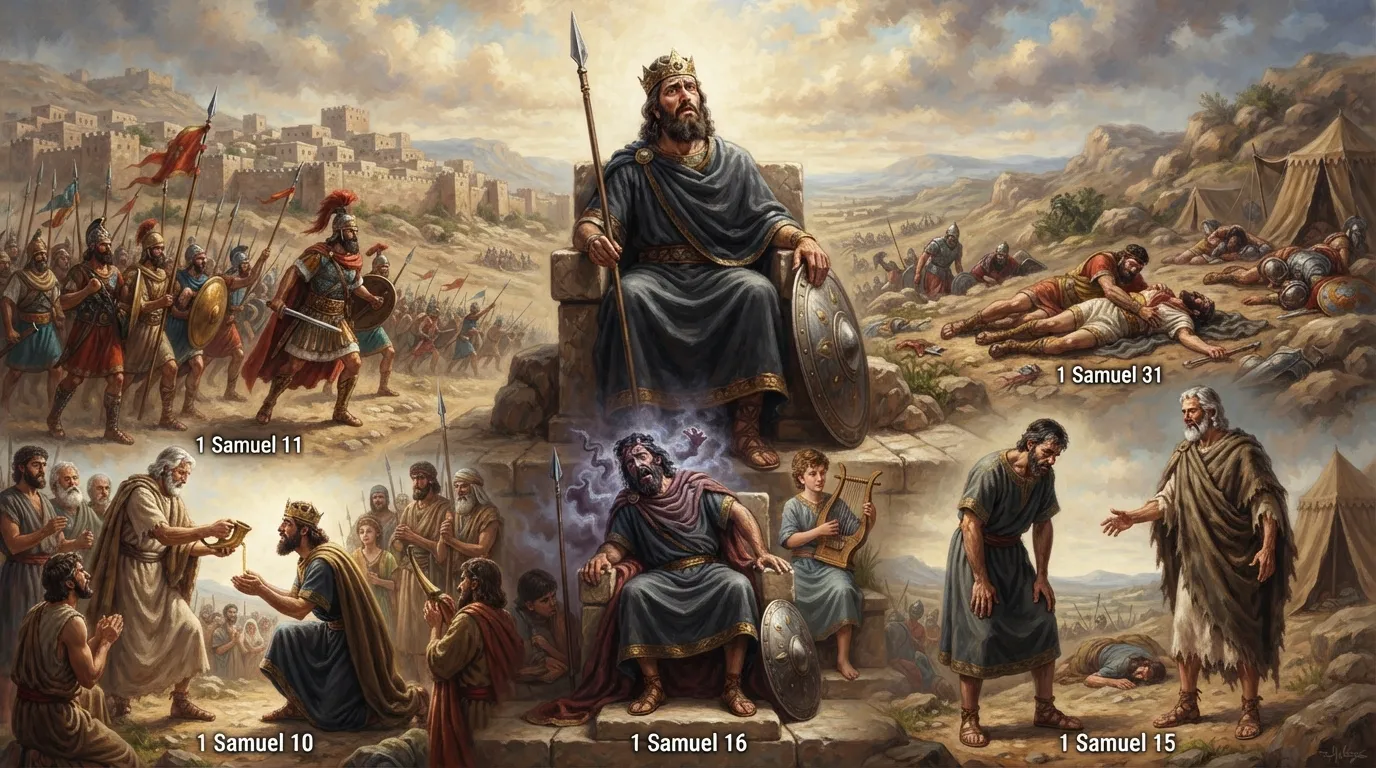
Israel did not ask for a king because they lacked leadership. They had Samuel — a prophet, judge, and the most trusted man in the nation. They asked for a king because they wanted to be like everyone else. “Appoint for us a king to judge us like all the nations,” they told Samuel (1 Samuel 8:5). God called the request a rejection — “they have rejected me from being king over them” (1 Samuel 8:7) — and then, astonishingly, He gave them what they asked for. Saul was the answer to a prayer God warned them about.
Saul’s story is one of the great tragedies of Scripture, and it is a tragedy precisely because it did not start badly. He started humble, anointed, empowered by the Spirit, and victorious. He ended paranoid, tormented, and dead on a battlefield, having consulted a medium the night before because God would no longer answer him. The arc from anointing to abandonment is the story of what happens when a gifted person stops obeying.
A King from Nowhere
Saul was from the tribe of Benjamin, the smallest tribe in Israel, and from an unremarkable family. When we first meet him, he is not seeking a throne; he is searching for his father’s lost donkeys (1 Samuel 9). He was tall — “from his shoulders upward he was taller than any of the people” (1 Samuel 9:2) — and handsome, the kind of man who looked like a king. Israel wanted someone impressive. God gave them someone who looked the part.
Samuel anointed Saul privately, then presented him publicly. When the moment came for Saul to step forward, he was hiding among the baggage (1 Samuel 10:22). The detail is endearing and prophetic at once: the man who would become king began by hiding from the calling. Samuel told him that the Spirit of the Lord would come upon him, that he would be “turned into another man” (1 Samuel 10:6), and that God would be with him.
And God was. When the Ammonites threatened the city of Jabesh-gilead, the Spirit of God rushed upon Saul, and he led Israel to a crushing victory (1 Samuel 11). The people celebrated. Samuel renewed the kingdom at Gilgal. For a moment, everything looked like it would work.
The Two Tests Saul Failed
Saul’s downfall came not in one dramatic act of wickedness but in two acts of partial obedience — and partial obedience, Samuel would tell him, is disobedience.
The first test was at Gilgal. Samuel had told Saul to wait seven days for him to come and offer sacrifices before battle (1 Samuel 10:8). The Philistines were massing. Saul’s soldiers were scattering. The seven days passed, and Samuel had not arrived. So Saul offered the burnt offering himself. The moment he finished, Samuel arrived. Saul’s explanation was reasonable — the troops were leaving, the enemy was gathering, Samuel was late — but his action was forbidden. Kings did not offer sacrifices; priests did. Saul had seized a role that was not his because waiting was hard. Samuel’s verdict was devastating: “You have done foolishly… now your kingdom shall not continue” (1 Samuel 13:13–14).
The second test was the Amalekites. God commanded Saul to devote the Amalekites and all they had to destruction — a judgment on a nation that had ambushed Israel in the wilderness (1 Samuel 15). Saul defeated them, but he spared King Agag and kept the best of the sheep, oxen, and livestock. When Samuel confronted him, Saul insisted he had obeyed — and then, in the same breath, explained that the troops had kept the animals “to sacrifice to the LORD your God at Gilgal” (1 Samuel 15:21). Notice the shift: “your God,” not “my God.” The language of distance had crept in.
Then came the most famous rebuke in the Old Testament: “Has the LORD as great delight in burnt offerings and sacrifices, as in obeying the voice of the LORD? Behold, to obey is better than sacrifice, and to listen than the fat of rams. For rebellion is as the sin of divination, and presumption is as iniquity and idolatry. Because you have rejected the word of the LORD, he has also rejected you from being king” (1 Samuel 15:22–23).
The Anatomy of Saul’s Decline
After the rejection, Saul’s story becomes a case study in how unrepentant disobedience corrodes a person. The Spirit of the Lord departed from Saul, “and a harmful spirit from the LORD tormented him” (1 Samuel 16:14). His court brought in a young shepherd named David to play the lyre and soothe him. The irony is thick: the man who would replace him was hired as his therapist.
What followed was a spiral: jealousy when the women sang “Saul has struck down his thousands, and David his ten thousands” (1 Samuel 18:7); rage when David’s popularity grew; repeated attempts to kill David with a spear, with soldiers, with traps; paranoia that consumed his reign; the murder of the priests of Nob who had innocently helped David; and finally, on the night before his last battle, a visit to the medium at Endor to summon Samuel’s spirit — the very practice he himself had banned — because God answered him neither by dreams, nor by Urim, nor by prophets (1 Samuel 28:6).
Saul’s pattern is worth studying because it is so common. First, impatience: he could not wait for Samuel. Then, excuse-making: he blamed the troops, the circumstances, the timing. Then, blame-shifting: it was always someone else’s fault. Then, jealousy: another man’s success became a threat. Then, violence: eliminating the threat became the goal. Then, desperation: consulting the darkness he had once opposed. Sin rarely arrives all at once. It descends one rationalized step at a time.
Jonathan: The Contrast Within Saul’s Own House
The most poignant contrast in Saul’s story is not David. It is Jonathan, Saul’s own son. Jonathan was the crown prince, the heir to the throne — and he became David’s closest friend. He recognized God’s hand on David, and instead of competing, he surrendered his own claim: he made a covenant with David, gave him his robe, his armor, and his weapons, and protected him from his father’s rage (1 Samuel 18:3–4; 20). Jonathan had everything to lose and gave it away freely. Saul had everything to lose and clung to it until it destroyed him. The same palace produced both men. One measured his life by the throne; the other measured it by God’s purpose. Jonathan died alongside his father on Mount Gilboa, but he died with his honor intact — remembered as a man of loyalty, courage, and selfless friendship. Saul died with his kingdom lost. The difference between father and son was the difference between grasping and giving.
Saul and David: A Study in Contrasts
David was not a better man than Saul by nature. David committed adultery and murder — sins Saul never committed. The difference was not the absence of sin; it was the response to it. When Nathan confronted David, David said, “I have sinned against the LORD” (2 Samuel 12:13) — no excuses, no blame, no bargaining. When Samuel confronted Saul, Saul said, “I have sinned… but please honor me now before the elders of my people” (1 Samuel 15:30). Saul wanted forgiveness and reputation at the same time. David wanted forgiveness and nothing else.
Saul’s repentance was about consequences; David’s was about God. That is why David is called “a man after God’s own heart” (1 Samuel 13:14) and Saul is not. The difference between the two kings is not that one fell and the other didn’t. Both fell. The difference is that one got up in genuine repentance, and the other kept performing.
What Saul’s Kingship Teaches
First, looking like a leader is not the same as being one. Saul had height, appearance, and early success. What he lacked was a heart that trusted God more than circumstances. God had warned Samuel about choosing by appearance long before David: “Man looks on the outward appearance, but the LORD looks on the heart” (1 Samuel 16:7).
Second, obedience cannot be replaced by religious activity. Saul’s sacrifices were real sacrifices, offered to the real God, with real animals. God rejected them anyway — because the sacrifices were a substitute for the obedience God had commanded. Religious performance is never an acceptable exchange for doing what God said.
Third, the first compromise is the most dangerous one. Saul’s kingdom was lost at Gilgal, over an offering made a few minutes early. The stakes of small disobedience are never small, because small disobedience trains the heart for larger rebellion.
Fourth, jealousy is a kingdom-killer. Saul had a throne, an army, a nation — and he threw it all away because he could not stand someone else getting a bigger song. Every leader, parent, and believer faces the same test: can you celebrate what God is doing through someone else?
Saul’s story ends on Mount Gilboa, where he fell on his own sword rather than be captured. It is a bleak ending — and it is meant to be. The Bible does not soften it, because the warning matters. But the story also points forward: Israel needed a king who would obey perfectly, whose kingdom would never end, whose heart would never turn. That King would come — not from the tribe of Benjamin, but from the tribe of Judah, not hiding among the baggage, but riding into Jerusalem to die for His people. For the historical context of Saul’s reign and Israel’s transition to monarchy, see the Wikipedia article on Saul.










