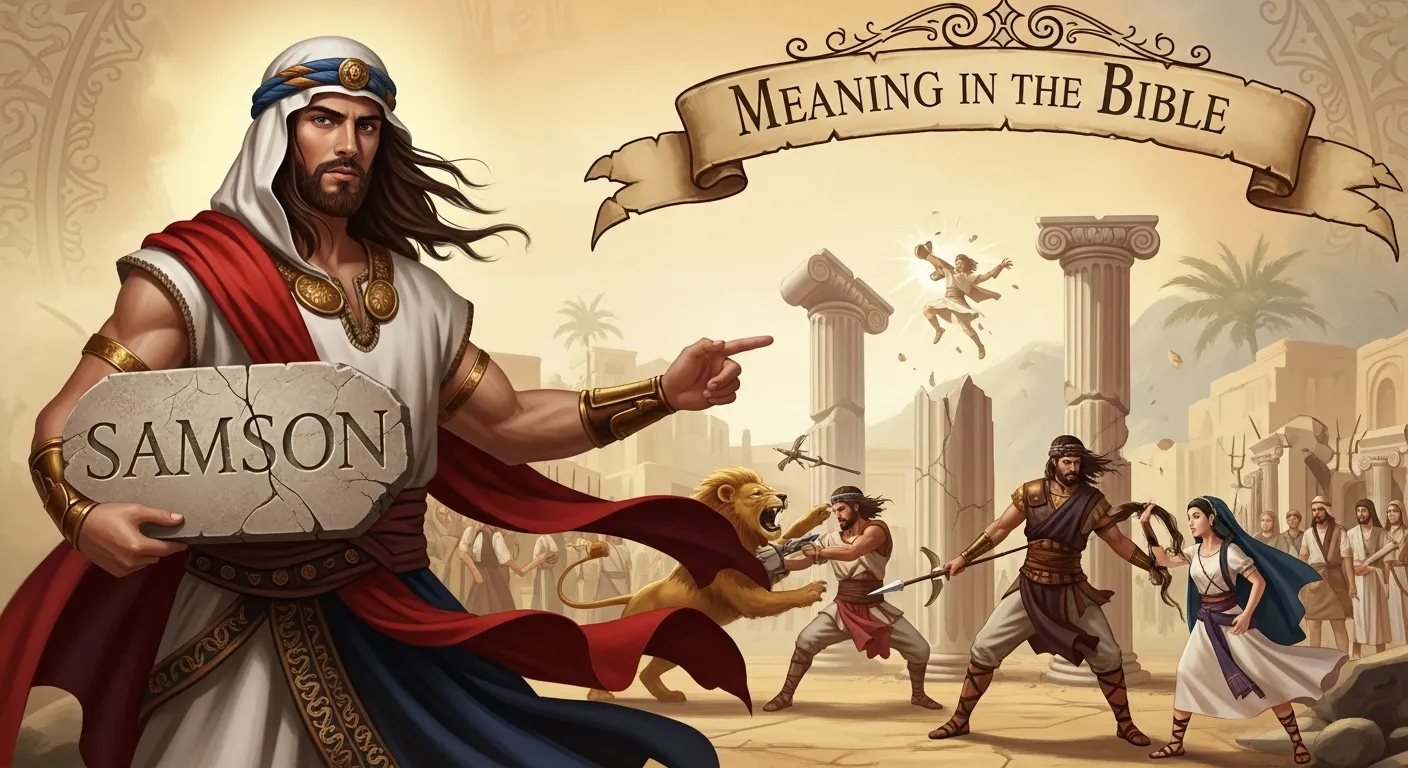
He tore a lion apart with his bare hands. He killed a thousand men with a donkey’s jawbone. He ripped the gates of a city off their hinges and carried them uphill. And he told the secret of his strength to a woman he knew was trying to destroy him — three times — before she finally got the truth out of him on the fourth try. The story of Samson in the Book of Judges is the Bible’s great tragedy of wasted power: a man given everything, who gave it all away piece by piece, and who in his final moment finally understood what his strength had been for all along.
Samson’s story occupies four full chapters (Judges 13–16), more space than any other judge, and the disproportion is deliberate. His life is a case study in the difference between giftedness and godliness — between the power of the Spirit, which he had in abundance, and the character of the Spirit, which he neglected until it was almost too late. The meaning of Samson in the Bible is not “be strong.” It is something far more searching: strength without surrender is just slow-motion self-destruction.
Set Apart Before Birth
Samson’s story begins the way only a few biblical stories begin: with an angelic announcement to a barren woman. Like Isaac, Samuel, and John the Baptist after him, Samson is a miracle baby — and like them, he is born with a mission already assigned. The angel tells his mother: “the boy will be a Nazirite of God from the womb until the day of his death” (Judges 13:7), and “he will take the lead in delivering Israel from the hands of the Philistines” (Judges 13:5).
The Nazirite vow (Numbers 6) had three requirements: no wine or grape products, no cutting the hair, and no contact with the dead. It was normally a temporary, voluntary vow. For Samson it was lifelong and involuntary — God set him apart before he could choose. His uncut hair was the visible sign of an invisible consecration: his strength was never his own. It was borrowed glory, on loan from God, contingent on the vow.
This is the key to the whole story, and most readers miss it: Samson’s strength was not in his muscles or even in his hair. It was in his consecration. The hair was the symbol; the separation was the substance. Every time the text says “the Spirit of the Lord came powerfully upon him” (Judges 14:6, 19; 15:14), it is reminding us that the power was God’s, visiting a man. Samson treated the symbol as the source and the gift as a possession — the two mistakes that define his life.
The Riddle-Maker: Power as a Game
Samson’s adult life reads like a series of escalating provocations. He demands a Philistine wife — “she’s the right one for me” (Judges 14:3) — in direct violation of God’s law (Deuteronomy 7:3). On the way to the wedding he kills a lion; later he finds bees and honey in the carcass. He touches the dead lion (vow broken, first crack), scoops honey from it (carrying defilement to his parents), and turns it all into a riddle at the wedding feast: “Out of the eater, something to eat; out of the strong, something sweet” (Judges 14:14).
The riddle episode is Samson in miniature: brilliant, reckless, treating sacred things as material for games. When his wife betrays the answer under threat, he slaughters thirty Philistines to pay the wager. When she is given to another man, he ties torches to three hundred foxes and burns the Philistine harvest. When they kill his wife in retaliation, he slaughters “hip and thigh with a great slaughter” (Judges 15:8). Each act is retaliation for retaliation, strength spent on personal vendettas rather than on the deliverance mission the angel announced.
And yet — and this is what makes Judges so honest — God uses it anyway. “His father and mother did not know that this was from the Lord, who was seeking an occasion to confront the Philistines” (Judges 14:4). God worked through Samson’s flawed, vengeful, self-willed campaigns to begin loosening Philistine oppression. The meaning is uncomfortable but important: God can use imperfect instruments without approving their imperfections. Samson’s victories were real. His methods were his own. Both things are true at once, and Scripture will not let us flatten either.
The Jawbone and the Thirst: Strength’s Emptiness
The peak of Samson’s military career is also its most revealing moment. Bound with new ropes and handed to the Philistines, he snaps them “as if they were strings” when the Spirit comes upon him, seizes a fresh jawbone of a donkey, and kills a thousand men (Judges 15:14–15). He even composes a victory poem about it. Then, immediately: “he was very thirsty” (Judges 15:18).
The juxtaposition is deliberate and devastating. The strong man is dying of thirst. He cries out to God — one of the few prayers in his story — and God splits the hollow place at Lehi so water gushes out. Samson names it En Hakkore, “the spring of the one who called.” For a moment, the strong man remembers he is the dependent man. Then the moment passes, and he goes back to his games — which leads him to Gaza, to a prostitute’s house, to the city gates he carries off as a trophy (Judges 16:1–3). The trophy proves nothing has changed: he is still performing strength instead of stewarding it.
Delilah: The Slow Surrender
Judges 16 is one of the most psychologically acute chapters in Scripture. Samson falls in love with Delilah, and the Philistine lords offer her eleven hundred shekels of silver each to discover his secret. What follows is almost unbearable to read, because Samson knows — he must know — what is happening. Three times she asks. Three times he lies: fresh bowstrings, new ropes, woven hair. Three times she binds him, calls “the Philistines are upon you!”, and watches him break free. Three times the evidence is conclusive that she is working for his enemies.
And he stays. He keeps returning to the woman who keeps trying to destroy him, until “with her nagging she prodded him day after day until he was sick to death of it” (Judges 16:16) — and he tells her everything. “No razor has ever been used on my head… If my head were shaved, my strength would leave me” (Judges 16:17).
Why did he tell her? Because by this point the surrender was already complete; the haircut only made it visible. Samson had been giving away his consecration for years — the dead lion, the Philistine wives, the prostitute in Gaza. Delilah was not the beginning of his fall. She was the end of a long process of treating God’s gift as his own property to spend. The famous line that follows is the saddest in the book: “He awoke from his sleep and thought, ‘I’ll go out as before and shake myself free.’ But he did not know that the Lord had left him” (Judges 16:20). Strength had become habit; he assumed the power would be there because it always had been. It is the Bible’s warning about the most dangerous stage of spiritual decline: not rebellion, but presumption — the assumption that yesterday’s anointing covers today’s compromise.
The Final Prayer: Strength Remembered at Last
Blinded, grinding grain in a Philistine prison, Samson finally becomes what he should have been all along: a man who knows his strength is not his own. His hair grows back — the symbol of a vow he had never formally renounced, only neglected. Brought out to entertain three thousand Philistines in the temple of Dagon, he prays the most honest prayer of his life: “Sovereign Lord, remember me. Please, God, strengthen me just once more” (Judges 16:28).
Note the theology of the prayer: remember me — he knows he does not deserve it. Just once more — he knows it is a gift, not a possession. For the first time, Samson asks for strength the way he should have asked all along: as a dependent, for God’s glory (“let me… get revenge on the Philistines for my two eyes” — still imperfect, still Samson, but pointed at God’s enemies at last). God answers. He pushes the pillars. The temple falls, killing more Philistines in his death than in his life (Judges 16:30).
And then the New Testament does something astonishing: it lists Samson among the heroes of faith. “What more shall I say? I do not have time to tell about… Samson…” (Hebrews 11:32). Not as a hero of morality — as a hero of faith. His faith was flawed, late, and mixed with vengeance, but in the end it was real: he trusted God for strength he knew he did not own, and God honored it. The meaning of Samson is not that God rewards recklessness. It is that God restores the repentant — that consecration, once surrendered, can be taken up again, and that it is never too late to stop performing strength and start depending on it. For the wider cultural and historical background of this judge’s story, the Wikipedia article on Samson traces the biblical account alongside its interpretation in art, literature, and tradition.










