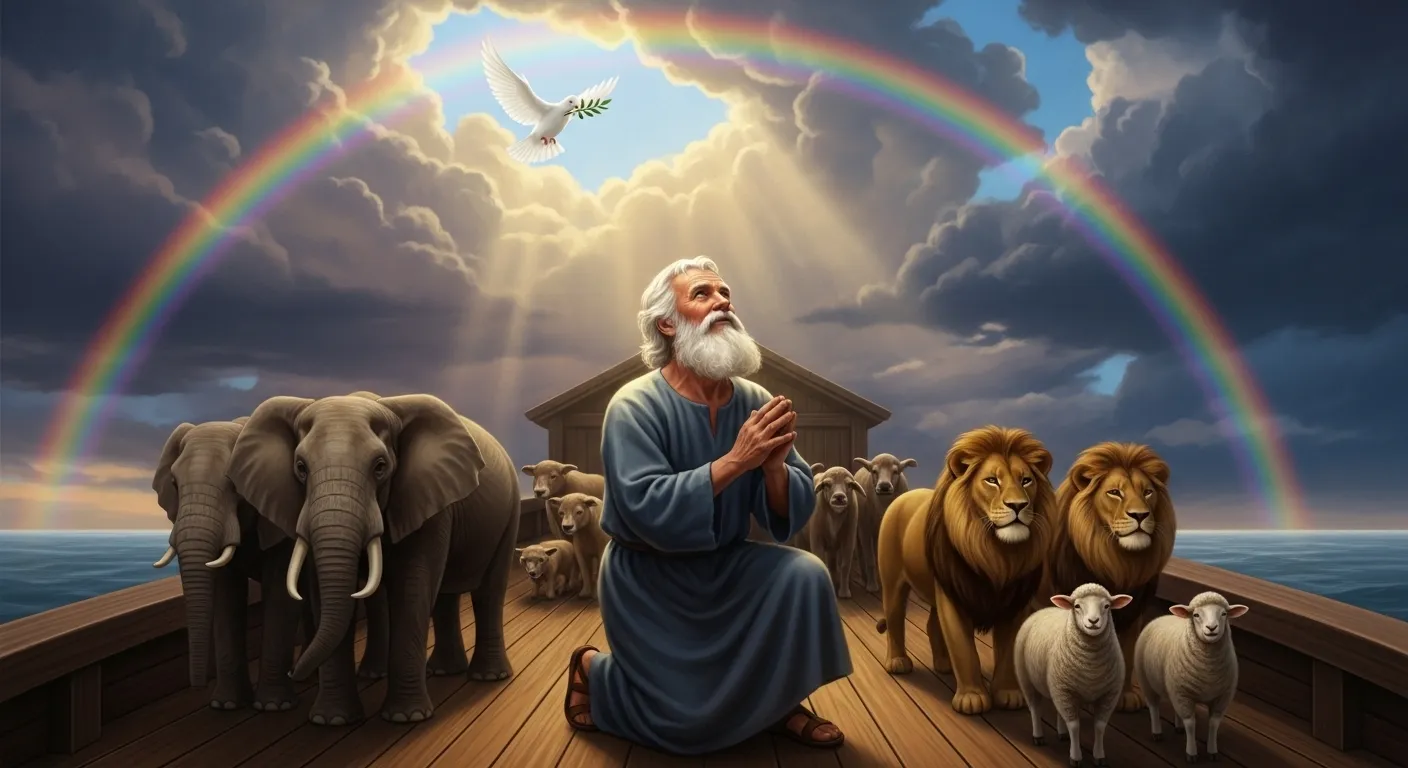
He built the largest construction project of his age in a place where it had never rained the way it was about to rain, for a judgment no one believed was coming, over a span of time longer than most lifetimes — and while he built, he preached. The New Testament remembers Noah with a title the Old Testament never gives him: “a preacher of righteousness” (2 Peter 2:5). For roughly 120 years, Noah did two things simultaneously: he constructed the ark, and he warned the world. Nobody listened. He built anyway. The life of Noah in the Bible is Scripture’s great portrait of obedience without an audience — faith that keeps hammering while the neighbors laugh, because the voice that matters has already spoken.
His name means “rest” or “comfort” — his father Lamech named him saying, “He will comfort us in the labor and painful toil of our hands” (Genesis 5:29). The comfort Noah brought was not what anyone expected. It came through judgment survived, not judgment avoided. His story, told in Genesis 5–9 and echoed across both Testaments, carries the Bible’s most sustained meditation on what it means to walk with God when the whole world walks the other way.
Walking With God in a World Walking Away
Genesis 6:9 gives Noah’s epitaph before his story even begins: “Noah was a righteous man, blameless among the people of his time, and he walked faithfully with God.” The phrase “walked with God” is rare in Scripture — used of Enoch (Genesis 5:24) and Noah, and of no one else in Genesis. It describes not perfection but direction: a life oriented toward God in a generation oriented away.
The context makes the commendation staggering. “The Lord saw how great the wickedness of the human race had become on the earth, and that every inclination of the thoughts of the human heart was only evil all the time” (Genesis 6:5). Violence filled the earth (Genesis 6:11). Noah was not righteous because his surroundings were good; he was righteous while his surroundings were the worst the Bible ever describes. This is the first meaning of his life for the reader: holiness is not a product of environment. Enoch walked with God before the flood; Noah walked with God during the corruption; Daniel would walk with God in Babylon. The address changes. The walk does not have to.
And notice the order in Genesis 6:8–9: “Noah found favor in the eyes of the Lord” comes before “Noah was a righteous man.” Grace precedes character. God did not choose Noah because Noah was impressive; Noah became steadfast because God was gracious. Every act of obedience that follows flows from that favor, not toward it.
The Ark: Obedience in Specifics
God’s instructions to Noah are famously detailed: gopher wood, 300 cubits long, 50 wide, 30 high, three decks, a roof, a door in the side, coated inside and out with pitch (Genesis 6:14–16). The specificity matters. Noah did not get a vague impression to “do something about the coming judgment.” He got a blueprint, and Genesis records his response with a sentence that covers decades of labor: “Noah did everything just as God commanded him” (Genesis 6:22).
Consider what “everything” cost. The ark was roughly 450 feet long — longer than a football field — built by a man with no shipbuilding tradition to draw on, in a region far from the sea, for a flood no one had ever seen. He had to gather materials, organize labor (his three sons worked with him), provision food for every living creature for over a year, and do it all while preaching to a generation that considered him a fool. The writer of Hebrews captures the spiritual physics of it: “By faith Noah, when warned about things not yet seen, in holy fear built an ark to save his family” (Hebrews 11:7). Faith, holy fear, family salvation — the verse compresses 120 years into one motion of the soul.
The ark’s meaning for the reader is not really about boats. It is about the obedience of specifics: doing exactly what God said, at the scale God said, for as long as God said, without editing the blueprint to fit public opinion. Most believers are not asked to build arks. They are asked to keep smaller, quieter commands with the same completeness — and Noah stands as the proof that such obedience is never wasted, even when no one applauds it.
The Flood: Judgment and the God Who Remembers
Genesis 7–8 describes the flood with the solemnity of a funeral and the precision of a logbook: the waters prevail 150 days, the ark rests on Ararat, the raven and the dove, the olive leaf. In the middle of the cataclysm sits one of the most comforting sentences in Scripture: “But God remembered Noah” (Genesis 8:1). In the Hebrew idiom, God’s “remembering” is not recalling something forgotten; it is acting on a covenant commitment. In the darkest passage of the story, God was already moving toward rescue.
The flood’s theological meaning is double-edged, and Scripture keeps both edges sharp. It is judgment — the definitive biblical statement that evil has consequences and that God will not let violence have the last word forever. And it is salvation — eight people carried through the waters, the human race given a second beginning. Peter explicitly connects the two: the flood prefigures baptism, the waters of judgment through which believers pass safely in Christ (1 Peter 3:20–21). The same water that drowned the world bore up the ark. Judgment and mercy are not two different stories; they are the same story told from inside and outside the ark.
The Covenant: A Rainbow and a Promise
When Noah steps out of the ark, his first act is worship — he builds an altar and offers sacrifices (Genesis 8:20). God’s response is the first great covenant of the Bible: never again will a flood destroy all life (Genesis 9:11), sealed with a sign hung in the sky itself. “I have set my rainbow in the clouds, and it will be the sign of the covenant between me and the earth” (Genesis 9:13).
The rainbow’s placement is worth pondering. In the ancient world, the bow was a weapon of war. God hangs His bow in the clouds — pointed away from the earth, strung down, retired. Every rainbow since is a reminder that God’s posture toward the world, even a world that will sin again, is mercy restrained by promise. The covenant is made not only with Noah but “with every living creature” (Genesis 9:10) — the most universal promise in Scripture until the Gospel.
And then comes the honest ending the Bible refuses to skip. Noah plants a vineyard, gets drunk, and lies uncovered; Ham dishonors him; a curse falls on Canaan (Genesis 9:20–27). The man of the ark is still a man. Scripture will not let us turn Noah into a plaster saint — the same chapter that records the covenant records the failure. The new beginning did not produce a new humanity; the sin problem survived the flood because it was inside the ark, in the hearts of its passengers. The story’s final meaning points beyond itself: the world needs more than a washed earth. It needs washed hearts — which is why the rainbow points forward to the cross, where God would deal with sin not by drowning it but by bearing it.
Living the Noah Life Now
Jesus said the days before His return would be “as it was in the days of Noah” (Matthew 24:37) — people eating, drinking, marrying, “and they knew nothing about what would happen until the flood came.” The parallel is not about the world’s wickedness reaching some threshold; it is about normalcy as anesthesia. Noah’s generation was not uniquely monstrous in its daily routines. It was uniquely unready because it had stopped listening.
So the Noah life, for the reader, is this: find favor with God and walk with Him while others drift. Obey in specifics, over decades, without an audience. Warn the people around you — not with panic but with the steady testimony of a life being built to God’s blueprint. Trust that God remembers His own in the flood. And when the waters recede, build an altar before you build anything else. The world will always have its laughers. It will always need its builders. For the broader historical and cultural picture of this figure across traditions, the Wikipedia article on Noah collects the biblical account alongside its reception in Judaism, Christianity, Islam, and world literature.










