His name was a prophecy his mother never intended. When Pharaoh’s daughter lifted the Hebrew baby from the Nile, she named him Moses — “because,” she said, “I drew him out of the water” (Exodus 2:10). The name means “drawn out,” and the whole of his life became a working-out of that word. Drawn out of the river. Drawn out of Egypt. Drawn out of obscurity in Midian. And then, for forty years, the great work of his life: drawing an entire nation out of slavery and toward God. The life of Moses in the Bible is the story of a man who was constantly being drawn out of one thing and into another — and of a God who does the same drawing work in every life He touches.
Moses is mentioned more than any other Old Testament figure in the New Testament — over eighty times. Jesus, Paul, Stephen, and the writer of Hebrews all treat him as a load-bearing wall of redemptive history. To understand Moses is to understand the pattern of God’s dealing with humanity: rescue, revelation, rebellion, and relentless grace. His life divides around the meaning of his name the way a river divides around a rock.
Drawn Out of the Water: Providence in a Basket
The story opens in darkness. Pharaoh has ordered the death of every Hebrew baby boy (Exodus 1:22), and Moses’ mother hides him for three months before setting him in a tarred basket among the Nile reeds — an act of faith the New Testament explicitly commends (Hebrews 11:23). What happens next is a cascade of improbabilities that the text presents as providence: Pharaoh’s daughter comes to bathe, finds the basket, feels compassion, and then — at the suggestion of the baby’s own sister, standing nearby — hires the baby’s own mother as his nurse.
The infant who should have died in the river is raised in the palace, “educated in all the wisdom of the Egyptians” (Acts 7:22), nursed by his own mother, paid for by the royal household. Stephen’s summary is striking: Moses “was powerful in speech and action” (Acts 7:22) — the polished, capable prince. But the palace was a parenthesis, not the plan. At forty, Moses tried to deliver his people his own way — killing an Egyptian taskmaster — and discovered that God’s work cannot be done with Pharaoh’s methods. He fled to Midian with a murder on his record and a calling he had tried to force.
The meaning here is for everyone who has tried to hurry God. Moses spent forty years learning statecraft in Egypt and then forty years unlearning it in the desert, tending sheep. God was not wasting those decades; He was draining the prince out of the deliverer. The man who would lead two million people through a wilderness first had to learn that he could not lead anyone — least of all himself.
Drawn Out of Obscurity: The Burning Bush
Exodus 3 is the hinge of Moses’ life and one of the great chapters of Scripture. An eighty-year-old shepherd sees a bush burning without being consumed, turns aside, and hears the voice that will define the rest of his life: “I am sending you to Pharaoh to bring my people the Israelites out of Egypt” (Exodus 3:10). Moses’ response is five rounds of objection — Who am I? Who are you? What if they don’t believe? I’m not eloquent. Please send someone else. (Exodus 3–4). God answers every objection with patience until the last one, when His anger burns — and even then He provides Aaron as spokesman rather than withdrawing the call.
Two revelations at the bush shaped everything Moses became. First, the name of God: “I AM WHO I AM” (Exodus 3:14) — the self-existent, covenant-keeping God who defines Himself and needs no definition from us. Second, the ground itself: “Take off your sandals, for the place where you are standing is holy ground” (Exodus 3:5). Moses learned in one afternoon that God’s presence makes ordinary places sacred and ordinary people capable — the twin truths he would spend forty years teaching Israel.
His inadequacy was not an obstacle to the call; it was the qualification for it. The prince who had once acted in his own strength had to become the shepherd who could say, “I can’t,” so that God could say, “I will be with you” (Exodus 3:12). Every believer who feels unqualified for what God is asking stands exactly where Moses stood — and the answer has not changed.
Drawing a Nation Out: Plagues, Sea, and Mountain
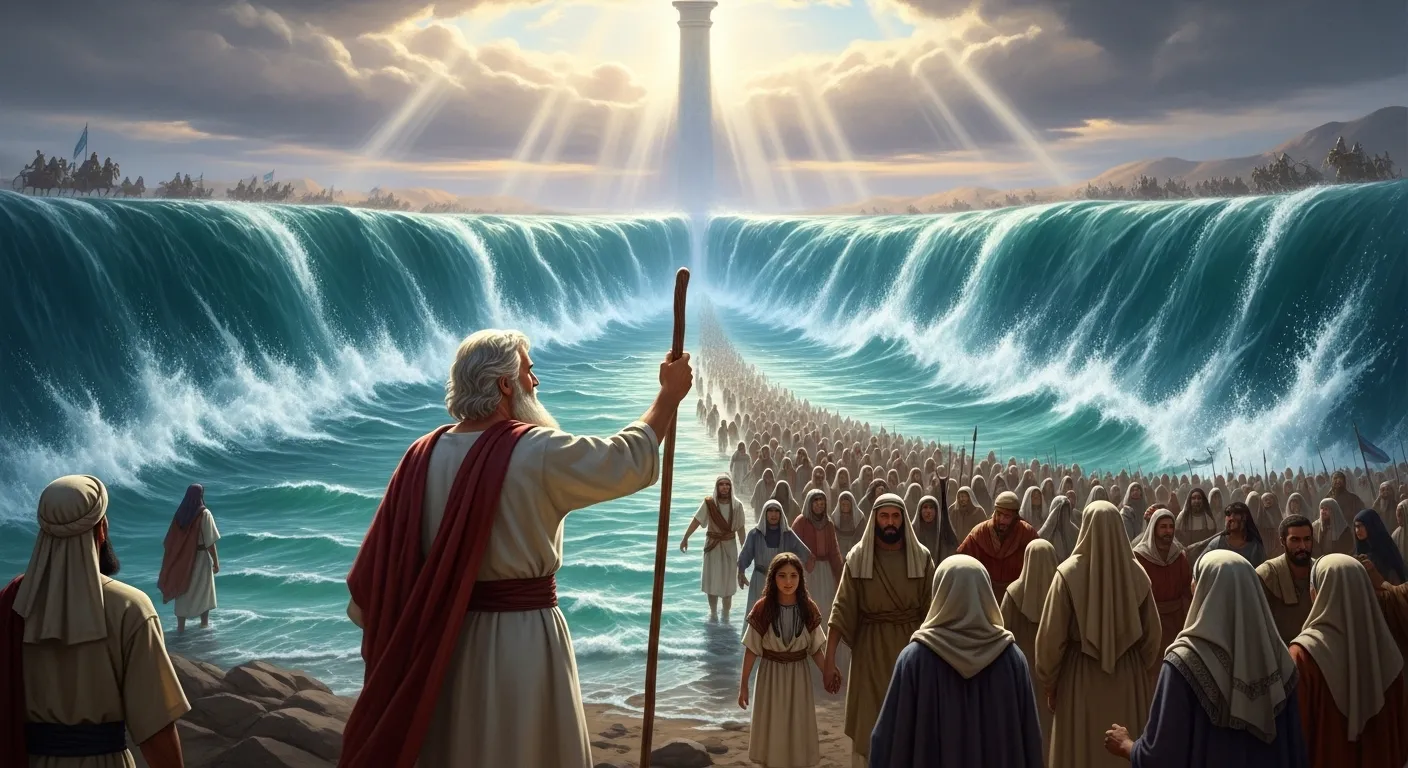
What followed is the central drama of the Old Testament. Ten plagues dismantled Egypt’s gods one by one — the Nile, the frogs, the sun itself — each a direct challenge to an Egyptian deity, culminating in the Passover, when the blood of a lamb turned judgment aside. Then the Red Sea: trapped between Pharaoh’s chariots and deep water, Moses stretched out his hand, and Israel walked through on dry ground while Egypt’s army drowned (Exodus 14).
But the greater work was not getting Israel out of Egypt; it was getting Egypt out of Israel. At Sinai, Moses received the Law — the Ten Commandments and the covenant that would define the nation (Exodus 19–20). He interceded when Israel built the golden calf, offering his own life in exchange: “blot me out of the book you have written” (Exodus 32:32) — a stunning foreshadowing of Christ. He met with God “face to face, as one speaks to a friend” (Exodus 33:11), and came down the mountain with his face shining so brightly he had to veil it (Exodus 34:29–35).
Through it all, Moses was the mediator — the man between. Between God and Pharaoh. Between God and Israel. Between Israel’s sin and God’s wrath. The New Testament sees in this mediating role a deliberate preview: “For there is one God and one mediator between God and mankind, the man Christ Jesus” (1 Timothy 2:5). Moses was the shadow; Christ is the substance. The Law came through Moses, but “grace and truth came through Jesus Christ” (John 1:17).
The Failure That Kept Him Out — and the Grace That Brought Him Back
Honesty about Moses requires the hardest chapter: Meribah. After decades of leading a complaining people, Moses struck the rock twice in anger instead of speaking to it as God commanded (Numbers 20:7–12). The consequence was severe: he would not enter the Promised Land. For one act of disobedience — born of exhaustion and frustration anyone can understand — the great deliverer died on Mount Nebo, viewing Canaan from a distance (Deuteronomy 34:1–5).
The severity troubles readers until they see what was at stake. The rock was Christ, Paul says (1 Corinthians 10:4) — the smitten rock of Exodus 17 pictured the crucifixion; the spoken-to rock of Numbers 20 pictured the risen Christ who needs only to be asked. By striking it, Moses distorted the picture of grace at the very moment Israel most needed it clear. Leaders are judged by a stricter standard (James 3:1), and Moses’ story is Scripture’s sobering reminder that no amount of past faithfulness exempts anyone from present obedience.
But the story does not end on Nebo. Fifteen centuries later, on another mountain, Moses appears — alive, glorified, talking with Jesus at the Transfiguration (Matthew 17:3). The man who was kept out of the earthly Canaan stands in glory discussing the “exodus” Jesus would accomplish at Jerusalem (Luke 9:31 — the Greek word is literally exodus). Grace had the last word. Jude even records that Michael contended for Moses’ body (Jude 9) — God would not abandon His servant even in death. The failure was real, the discipline was real, and the grace was more real than both.
The Pattern for Every Life
Hebrews 11 distills Moses’ life into three refusals and three choices: he refused to be called Pharaoh’s grandson, refused the fleeting pleasures of sin, refused to fear the king’s anger — and he chose mistreatment with God’s people, the reproach of Christ, and the reward of faith (Hebrews 11:24–27). “He persevered because he saw him who is invisible.”
That is the meaning of Moses for the reader: a life drawn out — out of the water, out of the palace, out of the desert, out of Egypt, and finally out of this world into glory — by a God who specializes in drawing people out of what is killing them and into what will save them. Whatever your Egypt is — the sin, the fear, the past, the impossibility — the God of the burning bush still says, “I will be with you.” And He still draws. For the historical and traditional dimensions of his life beyond the biblical narrative, the Wikipedia article on Moses surveys the scholarship, the archaeology, and the figure’s place in Judaism, Christianity, and Islam.










