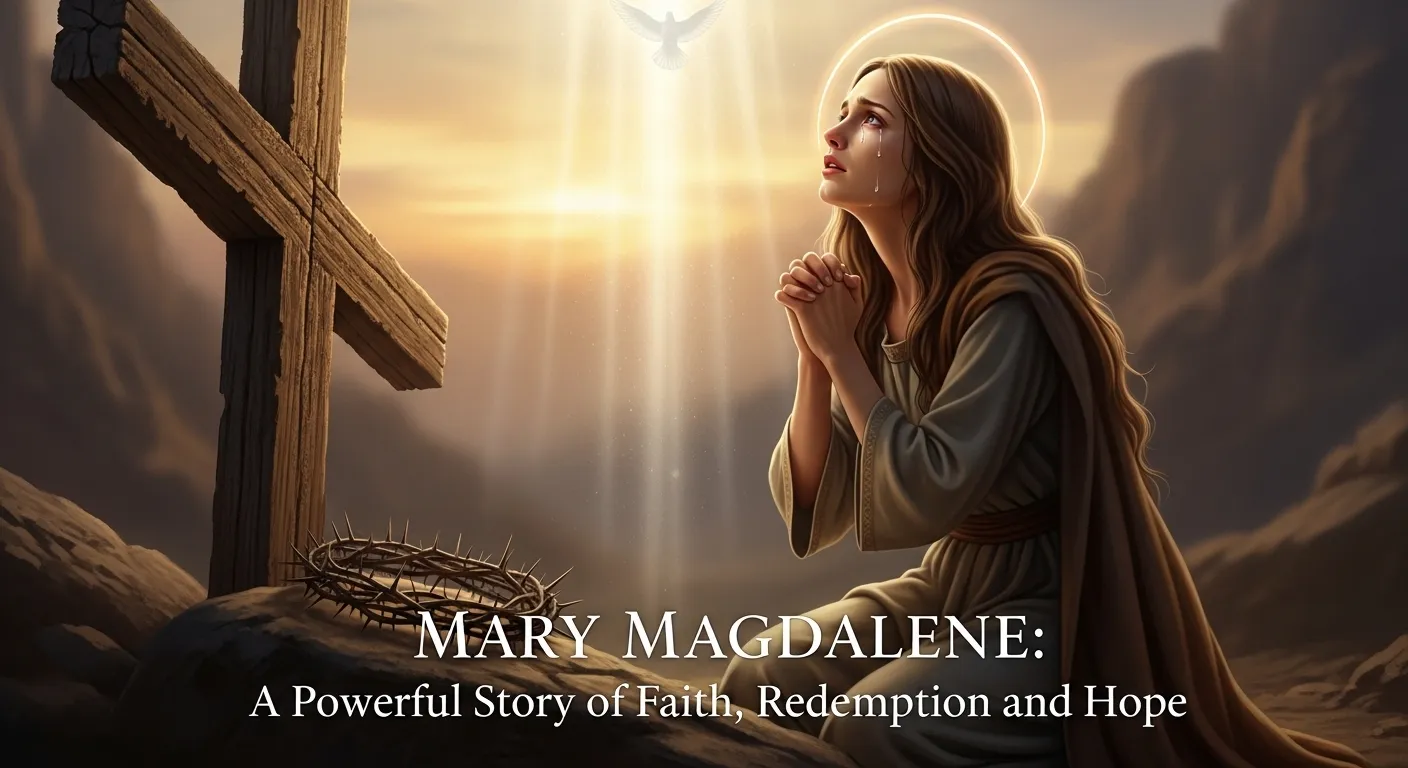
She is there at the cross when the men have fled. She is there at the tomb while it is still dark. She is there in the garden when the stone is rolled away, weeping, unwilling to leave even when there is nothing left to do but grieve. Of all the followers of Jesus, Mary Magdalene may be the one who simply would not go away — and the Gospels reward her loyalty with the greatest honor ever given to a human being: she is the first person in history to see the risen Christ and the first to carry the news. “Go… to my brothers and tell them,” Jesus says to her (John 20:17), making a woman the first preacher of the resurrection in a world that would not accept a woman’s testimony in court.
The meaning of Mary Magdalene in the Bible has been clouded by centuries of confusion — legends that made her a prostitute (Scripture never says this), novels that made her a secret wife (Scripture never hints at this), traditions that merged her with three other women. Strip all of that away and what remains is better than the legends: a real woman, delivered from real darkness, whose devotion carried her to the foot of the cross and into the empty tomb, and whose story has given hope to everyone who has ever felt too broken to be useful to God.
Magdala: Where the Story Starts
She is called “Magdalene” — Mary of Magdala — which tells us she came from a fishing town on the western shore of the Sea of Galilee. Magdala was a working town: fish processing, boat repair, the smell of the lake. Nothing in the Gospels suggests wealth or status. What Luke tells us instead is the one fact about her past that Scripture considers important: she was a woman “from whom seven demons had come out” (Luke 8:2).
Seven — the biblical number of completeness — suggests total affliction. Whatever form her torment took, it was comprehensive: mind, body, spirit, life. Some readers have tried to diagnose her across the centuries, but Luke is not interested in a diagnosis. He is interested in the deliverance. Jesus set her free — completely, finally — and her response to that freedom defines everything that follows. The woman who had been most bound became the most devoted. There is a principle here that runs through the whole New Testament: those who are forgiven much, love much (Luke 7:47). Mary’s past was not erased; it was converted into fuel.
This is the first thing her story means for readers carrying their own dark chapters. The Bible does not introduce Mary with embarrassment or euphemism. It names the seven demons the way a war record names battles — as the before-picture that makes the after-picture glorious. Whatever your Magdala was — addiction, abuse, a past you cannot undo — Scripture’s message through Mary is that Jesus does not merely tolerate rescued people. He entrusts them with the most important missions.
The Ministry Years: Devotion With an Open Purse
Luke 8:1–3 gives a glimpse of Mary’s life after deliverance that is easy to miss. She traveled with Jesus and the Twelve, along with Joanna, Susanna, “and many others” — and these women “were helping to support them out of their own means.” Mary Magdalene was not a passive follower. She was a financial patron of the ministry, funding the mission out of her own resources.
Think about what that implies. She had means — enough to underwrite an itinerant preacher and his twelve disciples. She had independence — traveling publicly with a rabbi’s entourage was not conventional. And she had gratitude that expressed itself practically. Her devotion was not only emotional; it was economic. She put her money where her deliverance was. For modern readers, this reframes devotion entirely: Mary’s love for Jesus was measured not in tears alone but in sustained, costly, unglamorous support — the travel, the meals, the logistics of a ministry that never stayed anywhere long.
The Gospels keep placing her in the background of the great moments — present, watching, serving — the way faithful people are always present in the background of great moments. She is there when others are calculating. She is there when others are arguing about greatness. Her presence is the quiet counterpoint to the disciples’ ambition: while they debated who was greatest, she simply stayed close.
The Cross: When Everyone Else Left
Then came the night everything collapsed. Judas betrayed. Peter denied. The rest “deserted him and fled” (Mark 14:50) — the Greek suggests they ran. But John 19:25 names the small group that stayed: “Near the cross of Jesus stood his mother, his mother’s sister, Mary the wife of Clopas, and Mary Magdalene.”
Consider what staying cost. The cross was a public execution by an occupying empire; standing near it marked you as a sympathizer. The disciples had reason to fear arrest. Mary stayed anyway. There was nothing left to gain — no more teachings, no more miracles, no more movement. The cause was dead on a Roman cross. Her loyalty at this point cannot be explained by self-interest, which is exactly why the Gospels record it. This is devotion purified of every motive except love itself.
She watched Him die. Mark names her again at the burial: “Mary Magdalene and Mary the mother of Joseph saw where he was laid” (Mark 15:47). She noted the location — the practical, grieving detail of someone planning to return. While the male disciples hid behind locked doors, Mary Magdalene was planning a predawn visit to a tomb. Courage in the Gospels often looks like this: not dramatic speeches but showing up, in the dark, with spices, for a dead man.
The Garden: The First Witness
John 20 is her chapter, and it deserves slow reading. “Early on the first day of the week, while it was still dark, Mary Magdalene went to the tomb” (John 20:1). She finds the stone removed. She runs to tell Peter and John. They come, they see, they leave — “the disciples went back to where they were staying” (John 20:10). But Mary stayed. “Now Mary stood outside the tomb crying” (John 20:11).
What follows is the most tender scene in the resurrection narratives. She sees two angels. She turns and sees Jesus but mistakes Him for the gardener — grief does that to the eyes. He says one word: “Mary.” And in that single word — her name, spoken in the voice she knew — everything changes. “She turned toward him and cried out in Aramaic, ‘Rabboni!’ (which means ‘Teacher’)” (John 20:16). Recognition comes not through argument but through being known. The Good Shepherd calls His sheep by name (John 10:3), and here is the proof.
Then the commission: “Go to my brothers and tell them” (John 20:17). The first sermon of the resurrection age is preached by Mary Magdalene to a roomful of frightened men: “I have seen the Lord!” (John 20:18). In a culture where a woman’s testimony was inadmissible, God chose a woman as His first witness — a deliberate overturning of human hierarchies that the church has been catching up to ever since. Her past — the seven demons, the rumors, the whispers — disqualified her in every human court. It qualified her perfectly in God’s.
What Her Life Means
Mary Magdalene’s story carries its meaning in its shape: bound, freed, devoted, faithful in darkness, first in the light. For the reader who feels disqualified by the past, she is proof that Jesus specializes in the disqualified. For the reader tempted to measure devotion in feelings, she is proof that devotion is measured in staying — at the cross when there is nothing to gain, at the tomb when there is nothing to hope for. For the church, she is proof that God entrusts His greatest news to unexpected messengers.
And for everyone who has wept in a garden while it was still dark: she is proof that the weeping does not last. Someone is about to speak your name. The legends about Mary Magdalene — the prostitute, the secret wife, the hidden gospel — all fade next to the actual record, which needs no embellishment: a delivered woman who loved Jesus, stayed with Jesus, and was sent by Jesus. That is enough glory for any life. Readers interested in how history, art, and tradition have handled her story alongside the biblical account will find the full survey in the Wikipedia article on Mary Magdalene, which traces both the Gospel portrait and the centuries of legend that grew around it.










