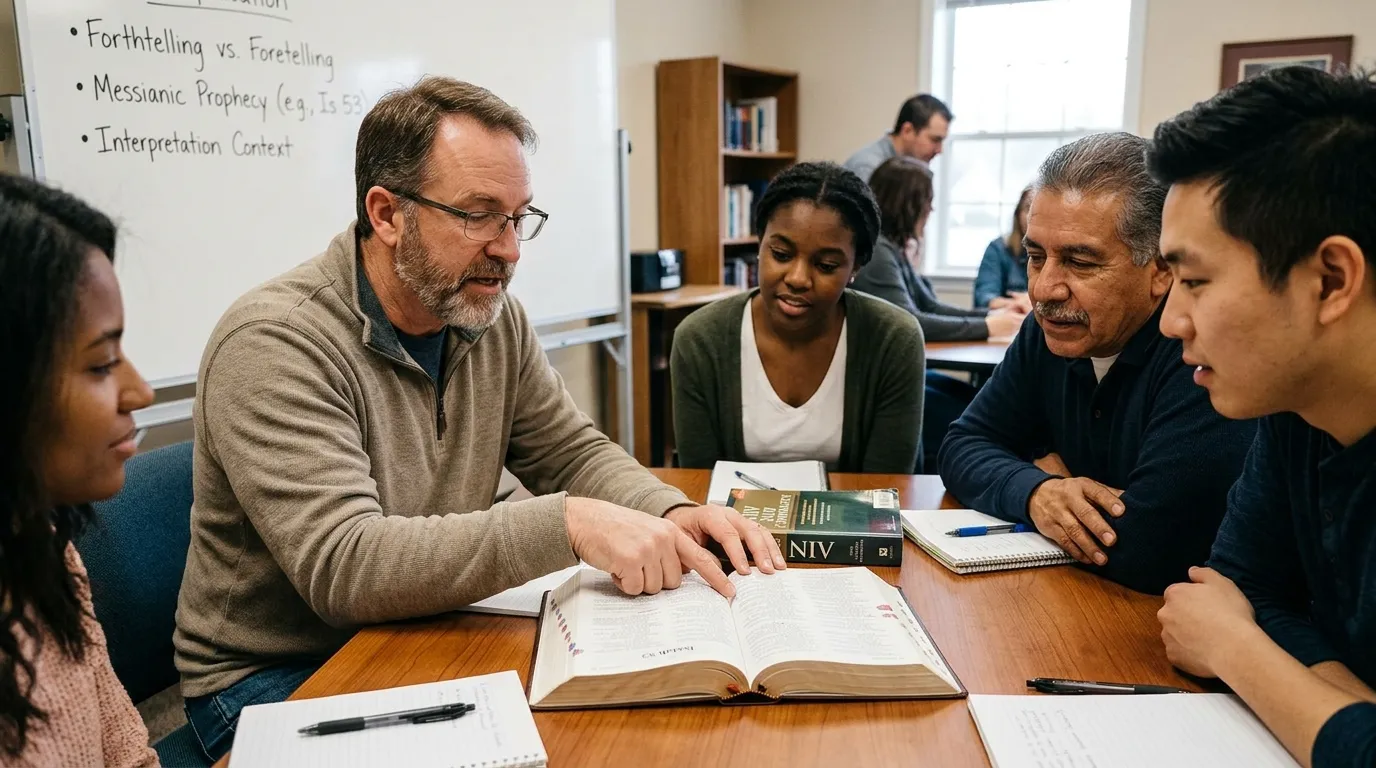
Ask a random person what a prophet does, and you will likely hear about predicting the future — a biblical fortune-teller with better branding. The image is so common that even many churchgoers are surprised to learn that most biblical prophecy is not about the future at all. Open Isaiah, Jeremiah, Amos, or Micah at random, and the odds are strong you will land on a passage about present injustice, present idolatry, and a present call to repent — not a forecast.
The confusion is understandable, because the spectacular predictions get the attention: Cyrus named a century early, Bethlehem pinpointed, the suffering servant described in detail. But those famous foretellings are the tip of something much larger. The Bible’s own word for the prophet’s work points the other way. A prophet (nabi) is literally “one who is called” to speak — God’s spokesperson, His mouth. And a spokesperson’s first job is not to announce tomorrow’s news but to deliver today’s message. Understanding prophecy begins with getting that job description right.
The Prophet Was God’s Mouth
The defining image comes from the very first commissioning. When Moses protested that he could not speak, God told him Aaron would be his mouth — and then, astonishingly, God applied the same structure to Himself and Moses: “He shall speak for you to the people, and he shall be your mouth, and you shall be as God to him” (Exodus 4:16). Then, when Jeremiah was called, God “put out his hand and touched my mouth… Behold, I have put my words in your mouth” (Jeremiah 1:9). The prophet is a mouth with God’s words in it. The organ’s function is delivery, not invention.
This is why the prophets’ signature phrase is not “I predict” but “Thus says the LORD.” The formula appears hundreds of times — over 400 in the Old Testament alone — and it reframes everything. The prophet is not offering analysis, intuition, or educated guessing. He is delivering a communiqué from the throne. That is also why false prophecy was treated as a capital crime in Israel (Deuteronomy 18:20): to put “Thus says the LORD” on words God never spoke was forgery of the King’s seal, treason against heaven.
And notice what the mouth mostly says. Read through the major and minor prophets and tally the content: the overwhelming majority is forthtelling — speaking God’s heart into the present moment. Idolatry denounced. Oppression condemned. Empty ritual exposed. Mercy offered. Judgment warned. Repentance pleaded. The future appears, but usually as the consequence of the present: keep walking this road and here is where it ends; turn around and here is where the other road leads. The prophet is less a weatherman forecasting tomorrow than a doctor diagnosing today — with the prognosis included.
Forthtelling: Speaking God’s Heart Into the Present
Consider Nathan confronting David. The king has committed adultery and arranged a murder, and he has gotten away with it — for nearly a year, by the narrative’s timeline. Nathan does not arrive with a prediction about next year’s harvest. He arrives with a story about a stolen lamb, waits for David’s verdict, and then detonates four words: “You are the man!” (2 Samuel 12:7). That is forthtelling at its purest: God’s moral judgment, delivered personally, presently, and without possibility of evasion. No future-telling was needed. The present was damning enough.
Or Elijah on Mount Carmel — no forecast, just a confrontation: “How long will you go limping between two different opinions?” (1 Kings 18:21). Or Amos, the fig farmer turned prophet, thundering against the wealthy women of Samaria who “oppress the poor” and “crush the needy” (Amos 4:1). Or Micah, reducing the whole prophetic message to a single ethical demand: “He has told you, O man, what is good; and what does the LORD require of you but to do justice, and to love kindness, and to walk humbly with your God?” (Micah 6:8).
Micah’s summary is worth sitting with, because it reveals prophecy’s deepest purpose. The prophet is not primarily an informant about the future; he is a mirror held up to the present, showing God’s people what their lives look like from heaven’s side. That is why the prophets spend so much ink on economics, courts, weights and measures, the treatment of widows and immigrants. God’s heart, spoken into the marketplace. Forthtelling is prophecy’s main business — and it is the part of prophecy that applies most directly to us, because our present needs the same mirror.
Foretelling: When God Opens the Future
None of this diminishes the foretelling — it puts it in its proper, dazzling place. Sometimes God’s mouth does announce what is coming, and when He does, the predictions are startlingly specific. Isaiah names Cyrus, the Persian king who would authorize the Jews’ return, roughly 150 years before Cyrus was born: “who says of Cyrus, ‘He is my shepherd, and he shall fulfill all my purpose'” (Isaiah 44:28; 45:1). Micah names Bethlehem as the birthplace of the coming ruler (Micah 5:2). Isaiah 53 describes a suffering servant — despised, pierced, silent before shearers, buried with the rich — with a precision that made the Ethiopian eunuch ask, “about whom does the prophet say this?” (Acts 8:34).
Why does God foretell at all? Scripture gives several reasons, and none of them is to satisfy curiosity. First, to prove He is God. “I am God, and there is no other… declaring the end from the beginning” (Isaiah 46:9-10). Fulfilled prophecy is God’s signature — the evidence no idol can forge, since idols cannot predict anything (Isaiah 41:21-24). Second, to give hope in darkness. Exiles in Babylon clung to Jeremiah’s promise of return after seventy years (Jeremiah 29:10) the way a drowning person clings to a rope. Third, to warn before judgment. Noah preached 120 years; the prophets warned for generations. Foretelling is mercy with a deadline.
And fourth, to identify the Messiah. The Old Testament’s predictive threads — the seed of the woman (Genesis 3:15), the prophet like Moses (Deuteronomy 18:15), the son of David with an everlasting throne (2 Samuel 7:12-16), the suffering servant, the Bethlehem birth — converge on Jesus with a specificity that the apostles treated as proof. “To him all the prophets bear witness” (Acts 10:43). The foretelling was never an end in itself. It was a trail of breadcrumbs leading to Christ.
The Tests of a True Prophet
Because prophecy claims divine authority, Scripture insists on testing it — and the tests are practical, not mystical. Accuracy: “if the word does not come to pass or come true, that is a word that the LORD has not spoken” (Deuteronomy 18:22). The professional date-setters, with their revised charts after every failed prediction, fail this test by definition. Orthodoxy: even a fulfilled sign proves nothing if the prophet uses it to lead people after other gods (Deuteronomy 13:1-3). Truth and truthfulness travel together; a true prediction in service of a false god is still false prophecy.
Fruit: “You will recognize them by their fruits” (Matthew 7:15-20) — the prophet’s life and the followers’ lives are evidence. And Christ-centeredness: “the testimony of Jesus is the spirit of prophecy” (Revelation 19:10). Any “prophecy” that marginalizes Christ, however spectacular its predictions, has lost the plot. These tests protect the church from two opposite dangers: the gullibility that swallows every claim, and the cynicism that dismisses the genuine gift (1 Thessalonians 5:20-21 — “do not despise prophecies, but test everything”).
The Prophetic Line Runs to Jesus — and Through the Church
Moses promised that God would raise up “a prophet like me from among you” (Deuteronomy 18:15), and the New Testament identifies Him without hesitation: Peter preaches that Jesus is that prophet (Acts 3:22-23), and Hebrews opens by declaring that God, who spoke “at many times and in many ways” through the prophets, “has spoken to us by his Son” (Hebrews 1:1-2). Jesus is not merely the subject of prophecy; He is its culmination — the Word the mouths were made to speak, now speaking for Himself.
Yet the gift did not retire with the apostles. Paul lists prophecy among the Spirit’s ongoing gifts (1 Corinthians 12:10; 14:1-5), given “for building up” the church — and note his description of its content: “the one who prophesies speaks to people for their upbuilding and encouragement and consolation” (1 Corinthians 14:3). Upbuilding, encouragement, consolation: that is forthtelling, the prophet’s main business, continuing in the congregation. The spectacular predictions may be rare; the steady work of speaking God’s heart into the present goes on wherever the Spirit is welcomed and tested.
So what is Bible prophecy? It is God’s mouth in human history — mostly forthtelling (His heart for today), sometimes foretelling (His hand on tomorrow), always tested, always pointing to Christ. Read it that way and the prophets come alive: not as puzzle-makers for the curious, but as heaven’s spokesmen for the complacent, the oppressed, the exiled, and the hopeful. Their message to us is the same one Nathan brought to David, compressed into four words we all need to hear: look honestly at the present — you are the man — and then look hopefully at the future, because the God who spoke it is faithful to finish it.
For a broader look at how prophecy has been understood across religions and history — and where the biblical vision stands distinct — Wikipedia’s article on prophecy provides useful context on the wider phenomenon this biblical gift both resembles and transcends.










