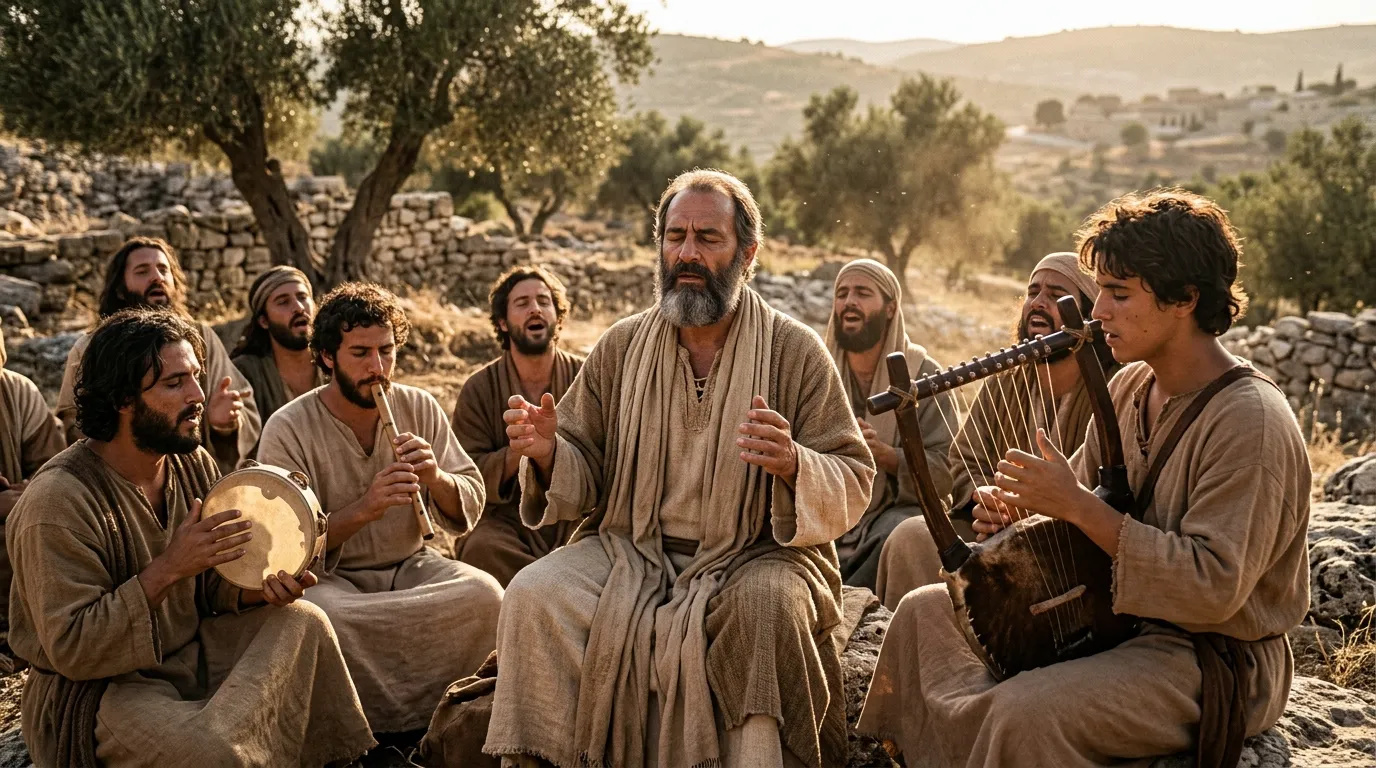
The king of Israel, the king of Judah, and the king of Edom were marching through the desert to attack Moab when their army ran out of water. In desperation they consulted Elisha — who responded with an instruction no one expected: “Now bring me a musician.” A harpist was found. He played. And “when the musician played, the hand of the LORD came upon him” — and Elisha prophesied water in the desert and victory in the battle (2 Kings 3:15-19).
Read that again slowly. The prophet did not ask for quiet. He did not ask for a scroll. He asked for sound — and the sound was the doorway the word walked through. All through Scripture, revelation has an acoustic dimension: God speaks, and remarkably often, He speaks through music — through harps and trumpets, through sung prophecy and the roar around His throne. The Bible’s God is not only the Word; He is the Song behind the word, and prophecy frequently arrives on a melody.
When the Music Played, the Word Came
Elisha’s harpist is not an isolated incident but a window into a pattern. When Samuel anointed Saul, he told him he would meet “a procession of prophets coming down from the high place with harp, tambourine, flute, and lyre before them, prophesying” — and that the Spirit of the LORD would rush upon Saul and he would prophesy with them (1 Samuel 10:5-6). Music was not the entertainment before the prophecy; it was the medium of the prophecy, the atmosphere in which the Spirit moved.
David institutionalized the pattern. Among the temple musicians he appointed were those who “prophesied with the lyre in thanksgiving and praise to the LORD” (1 Chronicles 25:1-3) — Asaph, Heman, and Jeduthun, whose prophesying was music. The Chronicler uses the actual verb for prophesying to describe what these musicians did with their instruments. In the Bible’s vocabulary, a played harp could be as prophetic as a preached sermon.
Why would sound open the ear to revelation? Perhaps because music does what argument cannot: it quiets the noise of the self. Elisha had just been provoked by the idolatrous king of Israel (2 Kings 3:13-14); his spirit was agitated, his attention fractured. The musician’s playing gathered him — slowed his breathing, stilled his irritation, tuned his heart to heaven’s frequency. Anyone who has felt a worship song dissolve a week’s anxiety understands the mechanism. Music does not manipulate God into speaking. It prepares us to hear — the way still water reflects what choppy water cannot.
Trumpets: The Alarm of Heaven
If the harp is prophecy’s gentle doorway, the trumpet is its alarm. In Israel, trumpets were not primarily musical instruments; they were signals — the ancient equivalent of a siren, a summons, and a proclamation rolled into one. God commanded silver trumpets “for summoning the congregation and for breaking camp… for war… and on your days of gladness” (Numbers 10:2, 9-10). The same blast that called to battle called to worship. Sound, in Israel, was how God got His people’s attention.
The prophets took up the image and turned the volume up. “Blow the trumpet in Zion; sound the alarm on my holy mountain!” (Joel 2:1) — the trumpet blast is the prophecy, a sound that means the day of the LORD is coming. At Jericho, seven priests with seven trumpets circled the city for seven days, and on the seventh the walls fell at the sound (Joshua 6:4-20) — prophecy enacted acoustically, the future collapse of the city announced in advance by marching feet and ram’s horns.
The New Testament keeps the trumpet at the center of its greatest prophecies. “The trumpet will sound, and the dead will be raised imperishable” (1 Corinthians 15:52). “The Lord himself will descend from heaven… with the sound of the trumpet of God” (1 Thessalonians 4:16). And Revelation’s central judgments unfold as seven trumpets blown by seven angels (Revelation 8-11) — each blast a prophetic announcement, heaven’s sound system proclaiming what is coming on the earth. When the last trumpet sounds, “the kingdom of the world has become the kingdom of our Lord and of his Christ” (Revelation 11:15). The end of the story, like its great turning points, arrives with a sound.
There is pastoral wisdom here for the anxious heart. God’s trumpet prophecies are never meant to produce panic in His people — the alarm is for the complacent, the reassurance for the faithful. The same trumpet that terrifies the rebellious will thrill the redeemed, because they know whose victory it announces. Learning to hear prophecy’s trumpets rightly means learning to distinguish the two audiences — and making sure you are in the second one.
The Songs Around the Throne
John’s visions of heaven are saturated with sound. Around the throne he hears “the voice of many angels… and the living creatures and the elders” singing a new song: “Worthy are you to take the scroll and to open its seals” (Revelation 5:8-12). Note the connection: the song is about the scroll — about God’s unfolding plan. Heaven’s worship is not background music to the prophecy; it is the prophecy’s interpretation, the redeemed cosmos declaring what the seals mean. The elders hold harps as well as bowls of incense (Revelation 5:8) — music and prayer, the two sounds of heaven, side by side.
The acoustic imagery intensifies: John hears “a voice from heaven like the roar of many waters and like the sound of loud thunder,” and the voice he heard “was like the sound of harpists playing on their harps” — and they sing a new song no one else can learn (Revelation 14:2-3). Thunder, water, harps: revelation’s soundtrack is overwhelming and intimate at once. And the final song of the redeemed is identified precisely: “the song of Moses, the servant of God, and the song of the Lamb” (Revelation 15:3) — the church at the end of history singing the church’s oldest prophetic song, the one from the Red Sea, now with the Lamb’s verses added. Prophecy’s music is one long song, from Exodus to eternity, with every generation adding its stanza.
David’s Harp and the Troubled King
Not all of prophecy’s music announces the future; some of it wars against the present darkness. When an evil spirit tormented Saul, David would take the harp and play, “and Saul would be refreshed and would be well, and the harmful spirit departed from him” (1 Samuel 16:23). No words are recorded — only sound. Yet the effect is unmistakably spiritual warfare: the music carried a presence the darkness could not abide.
The psalms confirm the theology: “Let the high praises of God be in their throats and two-edged swords in their hands” (Psalm 149:6). Praise and warfare in the same verse, the song as a weapon. Jehoshaphat’s army would later prove it literally, sending singers ahead of the troops — “Give thanks to the LORD, for his steadfast love endures forever” — while the enemy armies destroyed each other (2 Chronicles 20:21-22). Prophetic music does not merely describe God’s victories; deployed in faith, it participates in them.
Learning to Listen Today
What does all this mean for a believer with no harpist on call? At least three practices.
First, use music as Elisha did — to become hearable. Before a big decision, before confronting a hard truth, before preaching or praying when your spirit is agitated: play or sing something that turns your face toward God. Not as a technique to force His hand — He cannot be manipulated — but as the honest preparation of a noisy heart. “Be still, and know that I am God” (Psalm 46:10) is sometimes best obeyed with a hymn.
Second, let sung truth teach you. “Let the word of Christ dwell in you richly… singing psalms and hymns and spiritual songs” (Colossians 3:16). Paul treats congregational singing as a teaching ministry — the word dwelling richly through song. The songs you sing repeatedly are catechizing you, for better or worse. Choose them the way you choose teachers: for truth, not just for feeling. A church’s playlist is its unofficial systematic theology.
Third, discern the sound. Not every powerful musical experience is the Spirit of God — emotion is not revelation, and volume is not anointing. The same Bible that shows music opening prophets to God’s voice also shows it accompanying idolatry: Nebuchadnezzar’s orchestra summoned worship of a golden image (Daniel 3:5-7). The test is the same as for all prophecy: does this sound lead me to the true God, in truth, toward holiness? Music that does is a gift of the God who spoke the world into being with a word — and who, from Elisha’s harpist to the harps around His throne, keeps letting His voice arrive on a melody.
The next time worship moves you to tears before a single word is preached, remember the prophet who asked for a musician first. You are not being emotional instead of spiritual. You are standing where revelation has always liked to land — in the stillness after the song begins, where the hand of the LORD comes upon listening hearts.
Those who want to explore the Bible’s own songbook — the collection where prophecy and music most deeply intertwine — will find Wikipedia’s article on the Psalms a rich starting point, tracing their history from temple worship to the present day.










