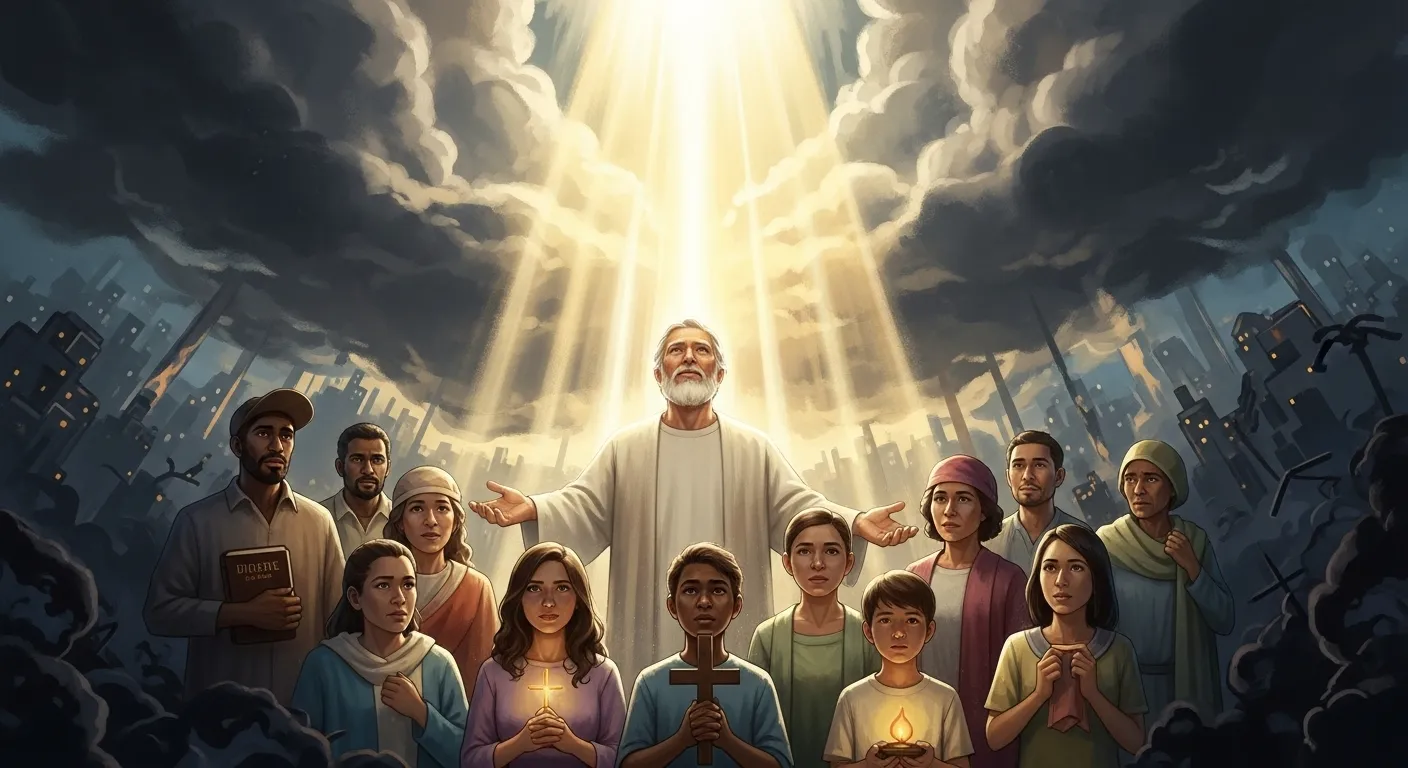
Follow the word “light” through the Bible and you trace the whole story of redemption in a single beam. It is the first thing God speaks into being and the last thing the new creation needs no longer. Between Genesis 1:3 and Revelation 22:5, light becomes Scripture’s richest metaphor — for God himself, for truth, for guidance, for holiness, for Christ, and finally for the people Christ remakes. When Jesus says, “I am the light of the world” (John 8:12), he is not coining a phrase. He is claiming the entire beam.
“Let There Be Light” — Before There Was a Sun
Light is God’s opening word: “And God said, ‘Let there be light,’ and there was light” (Genesis 1:3). Note the order — light arrives on day one; the sun, moon, and stars do not appear until day four (Genesis 1:14–19). The text is making a theological claim before it makes an astronomical one: light does not depend on the sun. Light depends on God. It is his first gift, his signature on creation, the visible form of his own nature — for “God is light; in him there is no darkness at all” (1 John 1:5).
That is why darkness in Scripture is never neutral. It is the realm of chaos before creation (Genesis 1:2), of judgment (the plague of darkness in Exodus 10:21–23), of evil deeds done in hiding (John 3:19–20). To speak of light in the Bible is always, implicitly, to speak of war — light invading darkness, and darkness unable to overcome it (John 1:5).
The Lamp Under Israel’s Feet
Through the Old Testament, light becomes the figure for everything God gives his people. “The LORD is my light and my salvation — whom shall I fear?” (Psalm 27:1). “Your word is a lamp for my feet, a light on my path” (Psalm 119:105). God’s law is not a burden in these verses; it is illumination, the thing that lets a traveler see the next step on a dark road.
The prophets turn the metaphor toward the future. Isaiah sees a people “walking in darkness” who “have seen a great light” (Isaiah 9:2) — a light dawning specifically “in Galilee of the nations” (Isaiah 9:1). Centuries later, Matthew will quote that exact prophecy to explain why Jesus based his ministry in Galilee (Matthew 4:14–16). The Old Testament does not merely use light as decoration; it aims the beam at a coming person.
The Light Dawns in Galilee
Then, in the temple courts during the Feast of Tabernacles — the festival when giant lampstands blazed in the temple courtyard to commemorate the pillar of fire that guided Israel through the wilderness — Jesus stands and says: “I am the light of the world. Whoever follows me will never walk in darkness, but will have the light of life” (John 8:12). The setting is electric. Against the memory of the wilderness fire and the blaze of the festival lamps, Jesus claims to be what those lights only pictured.
John’s Gospel has been building to this from its first verse: “In him was life, and that life was the light of all mankind. The light shines in the darkness, and the darkness has not overcome it” (John 1:4–5). Everything Jesus does in John is light-work — opening the eyes of a man born blind (John 9), calling Lazarus out of a tomb’s darkness (John 11), exposing the deeds of darkness while offering to wash them clean. The claim “I am the light of the world” is exclusive — the light, not a light — and it is an offer: whoever follows will never walk in darkness.
“You Are the Light of the World”
Here is the turn most readers miss. Jesus takes the very title he claims for himself and gives it to his followers: “You are the light of the world. A town built on a hill cannot be hidden” (Matthew 5:14). The church does not generate light; it reflects it, the way the moon shines with borrowed glory. But the command is real: “let your light shine before others, that they may see your good deeds and glorify your Father in heaven” (Matthew 5:16).
Paul picks up the same commission with an edge: “you shine like stars in the sky as you hold firmly to the word of life” (Philippians 2:15–16) — and he sets it in a “warped and crooked generation,” because light is most visible, and most needed, where darkness is thickest. This reframes the Christian life entirely. Holiness is not hiding from the dark; it is carrying light into it. A lamp’s purpose is not to admire itself in a bright room but to be carried down into the cellar.
And the New Testament is honest about the cost. “Everyone who does evil hates the light, and will not come into the light for fear that their deeds will be exposed” (John 3:20). Light comforts the lost and confronts the hiding. The same beam that guides the traveler exposes the thief. To follow the Light of the World is to consent to being seen — fully, mercifully, transformingly seen.
The City That Needs No Lamp
The Bible’s light-beam lands where it began: in a creation with no darkness left. John’s vision of the new Jerusalem is the mirror image of Genesis 1. In Eden, light was spoken into darkness; in the new creation, darkness is gone entirely. “The city does not need the sun or the moon to shine on it, for the glory of God gives it light, and the Lamb is its lamp” (Revelation 21:23). “There will be no more night. They will not need the light of a lamp or the light of the sun, for the Lord God will give them light” (Revelation 22:5).
Day one of creation needed light spoken; the last day needs no sun at all, because the Source himself is present. Every lamp, every sunrise, every festival flame, every “your word is a lamp” was a rehearsal for this: unmediated, unending light, with the Lamb as its lamp. The beam that started with “let there be” ends with “there shall be no more night.”
That is what “Light of the World” means, in full. It is a claim about who God is (light itself), about who Jesus is (the light arrived in person), about who believers are (lamps carrying his flame), and about where history is going (a city with no night). To follow him is to walk in the only light that darkness cannot extinguish — and to become, in a dark world, a small and steady evidence that the dawn is coming.
The Pillar of Fire
Long before Jesus claimed the title, Israel had followed the light. When God brought his people out of Egypt, “by day the LORD went ahead of them in a pillar of cloud to guide them on their way and by night in a pillar of fire to give them light, so that they could travel by day or night” (Exodus 13:21). For forty years, the nation’s direction was literally visible: move when the fire moves, stop when it stops. Divine guidance was not a feeling but a flame.
It is no accident that Jesus spoke the words “I am the light of the world” during the Feast of Tabernacles, when the temple courts blazed with great lampstands commemorating that very pillar of fire. Standing in that light, Jesus was saying: the pillar has a face now. The God who guided Israel as fire in the wilderness has come to guide his people in person. Every step Israel took behind that flame was a rehearsal for following him.
Walking in the Light
The New Testament turns the metaphor into an ethic. “If we walk in the light, as he is in the light, we have fellowship with one another, and the blood of Jesus, his Son, purifies us from all sin” (1 John 1:7). Walking in the light means living openly before God — no hidden corners, no secret compartments. It is the opposite of the darkness John describes: “Everyone who does evil hates the light, and will not come into the light for fear that their deeds will be exposed” (John 3:20).
Paul makes it practical: “For you were once darkness, but now you are light in the Lord. Live as children of light (for the fruit of the light consists in all goodness, righteousness and truth)” (Ephesians 5:8–9). Notice the tense change — not “you were in darkness” but “you were darkness,” and now “you are light.” Following the Light of the World does not merely illuminate a person; it transforms what they are. Goodness, righteousness, and truth are not the price of the light but its fruit — what grows naturally in those who walk in it.
Readers who would like a wider survey of how theologians and traditions have understood light as a divine attribute — from biblical imagery through mystical and philosophical reflection — will find the Wikipedia overview of light in theology a helpful companion to the biblical texts traced here.










