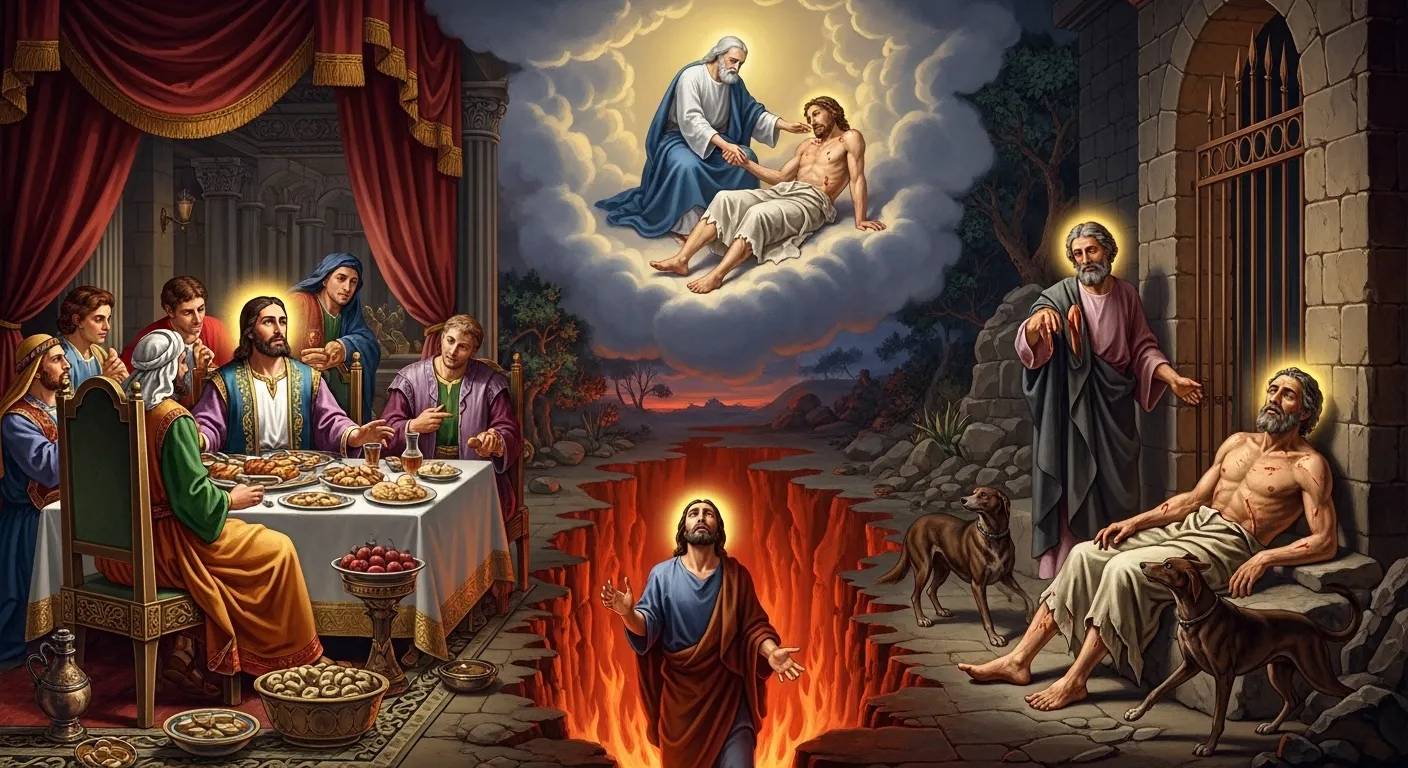
Of all Jesus’ parables, this is the one that feels least like a parable. It has named characters — Lazarus, and Abraham himself. It describes the afterlife with unsettling specificity: a great chasm, a drop of water, a conversation across it. And it ends with one of the most quoted sentences in Scripture about the sufficiency of God’s Word. The story of the rich man and Lazarus (Luke 16:19–31) has comforted the suffering, terrified the complacent, and sparked two thousand years of debate. What did Jesus mean by it — and what does it mean for how we live now?
First, an honest note about what kind of story this is. Most parables begin “a certain man” or “the kingdom of heaven is like.” This one gives its poor man a name: Lazarus, from the Hebrew Eleazar, “God has helped.” No other parable names its characters. Some interpreters conclude this is not a parable at all but a true account Jesus is reporting. Others note that the story’s setting — “Abraham’s side,” the underworld geography — matches popular Jewish descriptions of the afterlife in Jesus’ day, suggesting he is using familiar imagery to make a moral point, the way a preacher might use a well-known illustration. Either way, the story’s authority does not depend on settling the genre question. Its teaching is clear, and it is severe.
Two Lives at One Gate
Jesus paints the contrast with an artist’s eye. The rich man “was dressed in purple and fine linen and lived in luxury every day” (Luke 16:19). Purple dye was ruinously expensive; fine linen was the fabric of priests. This is not mere comfort — it is conspicuous, daily, unapologetic opulence. At his gate lies Lazarus, “covered with sores and longing to eat what fell from the rich man’s table. Even the dogs came and licked his sores” (Luke 16:20–21). The detail about the dogs is devastating: in a culture where dogs were unclean scavengers, the only creatures showing Lazarus any attention are the ones nobody wants near them.
And the gate is the point. Lazarus is not across town; he is at the rich man’s door, visible every single day. The rich man’s sin is not that he caused Lazarus’ suffering — Jesus never says he did — but that he saw it, daily, and did nothing. Indifference, not cruelty, is the indictment. The man is not condemned for being rich; Abraham himself was rich. He is condemned for a heart so padded by luxury that another man’s agony at his own gate never penetrated it. As Proverbs puts it, “Whoever is kind to the poor lends to the LORD” (Proverbs 19:17) — and whoever ignores them has refused the loan.
The Great Reversal
“The time came when the beggar died and the angels carried him to Abraham’s side. The rich man also died and was buried” (Luke 16:22). Read that sentence slowly. Lazarus gets an angelic escort; the rich man gets a funeral. On earth their burials would have been reversed — the rich man with mourners and monuments, Lazarus in a pauper’s grave. In eternity, the only funeral mentioned is the rich man’s, and it reads like an obituary for everything he trusted.
Abraham’s explanation makes the theology explicit: “Son, remember that in your lifetime you received your good things, while Lazarus received bad things, but now he is comforted here and you are in agony” (Luke 16:25). This is the Bible’s great reversal theme — Mary’s song (“he has lifted up the humble,” Luke 1:52), Jesus’ beatitudes (“blessed are you who are poor… woe to you who are rich,” Luke 6:20, 24). Earthly ledgers do not carry over. The story does not teach that poverty saves — Lazarus is comforted because of his relationship with God, implied by his place at Abraham’s side — but it shatters the ancient assumption, still alive today, that wealth equals divine favor and suffering equals divine abandonment.
A Conversation Across the Chasm
The story’s strangest feature is the dialogue between the dead. The rich man, in torment, sees Abraham far off with Lazarus beside him, and calls out: “Father Abraham, have pity on me and send Lazarus to dip the tip of his finger in water and cool my tongue” (Luke 16:24). Even in hell, the man still thinks in terms of errands — Lazarus as the servant boy, fetching water. His view of the poor man has not changed; only his address has.
Then comes the request for his brothers: “send Lazarus to my family, for I have five brothers. Let him warn them” (Luke 16:27–28). It is the story’s one sympathetic moment — the man who ignored the beggar at his gate now wants to evangelize his own family. But Abraham’s answer closes the door: “They have Moses and the Prophets; let them listen to them” (Luke 16:29). When the man protests that a resurrection would convince them, Abraham delivers the parable’s hammer-blow: “If they do not listen to Moses and the Prophets, they will not be convinced even if someone rises from the dead” (Luke 16:31).
The Last Line Is the Point
That final sentence is where the whole story was heading, and it is aimed directly at Jesus’ audience — the Pharisees, “who loved money” (Luke 16:14), listening in. The rich man’s brothers already have everything they need: Scripture. The problem was never lack of evidence; it was hardness of heart. A man who will not heed God’s Word will not be converted by a miracle, because unbelief is not an information problem. It is a will problem.
The irony Luke’s readers would later grasp is staggering: within a few years, someone would rise from the dead — a man named Lazarus of Bethany (John 11), and then Jesus himself — and the religious establishment’s response was not repentance but a plot to kill Lazarus too (John 12:10–11) and a bribed cover-up of the resurrection (Matthew 28:11–15). Abraham’s verdict was prophetic to the letter.
What the Story Asks of the Living
So what does this severe story require of us? Three things, each practical. First, eyes: who is at your gate? The story’s condemnation falls on unseeing, not on wealth itself. Compassion begins with noticing — the coworker quietly drowning, the neighbor in need, the suffering the algorithm never shows you. Second, mercy with your resources: the New Testament never commands universal poverty, but it relentlessly commands generosity — “command them to do good, to be rich in good deeds, and to be generous and willing to share” (1 Timothy 6:18). Wealth is a stewardship, and stewardship will be audited. Third, urgency about eternity: the chasm is “fixed” (Luke 16:26); choices made in this life echo into the next. The story is a loving alarm bell, not to produce panic but to produce repentance while repentance is still possible.
And there is comfort here too, easily missed beneath the warnings. Lazarus — whose name means “God has helped” — is the story’s proof that God does help, finally and fully, those the world discards. Every forgotten sufferer, every person lying wounded at someone’s gate, is seen by the God who sent angels as an honor guard for a beggar. The world’s valuations are not heaven’s. The last shall be first is not a slogan; in this story, it is a seating chart.
What Jesus’ Hearers Pictured
The story’s scenery — “Abraham’s side,” the torment, the “great chasm” — would have been familiar to Jesus’ audience from the popular Jewish picture of the afterlife in that era. Sheol (the grave, the realm of the dead) was commonly imagined as having distinct compartments: a place of comfort for the righteous, associated with Abraham, and a place of anguish for the wicked, separated by an unbridgeable divide. Jesus is not necessarily endorsing every detail of that folk geography as literal cosmology; he is using the imagery his listeners already carried to make a moral point — the way a preacher today might use a familiar illustration without vouching for its every detail.
What matters is what the imagery does in the story. “Abraham’s side” (literally “Abraham’s bosom”) pictures intimate honor — reclining next to the patriarch at the banquet, the seat of the favored guest. Lazarus, who begged for crumbs outside a rich man’s gate, now reclines in the place of highest honor. The “great chasm… fixed” between the two realms (Luke 16:26) dramatizes the story’s central warning: the decisions that determine destiny are made before death, not after. There is no postmortem negotiation, no appeal, no second hearing. The chasm is fixed because the time for choosing is this life.
This is also why the story cannot be used to build a complete doctrine of the afterlife by itself. Jesus’ purpose here is not to give a guided tour of heaven and hell but to confront the living — particularly the money-loving Pharisees listening in (Luke 16:14) — with the eternal weight of present choices. The details serve the warning; the warning serves repentance.
For a broader look at how this passage has shaped Christian thought about wealth, the afterlife, and social responsibility — and the long debate over whether it describes literal conditions or parabolic imagery — the Wikipedia article on the rich man and Lazarus provides a solid starting point with references for deeper study.










