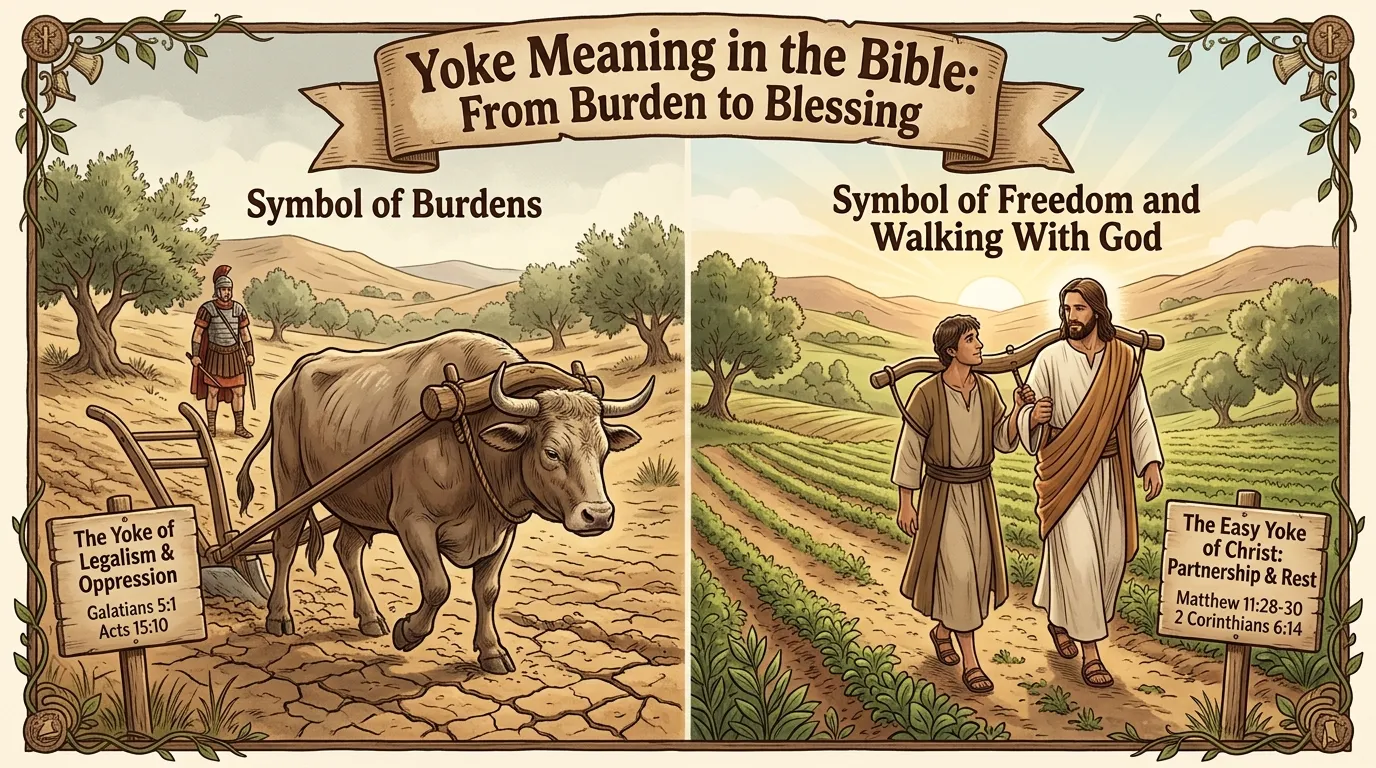
“Come to me, all who labor and are heavy laden, and I will give you rest. Take my yoke upon you, and learn from me, for I am gentle and lowly in heart, and you will find rest for your souls. For my yoke is easy, and my burden is light.” (Matthew 11:28–30). It may be the most quoted invitation Jesus ever gave — and the strangest. A yoke is a farm implement: a heavy wooden beam laid across the necks of oxen so they can pull the plow. Who offers rest by offering a yoke? The paradox is the point. Jesus is not promising the absence of all burden; he is promising a different burden — one that fits, one that is shared, one carried in step with him.
A Rabbi’s Yoke: What Jesus’ Hearers Heard
To first-century Jews, “yoke” was not primarily a farming metaphor — it was a discipleship metaphor. To “take the yoke” of a rabbi meant to become his disciple, submitting to his interpretation of the Torah. The rabbis spoke of “the yoke of the commandments” and “the yoke of the kingdom of heaven.” Every teacher offered a yoke; the question was always whose yoke you would bear.
By Jesus’ day, many found the Pharisees’ yoke crushing. Jesus says so bluntly: “They tie up heavy burdens, hard to bear, and lay them on people’s shoulders, but they themselves are not willing to move them with their finger” (Matthew 23:4). Layers of oral tradition, fence-laws around fence-laws, Sabbath regulations that turned rest into work — the yoke of religion had become the very burden it was supposed to lighten. Into that exhaustion Jesus speaks: take my yoke. Not no yoke — my yoke. Discipleship remains; the master changes.
“My Yoke Is Easy”: The Farming Picture
Behind the rabbinic metaphor sits the barnyard original, and it illuminates the promise. A yoke was custom-carved to fit the particular animal — a well-made yoke distributed weight across the shoulders without chafing. Farmers also yoked a young, inexperienced ox alongside an older, trained one: the elder set the pace, bore the greater weight, and taught the younger to walk straight. The Greek word for “easy” here, chrēstos, can also mean “well-fitting” — my yoke is tailor-made.
Now re-read the invitation with that picture: Jesus is the trained ox. He takes the yoke with us — “take my yoke”, the one he himself wears — sets the pace, bears the weight, and teaches us to walk in step. “Learn from me, for I am gentle and lowly in heart.” The yoke is easy not because the plowing is light but because the Partner is strong. Discipleship is not solo labor; it is shared labor, and the sharing makes all the difference.
Rest for Your Souls: What Kind of Rest?
Jesus promises “rest for your souls” — and the phrase echoes Jeremiah: “Stand by the roads, and look, and ask for the ancient paths, where the good way is; and walk in it, and find rest for your souls” (Jeremiah 6:16). Tragically, Israel answered, “We will not walk in it.” Jesus reissues the ancient invitation to a generation that had turned the good way into a crushing maze.
The rest he offers is not inactivity — yoked oxen are working. It is the rest of fittingness: the soul doing what it was made for, in step with the one who made it. Augustine’s famous line captures it: our hearts are restless until they rest in God. The yoke does not create the restlessness; it cures it, by hitching the restless heart to the only pace that satisfies. “In returning and rest you shall be saved; in quietness and in trust shall be your strength” (Isaiah 30:15).
Hebrews extends the theme: “there remains a Sabbath rest for the people of God” (Hebrews 4:9) — a rest that is both present (“we who have believed enter that rest,” 4:3) and future. The easy yoke is the doorway into it: cease striving to earn God’s favor, take up the shared work of following Christ, and discover that obedience — yoked to him — feels less like labor and more like coming home.
Learning Rest as a Disciple
The invitation has two verbs — come and learn — and both matter. Come is the initial surrender: the heavy-laden lay down the crushing yokes (of legalism, of people-pleasing, of self-salvation) and take up his. Learn is the ongoing apprenticeship: “learn from me.” Discipleship is school, and the curriculum is Christ’s own heart — gentle and lowly.
What does the coursework look like in practice?
- Trade performance for presence. The heavy yoke says do more, be more, prove more. The easy yoke says abide: “apart from me you can do nothing” (John 15:5) — and with him, the doing flows from the being.
- Let him set the pace. Yoked oxen that rush ahead or lag behind chafe and stumble. The disciple’s work is attentiveness: “My sheep hear my voice… and they follow me” (John 10:27). Pace is set by listening.
- Bring him the heavy loads. “Cast all your anxieties on him, because he cares for you” (1 Peter 5:7). The yoke is shared precisely so that no one carries alone what two were meant to bear.
- Rest weekly, on purpose. The Sabbath was made for man (Mark 2:27) — a built-in rehearsal of the easy yoke. One day in seven, lay down the plow and remember who pulls with you.
The New Testament’s Other Yokes
Jesus’ easy yoke shines brighter against the New Testament’s warnings about the wrong yokes. The apostles pick up the metaphor and wield it as a diagnostic:
- The yoke of slavery. “For freedom Christ has set us free; stand firm therefore, and do not submit again to a yoke of slavery” (Galatians 5:1). Paul writes to Gentile believers tempted to add circumcision and law-keeping to faith in Christ. His verdict: going back to earning is not spiritual maturity — it is re-enslavement. The easy yoke and the slavery yoke cannot both be worn.
- The unbearable yoke. At the Jerusalem council, Peter asks why the church would “place a yoke on the neck of the disciples that neither our fathers nor we have been able to bear” (Acts 15:10). Even Israel’s greatest could not carry the law’s full weight as a means of justification — which is precisely why the Messiah came to carry it for them, and why Gentiles must not be asked to start carrying it now.
- The mismatched yoke. “Do not be unequally yoked with unbelievers” (2 Corinthians 6:14). Back to the farmyard: two oxen of wildly different size or strength, yoked together, pull crooked and injure each other. Paul applies it to binding partnerships — the principle being that the yoke determines the direction, so choose your yoke-mates by their direction.
Read together, the New Testament’s yoke theology is beautifully coherent: there is a yoke that enslaves (law as merit), a yoke that mismatches (partnerships pulling opposite ways), and a yoke that gives rest (Christ himself). Discernment is knowing which is which — and having the courage to trade the crushing ones for the easy one. “Come to me” is not only an invitation; it is an exchange program.
Trading Yokes This Week
Everyone wears a yoke. The only question is whose. The yoke of others’ expectations chafes. The yoke of self-improvement exhausts. The yoke of religious performance crushes — it did in the first century, and it does now. Jesus does not offer yokelessness; he offers himself as the fellow-laborer.
So the examination is simple: what is heavy on you right now? Name the yoke — the pressure to earn, to impress, to control, to be enough. Then hear the invitation as if for the first time, because his mercies are new every morning: come to me. Not come to a program, a standard, or a better version of yourself. Come to me — the gentle and lowly one, already wearing the yoke, waiting to share it.
“Take my yoke upon you… and you will find rest for your souls.” The farm implement becomes the doorway to peace. The burden becomes the blessing. And the tired, heavy-laden soul discovers what the disciples discovered: the lightest load in the world is the one carried in step with Christ.
A Prayer for the Heavy-Laden
End where the invitation begins — in prayer. If you are heavy-laden today, make Matthew 11:28–30 your own: “Lord Jesus, I come to you — tired, burdened, carrying yokes I was never meant to bear. I lay down the yoke of earning, the yoke of others’ expectations, the yoke of my own impossible standards. Take your yoke with me. Teach me your pace — gentle, lowly, unhurried. Give my soul the rest you promised.” He never turns away those who come (John 6:37). The yoke is ready; the Partner is waiting; the rest is real. Come.
The farming implement behind the metaphor — its design, its history across cultures, the craft of fitting one to the animal — is described in detail in the encyclopedia’s article on the yoke. But the spiritual reality needs no footnote: a well-fitted yoke, a strong Partner, and rest for the weary — that is the whole gospel in a farmyard picture.










