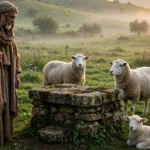
A father climbed a mountain carrying the firewood for his own son’s sacrifice. When Isaac asked where the lamb was, Abraham answered with a sentence that has echoed through three thousand years of faith: “God himself will provide the lamb for the burnt offering, my son.” By the time the two of them came back down that mountain, both understood the depth of those words, and one of the great names of God had been spoken for the first time. That name was Jehovah-Jireh — the Lord will provide.
The story is told in Genesis 22, one of the most concentrated chapters in all of Scripture. God tells Abraham to take Isaac — “your son, your only son, whom you love” — and offer him as a burnt offering in the land of Moriah. Abraham obeys in silence. He rises early, splits the wood, walks three days, binds his son on the altar, and raises the knife. And then heaven intervenes: the angel of the Lord calls his name twice from heaven, and Abraham lifts his eyes to see a ram caught by its horns in a thicket. The substitute is already there, already prepared, before the need has fully arrived. Abraham offers the ram and names the place Yahweh-yireh — “the LORD will provide.”
The name itself repays attention, because the Hebrew word behind “provide” also means “to see.” The place is called both “The LORD will provide” and, in the very next verse, “On the mountain of the LORD it will be provided” — a phrase many translators render “it will be seen.” The two senses belong together: the God who sees provides, and the God who provides has seen. Abraham did not discover a principle about supply chains. He met a Person whose seeing and whose giving are one movement of His heart.
The Test That Taught the Name
To feel what happened on Moriah, we have to reckon with what was being asked. Isaac was not just any son. He was the son of the promise, born when Abraham was a hundred and Sarah was ninety, the living evidence that God keeps impossible promises. Every covenant hope Abraham carried — descendants like the stars, blessing to all nations — ran through this one boy. To surrender him looked like surrendering the promise itself.
Yet Abraham went, and the New Testament tells us why: “Abraham reasoned that God could even raise the dead” (Hebrews 11:19). He did not expect the command to be canceled; he expected God’s character to hold. Notice what he told his servants at the foot of the mountain: “Stay here with the donkey while I and the boy go over there. We will worship and then we will come back to you” (Genesis 22:5). We will come back — a plural his faith supplied before his understanding caught up. Faith narrates the future in God’s voice.
The provision came in two movements. First, the voice from heaven stopped the knife — deliverance from what would have been. Second, the ram appeared — provision of what would be. God had not merely rescued; He had supplied. That double action is the signature of Jireh throughout the Bible: God both withholds the disaster and provides the substitute.
A Golden Thread From Genesis to Revelation
What Abraham learned on that summit was not a one-time miracle but the character of God, and the rest of Scripture keeps proving it. Follow the thread of provision and it appears in every era of the story:
- Manna in the wilderness. When Israel grumbled about hunger in Exodus 16, God rained bread from heaven every morning for forty years. The supply was daily and deliberate — they were told to gather only what each day required — teaching an entire generation that tomorrow’s mercy arrives tomorrow, and that hoarding is unbelief.
- The widow of Zarephath. In 1 Kings 17, during a famine, God sends Elijah to a widow gathering sticks for her final meal. Her jar of flour and jug of oil do not run out. She gave her last portion to the prophet first — provision found her in the act of generosity, not after she was safe.
- The feeding of the multitudes. Jesus takes a boy’s lunch — five loaves and two fish — and feeds five thousand men besides women and children (John 6). The disciples calculated the cost and despaired; Jesus received the small offering and multiplied it. Twelve baskets of fragments remained, because God’s provision overflows the need.
- The sharing church. In Acts 4, believers held everything in common, “and there were no needy persons among them.” God often provides through His people — heaven’s supply moving through human hands.
- Paul’s prison confession. Writing from chains, the apostle declares, “And my God will meet all your needs according to the riches of his glory in Christ Jesus” (Philippians 4:19). The man who had been beaten, shipwrecked, stoned, and imprisoned could sign that promise with full confidence, because he had lived it.
And the greatest provision of all completes the pattern. Romans 8:32 says God “did not spare his own Son, but gave him up for us all.” On Moriah, a ram took Isaac’s place; at Calvary, the Lamb of God took ours. Abraham’s words — “God himself will provide the lamb” — turn out to be prophecy as well as faith. Jehovah-Jireh reaches its fullest meaning at the cross, where God’s seeing of our need and God’s giving of His Son became one eternal act.
What “The Lord Will Provide” Does Not Promise
A true doctrine can be bent into a false comfort, and this one often is. “The Lord will provide” does not mean every desire will be gratified, and it is not a formula for material prosperity. Scripture is blunt about faithful people who suffered: Paul learned to be content “in any and every situation, whether well fed or hungry, whether living in plenty or in want” (Philippians 4:12). The same apostle who wrote the great promise of Philippians 4:19 had known both abundance and need — and counted both as the will of God for him at different times.
What the name does promise is that God will supply what is needed for His purposes in your life, from His own fullness rather than from your resources. David’s testimony stands: “I was young and now I am old, yet I have never seen the righteous forsaken or their children begging bread” (Psalm 37:25). Jesus anchored the same truth in the Father’s character: if God feeds the birds and clothes the lilies, “how much more will he clothe you” (Matthew 6:30). Jireh is not first a promise about our circumstances; it is a name of God — a statement about His nature. He provides because He is the Provider. The gift flows from the character, not the other way around.
Walking Up Your Own Mountain
How does this ancient name speak into the unpaid bill, the uncertain diagnosis, the empty cupboard, the prayer that seems to bounce off the ceiling? Abraham’s example gives us a posture rather than a technique. He did not know how the test would resolve; he only knew whom he was trusting. And there are rhythms that train that kind of trust.
Pray specifically. The Psalms name the need — bread, deliverance, healing — and God is honored by honest dependence, not vague piety. Tell Him exactly what is missing.
Give anyway. The widow of Zarephath gave her last meal first, and the jar never ran dry. Generosity in scarcity sounds like arithmetic in reverse, but it is the logic of Jireh: provision flows toward open hands.
Remember. Israel was commanded to pile stones from the Jordan and keep a jar of manna, because provision forgotten becomes provision doubted. Keep some record of what God has already supplied — a journal, a list, a story told at the table. Memory is the fuel of trust.
Wait in the right direction. Abraham’s servants heard “we will come back” before the ram had appeared. Speak about your future the way God speaks about it: not as a wish, but as a certainty anchored in His character.
The God Who Sees Is the God Who Supplies
We began with a father, a son, a knife, and a ram caught in a thicket — and we end with a name that has carried countless believers through their own mountains. Jehovah-Jireh is the confession that God’s seeing and God’s providing are one act. He saw Abraham’s need and Isaac’s peril, and the substitute was already waiting. He sees your need now, and the provision is already being prepared in the thicket — unseen for the moment, but certain. On the mountain of the Lord, it will be provided.
For those who want to study the name further, the Wikipedia entry on Jehovah-jireh offers a helpful overview of the term’s linguistic background and traditional interpretations — a useful companion to reading Genesis 22 itself with fresh eyes.