Most Christians have experienced a season that felt like more than ordinary difficulty. Prayer felt dry. Temptation pressed harder than usual. Discouragement settled like fog. Relationships frayed. The thought arises: Is this spiritual warfare? The Bible’s answer is yes — but probably not in the way popular culture imagines it. Spiritual warfare in Scripture is not primarily about demons hiding behind every problem, dramatic confrontations, or special techniques. It is about a real, ongoing conflict between God’s kingdom and the powers of darkness — a conflict that is fought mostly in ordinary places: in the mind, in the heart, in relationships, in truth-telling, and in quiet faithfulness.
The Bible’s teaching on spiritual warfare is marked by two balances. First, the enemy is real, but he is defeated. Second, the battle is serious, but the Christian’s posture is standing, not striving. Understanding both balances changes everything.
The Enemy: Real, Powerful, and Already Defeated
Scripture is unambiguous that a personal, intelligent evil exists. Satan — the Hebrew word means “adversary” — is described as a tempter (Matthew 4:3), an accuser (Revelation 12:10), a deceiver (Revelation 12:9), a roaring lion seeking someone to devour (1 Peter 5:8), and the “god of this world” who blinds minds (2 Corinthians 4:4). Demons — fallen angels who followed Satan’s rebellion — are real beings who oppose God’s purposes.
But the Bible is equally clear that Satan is not God’s equal. He is a creature, not a co-god. He cannot be everywhere at once. He cannot read minds. He cannot force a believer to sin. His power is limited by God’s permission — as Job’s story demonstrates, where Satan could only do what God allowed. And his fate is sealed. “The God of peace will soon crush Satan under your feet” (Romans 16:20). The cross was his defeat: “He disarmed the rulers and authorities and put them to open shame, by triumphing over them in him” (Colossians 2:15). Satan is a defeated enemy still fighting a war he has already lost.
That is why the New Testament never tells Christians to be afraid of Satan. It tells them to resist him. “Submit yourselves therefore to God. Resist the devil, and he will flee from you” (James 4:7). The order matters: submit first, then resist. Resistance is not a technique. It is the overflow of a life surrendered to God.
The Battlefield: The Mind, the Heart, and the Church
Where does spiritual warfare actually happen? The Bible locates it in three places, and none of them is a haunted house.
First, the mind. Satan’s primary weapon is deception. He is “a liar and the father of lies” (John 8:44). In the Garden, he did not overpower Eve; he deceived her, twisting God’s words: “Did God actually say…?” (Genesis 3:1). In the wilderness, he tried the same tactic on Jesus, quoting Scripture out of context. The battlefield of the mind is where lies take root: lies about God (“He doesn’t love you”), lies about self (“You are worthless, unforgivable”), lies about sin (“This won’t hurt anyone”), lies about others (“They are your enemy”). Paul describes the Christian’s task as “destroying arguments and every lofty opinion raised against the knowledge of God, and taking every thought captive to obey Christ” (2 Corinthians 10:5). Spiritual warfare begins when a believer recognizes a lie and replaces it with truth.
Second, the heart and the flesh. Not every struggle is demonic. The Bible identifies three enemies: the world, the flesh, and the devil (Ephesians 2:1–3). The flesh — our fallen nature with its desires — is often the more immediate opponent. Many things Christians attribute to spiritual attack are actually the consequences of their own choices, habits, or wounds. Discernment means asking: Is this temptation, or is this a pattern I have fed? Is this oppression, or is this exhaustion? Is this a demon, or is this my own heart? The Bible’s answer is often “your own heart.” “Each person is tempted when he is lured and enticed by his own desire” (James 1:14).
Third, the church and the world. Satan’s strategy is not only individual. He sows division in churches (2 Corinthians 2:10–11), spreads false teaching (1 Timothy 4:1), persecutes believers (Revelation 2:10), and blinds unbelievers to the gospel (2 Corinthians 4:4). The warfare is corporate as well as personal. That is why Paul’s armor passage in Ephesians 6 is addressed to the church as a whole — “you” plural — and why the battle is fought together, not alone.
The Armor: Standing, Not Striving
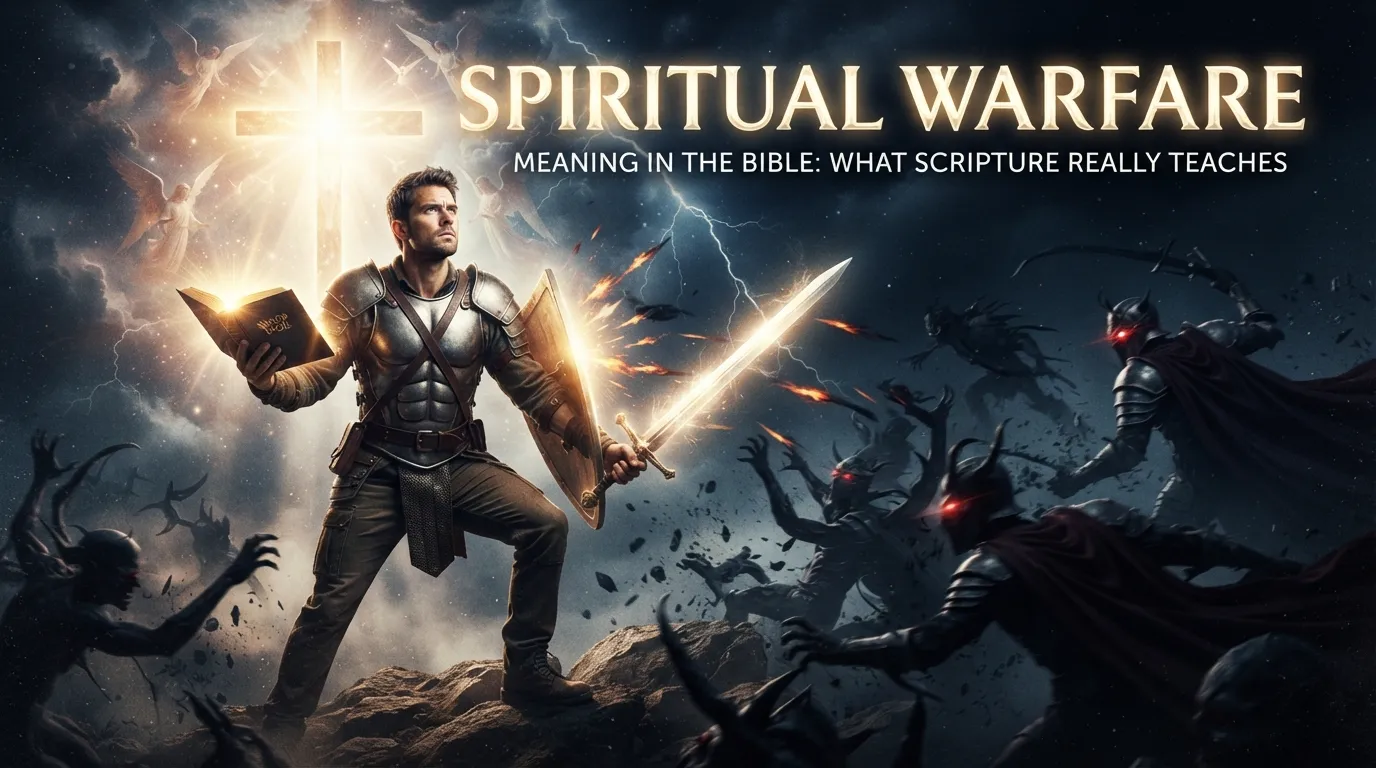
Ephesians 6:10–18 is the Bible’s most detailed passage on spiritual warfare, and its main verb is surprising. Paul does not say “attack.” He says “stand” — four times. “Put on the whole armor of God, that you may be able to stand against the schemes of the devil… having done all, to stand firm. Stand therefore…” (Ephesians 6:11, 13–14). The Christian’s posture in warfare is defensive, not offensive. The victory has already been won by Christ. The believer’s job is to hold the ground Christ conquered.
Each piece of armor is worth examining. The belt of truth: knowing and living by God’s Word, the antidote to Satan’s lies. The breastplate of righteousness: the righteousness of Christ that protects the heart from accusation and guilt. The shoes of the gospel of peace: readiness to carry the good news, which is itself an act of warfare — every conversion is a rescue from the enemy’s territory. The shield of faith: trust in God that extinguishes “the flaming darts of the evil one” — the sudden accusations, fears, and temptations that fly at believers. The helmet of salvation: the assurance of salvation that protects the mind from doubt. The sword of the Spirit, the Word of God: the only offensive weapon, and the one Jesus Himself used in the wilderness (“It is written…”).
Notice what is missing: there is no armor for the back. The soldier of Christ is not equipped to run. And the passage ends not with a technique but with prayer: “praying at all times in the Spirit, with all prayer and supplication” (Ephesians 6:18). Prayer is not the preparation for the battle. Prayer is the battle.
What Spiritual Warfare Is NOT
The Bible’s sober teaching corrects several popular misunderstandings. First, spiritual warfare is not about seeing a demon behind every problem. Illness is usually illness. Depression is usually depression — a medical, emotional, and spiritual reality that deserves compassionate care, not exorcism. Conflict is usually conflict. Christians should not spiritualize what is natural, nor naturalize what is spiritual. Wisdom knows the difference.
Second, spiritual warfare is not about special formulas, objects, or rituals. The Bible never teaches that believers need anointed oil, specific phrases, or particular postures to defeat Satan. The seven sons of Sceva tried to use Jesus’ name as a magic formula and were beaten by the demon they tried to cast out (Acts 19:13–16). Authority in spiritual warfare comes from belonging to Christ, not from techniques.
Third, spiritual warfare is not about fear. Christians who live in terror of demons have misunderstood the gospel. “Greater is he that is in you than he that is in the world” (1 John 4:4). The Holy Spirit in a believer is greater than any power of darkness. Fear is itself one of the enemy’s weapons — and it is disarmed by the truth of Christ’s victory.
Fourth, spiritual warfare is not a reason to avoid practical help. A believer struggling with addiction needs counseling and accountability, not just prayer. A believer with depression may need medical treatment. God works through doctors, therapists, friends, and wise counsel as well as through prayer. Refusing practical help in the name of “spiritual warfare” is not faith; it is foolishness.
The War Is Already Won: Living from Victory
There is a difference between fighting for victory and fighting from victory, and it changes everything about spiritual warfare. A soldier fighting for victory is anxious — the outcome is uncertain, and everything depends on his performance. A soldier fighting from victory is confident — the outcome is settled, and his job is to hold ground that has already been won. Christians are in the second position. The decisive battle was fought at the cross, where Jesus “disarmed the rulers and authorities” (Colossians 2:15), and at the empty tomb, where death itself was defeated. Satan’s defeat is not a future hope; it is a past fact. What remains is the mopping-up operation — the resistance of a defeated enemy who knows his time is short (Revelation 12:12) and fights with the desperation of the doomed. That is why the New Testament’s tone about spiritual warfare is calm, not frantic. Believers are not called to win the war. They are called to stand in the victory Christ has already won, resist the enemy’s lies, and watch the defeated foe flee.
How to Fight — and Win
The Bible’s strategy for spiritual warfare is simpler than most books on the subject suggest. Know the truth, and tell it to yourself daily — especially the gospel truths about who God is and who you are in Christ. Resist temptation at the first thought, before it takes root. Confess sin quickly, because unconfessed sin is an open door. Stay in community, because isolated Christians are vulnerable Christians. Pray constantly, because prayer is dependence on the One who has already won. And keep your eyes on Jesus — not on the devil. Christians who stare at the enemy become fearful. Christians who stare at Christ become fearless.
The war is real. The enemy is defeated. The armor is provided. The victory is certain. And the One who fights for you has already won. For a survey of how Christian traditions have understood spiritual warfare, see the Wikipedia article on spiritual warfare.










