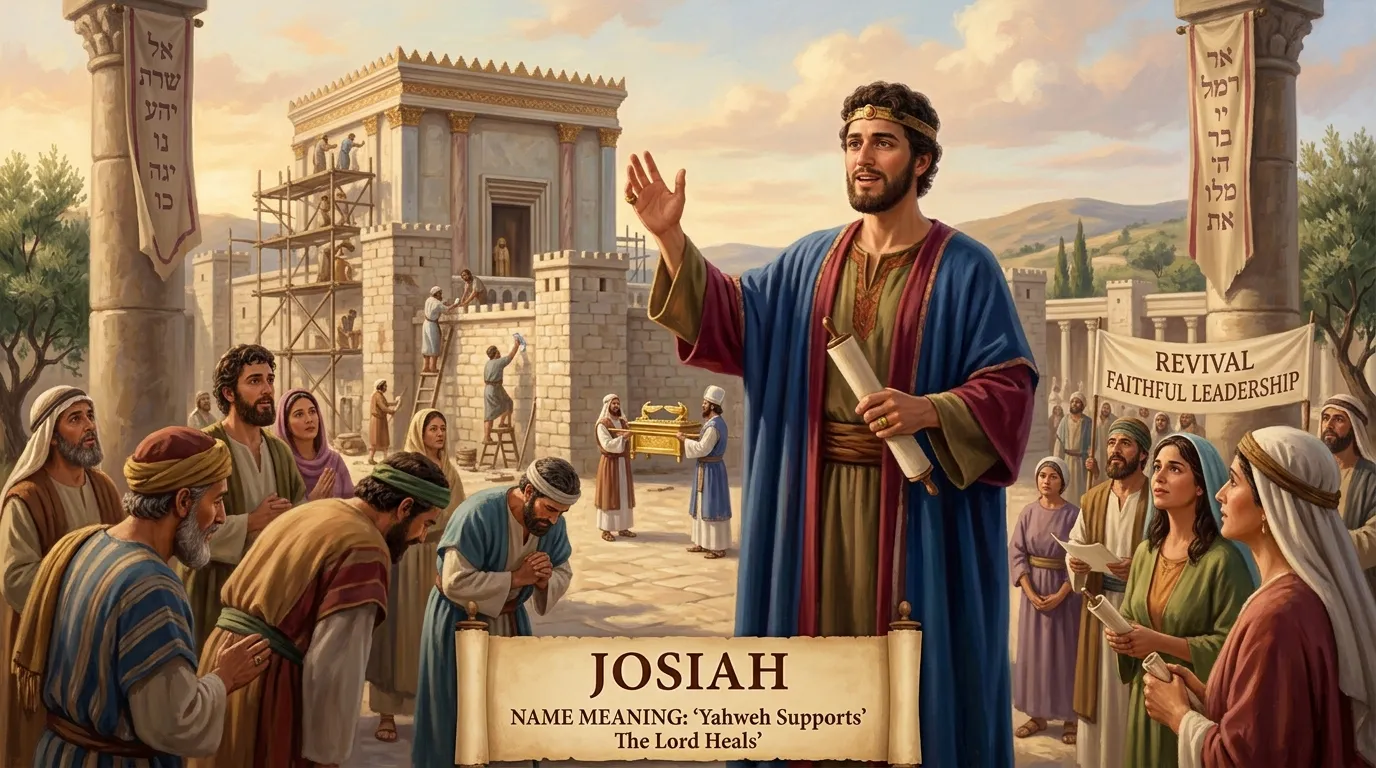
He was eight years old when they put the crown on him. Eight — an age when most children are learning to read chapter books. Josiah inherited a kingdom soaked in idolatry: his grandfather Manasseh had filled Jerusalem with altars to foreign gods and even sacrificed his own son in the fire (2 Kings 21:6), and his father Amon had continued the evil for a brief, violent two years before being assassinated (2 Kings 21:19-23).
Nobody expected revival from this child. Nobody expected anything, really, except more of the same. What happened instead is one of the most startling turnarounds in all of Scripture — and it began, of all things, with a repair project.
The Name He Was Given
Josiah’s name is itself a small prophecy. In Hebrew, Yoshiyahu (יֹאשִׁיָּהוּ) combines the divine name Yahweh with a root meaning to heal, to support, or to grant — most scholars render it “Yahweh heals” or “Yahweh supports.” Some even hear in it “Yahweh will grant,” as though the name anticipated what God would grant through him.
Names in Scripture often describe destinies, and Josiah’s proved true in the deepest sense. He would become the king through whom God “healed” a nation — not permanently, for Judah’s wound ran too deep, but genuinely, for a generation. When God wants to signal what He is about to do, He sometimes starts with what a child is called.
The Book Nobody Had Read
In the eighteenth year of Josiah’s reign — he is now twenty-six — the king orders repairs to the temple, which has been neglected for decades. During the work, the high priest Hilkiah makes a discovery that should stagger us: “I have found the book of the law in the house of the LORD” (2 Kings 22:8). The Book of the Law. In the temple. Lost. God’s Word had been misplaced in God’s own house, possibly for generations.
Hilkiah hands it to Shaphan the scribe, who reads it before the king. And Josiah’s response is immediate and physical: “when the king had heard the words of the book of the law, that he rent his clothes” (2 Kings 22:11). Tearing one’s garments was the ancient gesture of horror and grief. The twenty-six-year-old king hears the covenant curses — the warnings of what disobedience brings — and understands in a single sitting what his nation has been doing.
Pause on this: revival did not begin with a strategy, a program, or a personality. It began with reading. The Word, long ignored, was opened — and a heart that was soft toward God did the rest. “Because thine heart was tender, and thou hast humbled thyself before the LORD, when thou heardest what I spake” (2 Kings 22:19). Tenderness of heart is Josiah’s defining trait, mentioned before any of his achievements. God can work with a tender heart. He cannot work with a hard one.
The Reforms: Tearing Down to Build Up
What follows in 2 Kings 23 is the most thorough religious purge in Judah’s history. Josiah does not nibble at idolatry; he demolishes it:
- He burns the vessels made for Baal and Asherah and removes the idolatrous priests (2 Kings 23:4-5).
- He brings out the Asherah pole from the temple, burns it, and scatters its ashes on common graves (2 Kings 23:6).
- He tears down the houses of the ritual prostitutes attached to the temple (2 Kings 23:7).
- He defiles Topheth, where children had been sacrificed to Molech, “that no man might make his son or his daughter to pass through the fire” (2 Kings 23:10).
- He even extends the purge north into the ruins of Israel, fulfilling a prophecy made centuries earlier — by name. A prophet had foretold that “a child shall be born unto the house of David, Josiah by name” who would desecrate Jeroboam’s altar (1 Kings 13:2). Josiah does exactly that (2 Kings 23:15-16), three hundred years after the prediction.
The scope is breathtaking. This is not moderation; it is surgery. Josiah understood what comfortable religion forgets: you cannot add the worship of God to the worship of idols. The idols have to go — all of them, publicly, irreversibly.
The Passover Like No Other
With the land cleansed, Josiah turns to celebration. He commands the greatest Passover in generations: “Surely there was not holden such a passover from the days of the judges… neither did all the kings of Israel, nor the kings of Judah, keep such a passover” (2 Kings 23:22). Second Chronicles 35 describes the scene — tens of thousands of lambs, the priests and Levites in their places, the whole nation remembering the Exodus together.
The order matters: purge, then Passover. Repentance, then rejoicing. Josiah does not try to celebrate redemption while clinging to idols; he clears the ground and then fills it with worship. Revival always follows this sequence. Joy that skips repentance is entertainment. Repentance that never reaches joy is incomplete.
The Tragedy at Megiddo
Josiah’s story does not end the way we want it to. In 609 BC, Pharaoh Neco marches north to assist Assyria, and Josiah — for reasons Scripture does not fully explain — goes out to oppose him at Megiddo. Neco even warns him: “What have I to do with thee, thou king of Judah? I come not against thee this day… forbear thee from meddling with God, who is with me, that he destroy thee not” (2 Chronicles 35:21). Josiah disguises himself, enters the battle anyway, and is struck by archers. He dies at thirty-nine.
It is a sobering coda. Even the best king can make a fatal misjudgment; even a tender heart can overreach. Yet Scripture’s verdict on Josiah never wavers: “And like unto him was there no king before him, that turned to the LORD with all his heart, and with all his soul, and with all his might, according to all the law of Moses; neither after him arose there any like him” (2 Kings 23:25). God measures the life, not just the death.
Huldah: The Prophetess Who Confirmed It All
One detail of Josiah’s story deserves its own spotlight, because it corrects a modern assumption. When the Book of the Law is found and the king is terrified, he sends a delegation to inquire of the LORD — and they go to Huldah the prophetess (2 Kings 22:14). In a crisis of national proportions, with priests and scribes available, God’s word comes through a woman.
Huldah’s prophecy is unflinching: judgment on Judah is certain — “I will bring evil upon this place” (2 Kings 22:16) — but Josiah personally will be spared: “because thine heart was tender… I also have heard thee, saith the LORD” (2 Kings 22:19). She speaks with full prophetic authority — “Thus saith the LORD God of Israel” — and the king and the nation accept her word without question.
Scripture never treats this as unusual. Deborah judged Israel (Judges 4:4), Miriam is called a prophetess (Exodus 15:20), Anna prophesies in the temple (Luke 2:36). Huldah stands in that line: when God wants to speak decisively, He is not limited by human categories. And note what her presence proves about Josiah’s reforms — this was not a boys’ club of power but a genuine return to God’s word, wherever that word was found. When the church marginalizes women’s voices, it risks missing the Huldahs — the very messengers God has appointed for the hour.
What Josiah Still Teaches
It is never too late — and never too early. Josiah began seeking God at sixteen (2 Chronicles 34:3) and reformed a nation by twenty-six. Youth is no barrier to God, and a ruined inheritance is no excuse.
The Word must be found again. Every generation risks losing the Book in the temple — possessing Scripture while ignoring it. Revival starts the same way every time: open it, read it, let it cut.
Tenderness precedes transformation. Before the reforms came the torn clothes. God did not use Josiah because he was powerful; He used him because he was soft. “To this man will I look, even to him that is poor and of a contrite spirit, and trembleth at my word” (Isaiah 66:2).
God uses the young and the overlooked. Josiah was eight when crowned; Huldah the prophetess was consulted when priests were available; the Book was found by workmen doing repairs. Revival rarely starts with the obvious candidates. If you feel too young, too ordinary, or too late — you are exactly the kind of person God has always used.
Obedience has a limit God honors anyway. Josiah could not ultimately save Judah — the nation’s judgment was decreed (2 Kings 23:26-27). But God delayed it “because thine heart was tender” (2 Kings 22:19), granting peace in Josiah’s lifetime. Faithfulness matters even when it cannot reverse everything. The Wikipedia article on Josiah lays out the historical and archaeological backdrop of his reign; the biblical account adds what history alone cannot give — the portrait of a boy king whose soft heart changed a nation, and whose name meant healing.










