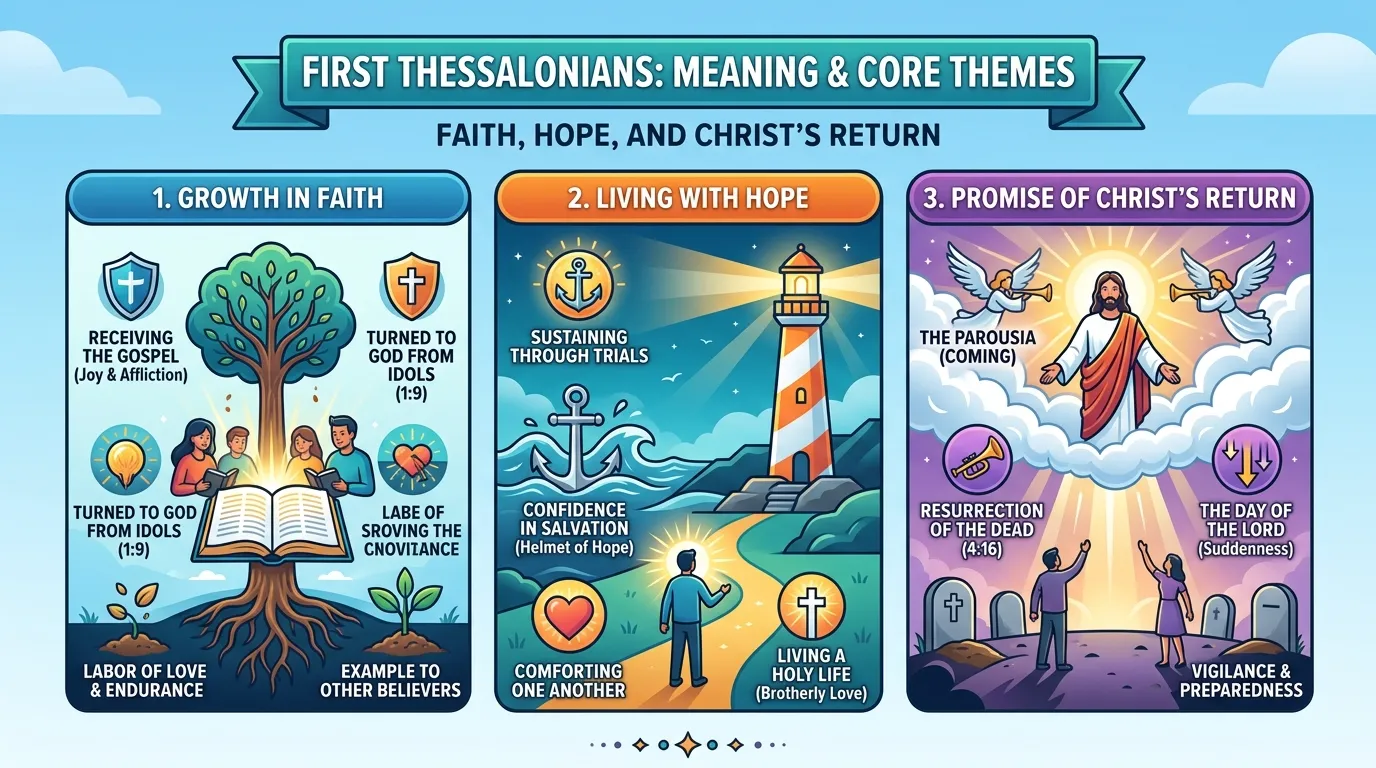
Every letter of Paul has a heartbeat — a central conviction that drives everything else. In First Thessalonians, the heartbeat is a threefold cord Paul names in the very first chapter: “your work produced by faith, your labor prompted by love, and your endurance inspired by hope in our Lord Jesus Christ” (1 Thessalonians 1:3). Faith, love, and hope. The whole letter can be read as an unfolding of those three words. If you want to understand what First Thessalonians means, follow that thread.
This article takes that thematic approach: rather than walking through the letter chapter by chapter, it traces how faith, love, and hope each shape the life of the Thessalonian church — and what each one asks of us today.
Faith That Works
Paul does not describe the Thessalonians’ faith as a set of beliefs they held. He describes it as work. “Work produced by faith” — faith that gets its hands dirty. What did that work look like? The Thessalonians had “turned to God from idols to serve the living and true God” (1 Thessalonians 1:9). In a city full of temples, civic cults, and emperor worship, that turn was costly. It meant breaking with old loyalties, old habits, and old social circles. Faith, for them, was not a private opinion. It was a public reorientation.
Paul also notes that their faith “rang out” — the Greek word suggests a trumpet blast — across Macedonia and Achaia (1 Thessalonians 1:8). They had become examples to believers everywhere. This is striking because the church was brand new and under pressure. They had no buildings, no programs, no history. They had a gospel that had come to them “with power, with the Holy Spirit and deep conviction” (1 Thessalonians 1:5), and lives that showed it. Their faith worked because it was real, and it spread because it was visible.
The letter later connects faith to daily conduct. Paul urges the Thessalonians to live to please God, to control their own bodies in holiness, to love one another, and to work with their hands (1 Thessalonians 4:1–12). Faith that works does not float above daily life; it enters it. It shapes how we handle our bodies, our money, our work, and our neighbors. A faith that never touches Monday morning is not the faith Paul celebrated in Thessalonica.
Love That Labors
The second strand is love — and Paul pairs it with labor. Love, in this letter, is not sentiment. It is effort. The Thessalonians’ love showed up in how they treated one another and how they received Paul’s team. Paul reminds them that he and his companions had been “gentle among you, like a mother caring for her little children,” and that they had shared not only the gospel but their lives (1 Thessalonians 2:7–8). That is the texture of love that labors: it gives time, presence, and tenderness, not just words.
Paul’s instructions about love are practical. “Now about your love for one another we do not need to write to you,” he says, “for you yourselves have been taught by God to love each other” (1 Thessalonians 4:9). Then he urges them to do so “more and more.” Love is both a gift and a growth project. The Thessalonians already loved well; Paul wanted them to love more. He gives that love a specific shape: respect those who work hard among you, hold them in the highest regard, live in peace, warn the idle, encourage the disheartened, help the weak, be patient with everyone, and never repay evil with evil (1 Thessalonians 5:12–15). That is love as a daily discipline, not a feeling.
There is also a quiet lesson in how Paul handles conflict. He does not scold the Thessalonians for their struggles. He thanks God for them, tells them what he loves about them, and then gently instructs them. Love that labors corrects without crushing. It tells the truth with a tenderness that makes the truth receivable. Churches that learn that tone — truth wrapped in affection — become places where people can actually grow.
Hope That Endures
The third strand, hope, is the one that gives the letter its staying power. The Thessalonians were enduring persecution, and some of their number had died. Their hope was under pressure from two directions: suffering in the present and grief about the future. Paul’s answer to both is the return of Christ.
Hope, for Paul, is not optimism. It is not the feeling that things will probably work out. It is a confident expectation anchored in a past event: the resurrection of Jesus. “For we believe that Jesus died and rose again,” Paul writes, “and so we believe that God will bring with Jesus those who have fallen asleep in him” (1 Thessalonians 4:14). The logic is tight: because Christ rose, those who belong to Him will rise too. Grief is real, but it is not the last word. Christians grieve — Paul never denies that — but they do not grieve “like the rest of mankind, who have no hope” (1 Thessalonians 4:13).
Hope also produces endurance. That is why Paul ties hope to waiting: the Thessalonians were “waiting for his Son from heaven” (1 Thessalonians 1:10). Waiting, in Scripture, is not passive. It is active readiness — staying awake, staying sober, putting on faith and love as a breastplate and the hope of salvation as a helmet (1 Thessalonians 5:8). Hope endures because it knows the story’s ending. The day of the Lord will come, and those who belong to Christ will be with Him forever. That promise does not remove suffering, but it reframes it: suffering is a chapter, not the whole book.
Questions the Thessalonians Asked — and We Still Ask
It helps to name the questions behind the letter, because they are our questions too. What happens to believers who die before Christ returns? Paul’s answer: they are not lost. They will rise first, and we will be caught up together with them. No one is left behind. When will Christ return? Paul’s answer: no one knows, and anyone who claims to know is not speaking for God. The day will come like a thief in the night — suddenly, unexpectedly. How then should we live? Paul’s answer: awake, sober, grateful, encouraging one another, doing good, praying continually, and holding on to what is good.
Notice the pattern: every doctrinal answer ends in a practical instruction. Paul does not give the Thessalonians a timeline; he gives them a way to live. That is worth remembering in every generation that becomes obsessed with end-times charts. The point of prophecy, in First Thessalonians, is not speculation. It is comfort for the grieving and steadiness for the fearful: “Therefore encourage one another and build each other up” (1 Thessalonians 5:11).
Encouragement as a Ministry
One word in First Thessalonians deserves its own attention: encourage. Paul uses it again and again — “encourage one another,” “build each other up,” “encourage the disheartened.” In a letter to a persecuted church, encouragement is not a pleasantry. It is a ministry. Paul knew that persecuted believers do not only need doctrine. They need people who will stand beside them and say, “Hold on. You are not alone. God is faithful.”
Paul models encouragement in the letter itself. He thanks God for the Thessalonians. He tells them how he remembers them in prayer. He reminds them of what they have already endured and how well they have endured it. He shares his own longing to see them. Then, and only then, does he instruct them. Encouragement, in Paul’s hands, is not empty cheerleading. It is truth spoken with affection — the reminder of what God has done, what God has promised, and who the believers already are in Christ.
That is a ministry every believer can practice. You do not need a title to encourage someone. You need attention: notice who is struggling, speak the truth about God’s faithfulness, and remind them of the hope that anchors them. In a world that is quick to criticize and slow to comfort, encouragement is one of the most countercultural things a church can do — and one of the most needed.
Three Anchors for Today
First Thessalonians is nearly two thousand years old, but its three anchors hold. Faith that works asks whether our beliefs have reached our hands and feet. A faith that never serves, gives, or changes anything may not be faith at all. Love that labors asks whether our relationships carry the weight of real commitment — patience with the difficult, help for the weak, gentleness with the wounded. Hope that endures asks whether our grief and fear have met the resurrection. If Christ is risen, then no loss is final and no waiting is wasted.
Paul closes the letter with a blessing that gathers all three strands: “May God himself, the God of peace, sanctify you through and through… The one who calls you is faithful, and he will do it” (1 Thessalonians 5:23–24). The letter begins with thanksgiving for what God has done in Thessalonica and ends with confidence in what God will do. Between those two poles, faith works, love labors, and hope endures — and the church, in any age, stands firm. For the story of the city where this young church took root, see the Wikipedia article on ancient Thessalonica.