Imagine a young believer trying to follow God while feeling unsure, nervous, or too young for the work ahead. He may wonder, Can God really use me? The Bible gives us a beautiful answer through the life of Timothy. The Timothy meaning in the Bible is closely connected with the idea of honoring or worshiping God. Timothy was a young Christian leader, a trusted friend of the apostle Paul, and a faithful servant of Jesus Christ.
His story is not mainly about having a perfect life. It is about learning, growing, serving, and remaining faithful to God. Timothy’s life can encourage anyone who feels weak, young, unprepared, or afraid to step into God’s calling.
Timothy Meaning in the Bible
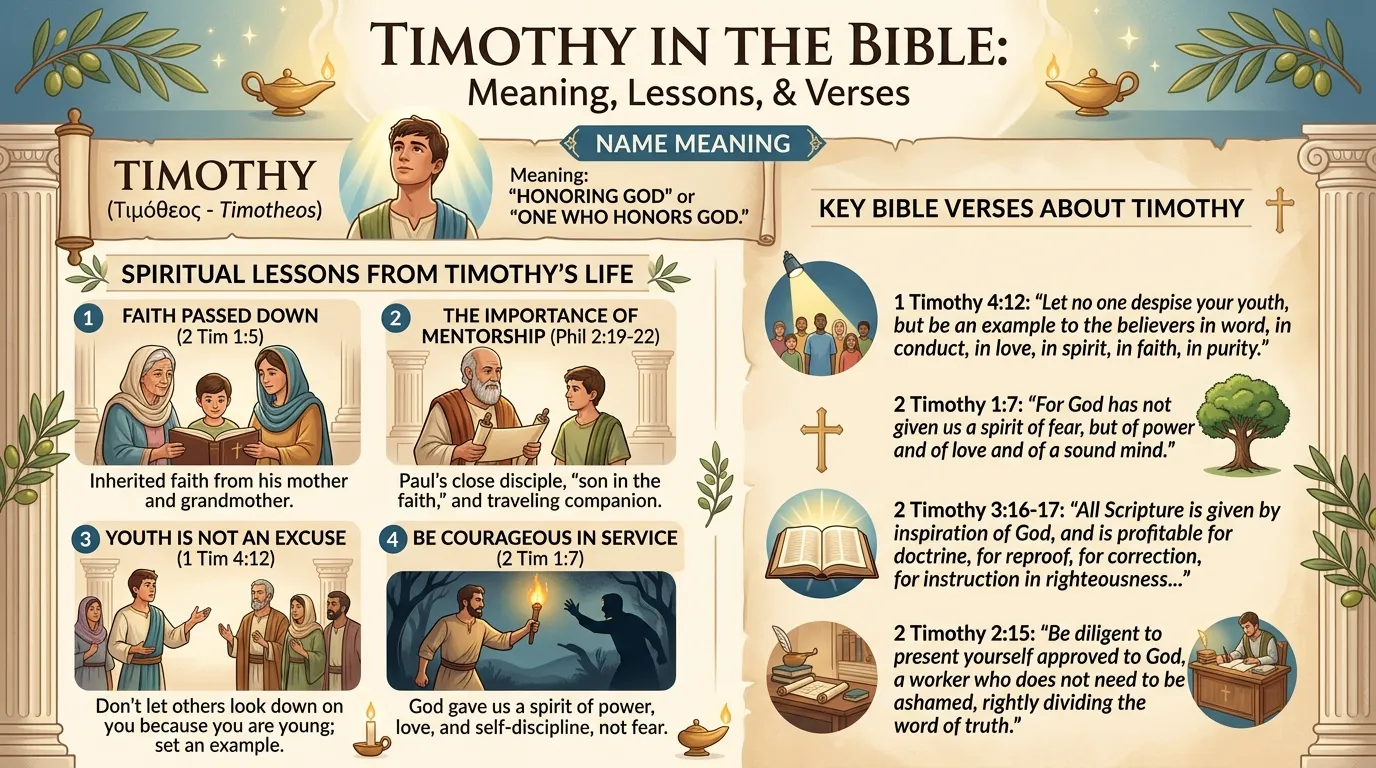
The name Timothy comes from the Greek name Timotheos. It is commonly understood to mean honoring God, honored by God, or one who honors God.
The first meaning is especially helpful when we look at Timothy’s life in Scripture. He was known as a believer who served God faithfully and worked with Paul to spread the gospel.
The Bible introduces Timothy as a disciple with a good reputation among believers.
In Acts 16:1–3, Paul meets Timothy in Lystra. Timothy had a Jewish mother who was a believer and a Greek father. Paul chose Timothy to travel with him in ministry.
This shows something important about his name and life. Timothy did not merely carry a name connected with God. His life became an example of devotion to God.
Timothy Hebrew Meaning
A common question is, What is the Hebrew meaning of Timothy?
Timothy is not originally a Hebrew name. It comes from the Greek Timotheos. Therefore, it does not have a direct Hebrew etymology in the same way that Hebrew biblical names such as David, Samuel, or Isaiah do.
The Greek name is connected to two ideas:
- Timē, meaning honor or respect
- Theos, meaning God
Together, the name carries the sense of honoring God or one who honors God.
Some Christian resources may connect Timothy’s meaning with Hebrew concepts such as honoring God, but this should not be confused with saying that Timothy itself is a Hebrew name.
The Bible gives us a stronger reason to appreciate the name. Timothy’s life demonstrates what it can look like to honor God through faith, obedience, service, and perseverance.
Who Was Timothy in the Bible?
Timothy was one of Paul’s closest ministry companions. His story appears mainly in Acts and in Paul’s letters known as 1 Timothy and 2 Timothy.
Paul refers to Timothy with great affection. In 1 Corinthians 4:17, Paul calls Timothy his beloved and faithful child in the Lord. This shows that their relationship was more than a ministry partnership. Paul cared about Timothy’s spiritual growth.
Timothy also had a strong spiritual foundation at home.
Paul reminds him in 2 Timothy 1:5 of the sincere faith that first lived in his grandmother Lois and his mother Eunice. Their faith had helped shape Timothy’s own walk with God.
This gives Christian families an encouraging lesson:
Faithful teaching and example can have a lasting influence on the next generation.
Parents and grandparents may not always see the results of their prayers and teaching immediately. Timothy’s story shows that spiritual influence can grow over time.
Timothy’s Family and Faith
Timothy’s mother, Eunice, and grandmother, Lois, are important parts of his biblical story.
Paul tells Timothy in 2 Timothy 3:14–15 to continue in what he had learned. He reminds Timothy that he had known the Holy Scriptures from childhood.
This is a beautiful picture of Christian discipleship.
Timothy did not suddenly become spiritually mature. He learned God’s Word over many years. His family helped him understand Scripture, and later Paul helped train him for ministry.
Spiritual growth often happens through faithful people, patient teaching, and daily time in God’s Word.
This can encourage anyone who feels that their quiet spiritual work does not matter. Teaching a child to pray, reading Scripture with a family member, encouraging a new believer, or simply living faithfully can have a lasting impact.
Timothy and the Apostle Paul
Paul trusted Timothy with important ministry responsibilities.
In Acts 16, Timothy joins Paul’s missionary work. From that point forward, Timothy becomes an important part of Paul’s ministry team.
Paul sent Timothy to help churches and strengthen believers.
For example, Paul sent Timothy to Thessalonica because he wanted the believers there to remain strong in their faith during hardship. First Thessalonians 3:2 describes Timothy as a servant of God who was sent to strengthen and encourage the church.
This gives us a practical meaning of Timothy’s story:
God can use ordinary people to bring strength and encouragement to others.
Timothy did not need to be the most famous person in the room. He needed to be faithful.
What Does Timothy Teach Us About Serving God?
Timothy’s life teaches several important lessons about Christian service.
God Can Use Young Believers
Paul’s words to Timothy in 1 Timothy 4:12 are among the best-known verses connected with his life:
“Let no man despise thy youth; but be thou an example of the believers…” — 1 Timothy 4:12, KJV
Paul did not tell Timothy to wait until he became older before living faithfully.
Instead, Timothy was told to become an example through his speech, conduct, love, faith, and purity.
This is important for young Christians today. Age does not prevent someone from showing Christ’s character.
A teenager can encourage a friend. A young adult can serve the church. A new believer can share what God is teaching them.
Christian maturity is shown through faithful character, not simply through age.
God Gives Strength to Those Who Serve Him
Timothy appears to have struggled with fear and timidity at times.
Paul writes in 2 Timothy 1:7:
“For God hath not given us the spirit of fear; but of power, and of love, and of a sound mind.”
The verse does not mean Christians will never feel afraid. Instead, it reminds believers that fear does not have to control their lives.
Timothy needed courage to continue his ministry.
Likewise, you may feel nervous when God places an opportunity in front of you. You may feel unqualified to speak, serve, lead, forgive, or begin again.
Timothy’s story reminds us to depend on God’s strength rather than our own confidence.
Timothy and the Importance of Scripture
One of Paul’s strongest instructions to Timothy concerns Scripture.
In 2 Timothy 3:16–17, Paul teaches that all Scripture is inspired by God and useful for teaching, correction, and training in righteousness.
This was not merely a lesson for Timothy. It remains important for Christians today.
When emotions are confusing, God’s Word gives truth.
When culture sends mixed messages, Scripture gives a firm foundation.
When we make mistakes, Scripture teaches us about repentance and grace.
When we feel discouraged, Scripture points us back to God’s faithfulness.
A Christian should test spiritual ideas against God’s Word rather than allowing feelings alone to become the guide.
Timothy’s Name and Spiritual Symbolism
The name Timothy can provide a meaningful spiritual picture because it is connected with honoring God.
However, the Bible does not teach that the name Timothy gives a person a special spiritual destiny. We should avoid treating biblical names as magical signs or promises.
Instead, Christians can reflect on the name as a reminder of a biblical value.
To honor God means to recognize His worth and live in a way that reflects devotion to Him.
That can happen through:
- Honest words
- Faithful work
- Prayer
- Serving others
- Forgiving people
- Studying Scripture
- Showing love
- Remaining faithful during hardship
The deepest lesson is not simply what Timothy’s name means. It is how Timothy lived out his faith.
Timothy Meaning in Dreams
Some people search for the Timothy meaning in the Bible because they have dreamed about someone named Timothy or repeatedly noticed the name.
The Bible does contain examples of God using dreams. For example, Joseph received important dreams in Genesis, and Joseph, the husband of Mary, received divine guidance through dreams in Matthew 1–2.
However, Scripture does not teach that every dream contains a hidden message from God.
Therefore, seeing the name Timothy in a dream does not automatically mean that God is giving you a specific prophecy.
A dream about Timothy could simply be connected to your memories, relationships, thoughts, or experiences.
If you believe a dream may have spiritual significance, test it carefully against Scripture.
Ask:
- Does the interpretation agree with God’s Word?
- Does it point toward Christ and godly character?
- Am I treating a personal impression as though it were biblical truth?
- Could the dream simply reflect something I have been thinking about?
- Have I prayed for wisdom rather than assuming an answer?
Scripture should remain the final authority, not a dream or personal feeling.
Timothy Meaning in Real Life Experiences
The name Timothy may also stand out during important seasons of life.
For example, perhaps you meet someone named Timothy when you are beginning a new ministry. Maybe you read 1 Timothy during a difficult season. Or perhaps Timothy’s story comes to mind when you feel too young or inexperienced to serve God.
These moments can encourage personal reflection.
But Christians should be careful not to turn ordinary events into guaranteed signs from God.
Instead, ask what clear biblical truth applies to your situation.
If Timothy’s story reminds you to be faithful, courageous, teachable, and grounded in Scripture, that is a healthy application.
God’s guidance should lead us toward biblical wisdom rather than superstition.
Important Bible Verses About Timothy
Several passages help us understand Timothy’s character and ministry.
Acts 16:1–3
This passage describes Paul’s meeting with Timothy and his decision to take him along in ministry.
It shows Timothy beginning a significant season of Christian service.
1 Corinthians 4:17
Paul describes Timothy as a faithful child in the Lord.
This highlights the trust Paul had in Timothy.
1 Timothy 4:12
Paul tells Timothy not to let others look down on him because of his youth.
Instead, he should become an example in speech, conduct, love, faith, and purity.
2 Timothy 1:5
Paul remembers the sincere faith of Timothy’s grandmother Lois and mother Eunice.
This verse highlights the spiritual influence of family.
2 Timothy 1:7
Paul reminds Timothy that God gives power, love, and a sound mind rather than a spirit controlled by fear.
2 Timothy 2:15
Paul encourages Timothy to present himself to God as a worker who handles the word of truth correctly.
This is a strong reminder that Christian service should be connected to careful understanding of Scripture.
2 Timothy 3:14–17
Paul tells Timothy to continue in what he learned and points him back to the Holy Scriptures.
These verses strongly connect Timothy’s ministry with God’s Word.
2 Timothy 4:2
Paul tells Timothy to preach the Word and remain faithful to his responsibility.
This shows that Timothy’s calling involved persistence, even when ministry was difficult.
What Does Timothy Mean Spiritually?
From Timothy’s story, several spiritual lessons stand out.
Honor God with your life.
The meaning of Timothy’s name can remind us that worship is more than singing. We honor God through the way we live.
Do not let fear stop faithful obedience.
Timothy needed encouragement to remain courageous.
Learn from faithful believers.
Paul, Lois, and Eunice all played important roles in Timothy’s spiritual development.
Stay grounded in Scripture.
Timothy was repeatedly directed toward God’s Word.
Serve others with humility.
Timothy’s ministry involved strengthening and helping other believers.
Keep growing.
Timothy was not presented as someone who knew everything. He was a disciple who continued learning.
How Christians Can Apply Timothy’s Story Today
Timothy’s example can become very practical in everyday life.
If you are a student, you can honor God by being honest in your work and treating others with kindness.
If you are a parent, you can follow the example of Lois and Eunice by teaching your children God’s Word and showing faith through your actions.
If you are young and feel overlooked, remember Paul’s encouragement in 1 Timothy 4:12. You can be an example right now.
If you are older, you can invest in younger believers through prayer, encouragement, teaching, and friendship.
If you feel afraid, remember 2 Timothy 1:7 and ask God for courage, love, wisdom, and self-control.
If you feel spiritually weak, return to Scripture rather than depending only on your emotions.
Faithfulness in small things can become part of a much larger work God is doing.
Is Timothy a Good Biblical Name?
Yes. Timothy is a meaningful biblical name with a strong connection to honoring God.
It is especially meaningful because Timothy was a real person in the New Testament who served Christ and helped strengthen the early church.
The name can remind a Christian family of values such as:
- Faith
- Honor
- Service
- Courage
- Biblical wisdom
- Spiritual growth
- Faithfulness
Still, the Bible does not say that choosing the name Timothy guarantees a particular future for a child. A name can carry beautiful meaning, but a person’s character is shaped through faith, choices, relationships, and God’s grace.
Frequently Asked Questions
What does Timothy mean in the Bible?
Timothy comes from the Greek Timotheos and is commonly understood to mean honoring God or one who honors God. Timothy was Paul’s trusted ministry companion and a leader in the early Christian church.
Is Timothy a Hebrew name?
No. Timothy is a Greek name, not originally a Hebrew name. Its meaning comes from Greek words associated with honor and God.
What does Timothy symbolize spiritually?
The name can serve as a reminder of honoring God through faithful living. Timothy’s biblical story also points to courage, service, spiritual growth, and commitment to Scripture.
What is Timothy known for in the Bible?
Timothy is known for serving alongside Paul, strengthening churches, teaching believers, and faithfully carrying out his ministry responsibilities. Paul addressed two New Testament letters directly to him.
What does 1 Timothy 4:12 teach?
First Timothy 4:12 teaches Timothy not to allow his youth to become a reason for others to dismiss him. Paul calls him to be an example through his words, behavior, love, faith, and purity.
What can Timothy teach young Christians?
Timothy shows that young believers can live faithfully, serve others, learn Scripture, and become examples of Christian character. You do not have to wait until you feel completely ready to begin following God faithfully.
Does dreaming about Timothy have a biblical meaning?
The Bible does not provide a fixed meaning for dreaming about someone named Timothy. Dreams should not automatically be treated as divine messages. Any spiritual interpretation should be tested carefully against Scripture.
Final Thoughts
The Timothy meaning in the Bible points us toward the beautiful idea of honoring God. Yet Timothy’s story gives that meaning a deeper shape. He honored God through service, faithfulness, learning, courage, and care for other believers.
His life also reminds us that God can work through people who feel young, weak, or unprepared.
You may not feel ready for everything in front of you. You may sometimes struggle with fear or wonder whether your efforts matter. Timothy’s story offers a gentle reminder: God can use a faithful heart that is willing to learn and obey Him.
So, if the name Timothy has become meaningful to you, let it lead you back to Scripture rather than superstition. Pray for wisdom. Study God’s Word. Follow Christ faithfully. Encourage someone who needs hope.
And remember the lesson Paul gave Timothy: your life can become an example of faith, love, purity, and godly character.
May you continue to trust God even when the path is unclear, knowing that His grace is sufficient and His wisdom is greater than our own. Honor God in the small things today, and leave tomorrow in His hands.