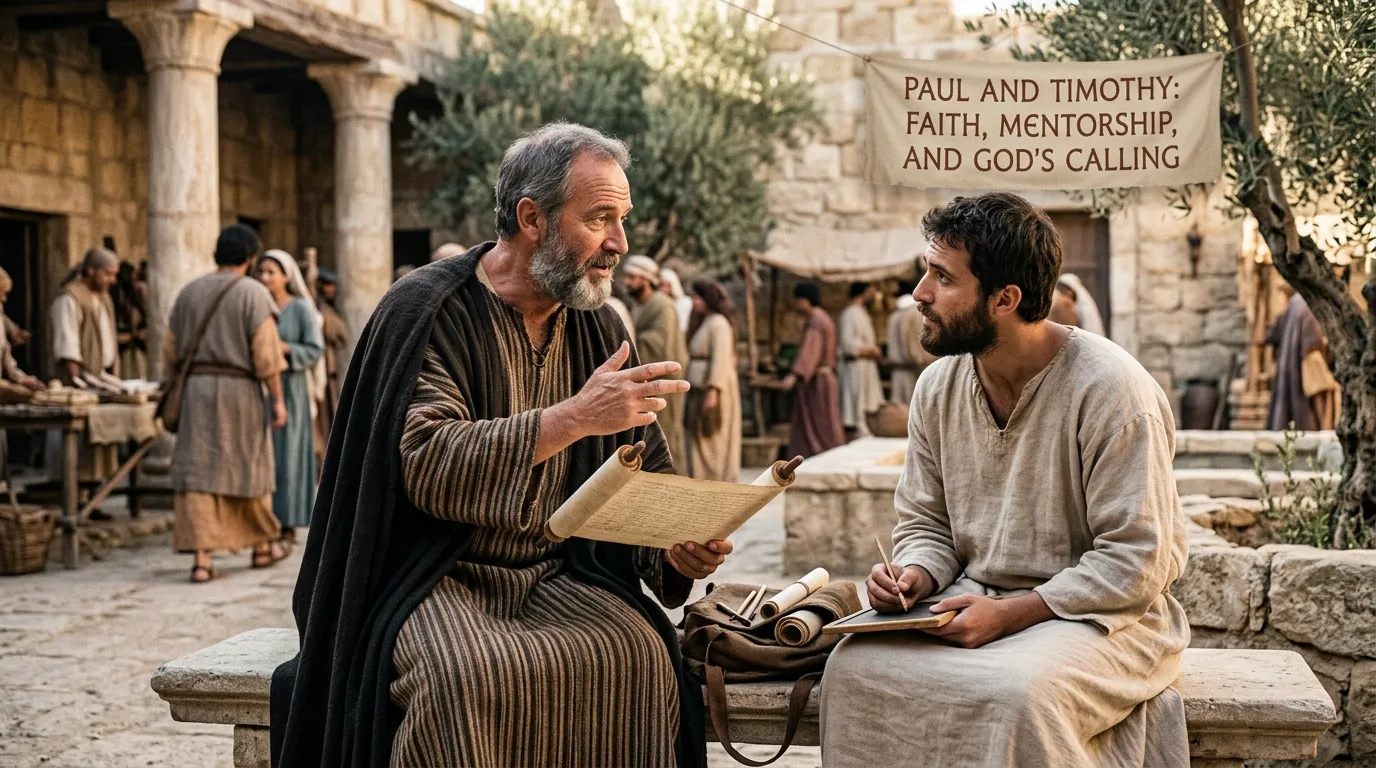
Imagine a young believer standing at a crossroads. He wants to serve God, but he feels unsure. He needs someone older and wiser to guide him. Now imagine a faithful Christian who has already walked through suffering, rejection, and hardship, yet still chooses to encourage the next generation.
This picture helps us understand the Paul and Timothy meaning in the Bible. Their relationship is one of the clearest biblical examples of spiritual mentoring, faithful service, courage, and passing the faith from one generation to another.
Paul was an apostle and missionary who suffered greatly for the gospel. Timothy was a younger believer whom Paul encouraged, taught, and trusted with important ministry work. Their story shows that God can use relationships to strengthen faith and prepare people for service.
The Bible does not present Paul and Timothy as perfect men. Instead, it shows ordinary people learning to trust God, obey His Word, endure difficulties, and serve others.
Who Were Paul and Timothy in the Bible?
Paul, first known as Saul, was a major leader in the early Christian church. Before becoming a follower of Christ, he strongly opposed Christians.
His life changed dramatically after his encounter with Jesus on the road to Damascus. Acts 9 records how Christ called him, and Paul later became one of the most important missionaries in the early church.
Timothy was a younger Christian from Lystra. Acts 16:1–3 tells us that his mother was a Jewish believer, while his father was Greek. Timothy had already developed a reputation among believers when Paul chose him to join his missionary work.
Paul did not simply see Timothy as a helper. Over time, Timothy became a trusted ministry partner and spiritual son.
Paul often called him “my true child in the faith” (1 Timothy 1:2). This language shows the deep spiritual relationship they shared.
Paul and Timothy Meaning in the Bible + Hebrew Meaning
The names Paul and Timothy have interesting meanings, although the Bible’s message about them does not depend on the meanings of their names.
The name Paul comes from the Latin Paulus, commonly understood as meaning “small” or “humble.” Paul himself emphasized humility when describing his place among the apostles. In 1 Corinthians 15:9, he called himself the least of the apostles because he had persecuted the church.
The name Timothy comes from the Greek Timotheos, meaning “honoring God” or “one who honors God.”
It is important to be careful here. These name meanings can provide interesting reflection, but Scripture does not teach that the names Paul and Timothy contain a hidden spiritual prophecy about their lives.
Also, neither name is originally Hebrew. Paul is a Latin name, while Timothy is a Greek name. Therefore, it would be misleading to claim that the Bible gives a special Hebrew prophetic meaning for the two names.
Still, their lives beautifully illustrate ideas associated with their names: humility, devotion, faithfulness, and honoring God.
The Biblical Meaning of Paul and Timothy’s Relationship
One of the strongest meanings of Paul and Timothy’s relationship is spiritual mentorship.
Paul had experience that Timothy did not yet have. Rather than keeping that knowledge to himself, Paul invested in Timothy.
Paul taught Timothy how to serve Christ, endure hardship, teach God’s Word, and lead believers.
This pattern is seen throughout Scripture. Older and more experienced believers are often called to help younger believers grow.
Titus 2:3–5, for example, describes older believers teaching and encouraging younger believers in godly living.
The relationship between Paul and Timothy shows that Christian growth is often strengthened through faithful relationships.
A new Christian may understand the gospel but still need help learning how to pray, study Scripture, make wise choices, and remain faithful during difficult seasons.
Paul and Timothy as an Example of Spiritual Fatherhood
Paul’s description of Timothy as his spiritual child is especially meaningful.
In 1 Corinthians 4:17, Paul says that he sent Timothy because Timothy was his “beloved and faithful child in the Lord.”
This does not mean Paul replaced Timothy’s earthly family. Instead, Paul had played an important role in Timothy’s spiritual development.
Spiritual fatherhood or motherhood can involve:
- Teaching God’s Word
- Offering wise correction
- Praying for another believer
- Encouraging someone who feels weak
- Sharing practical wisdom
- Helping someone discover ways to serve God
- Modeling faithful Christian living
For example, a church member may notice a young believer struggling with confidence. Instead of criticizing that person, a mature Christian might meet with them, pray with them, study Scripture together, and encourage them to keep growing.
That reflects the same kind of investment we see in Paul and Timothy.
What the Bible Says About Timothy’s Faith
Timothy’s faith was not something Paul created. Scripture shows that Timothy had already received a strong spiritual foundation through his family.
Paul reminds him of this in 2 Timothy 1:5, mentioning the sincere faith that first lived in his grandmother Lois and his mother Eunice.
Then Paul tells Timothy to continue in what he had learned.
This is an important biblical lesson: faith can be encouraged through family and community, but each person must personally follow Christ.
Parents and grandparents can teach children Scripture. Pastors can teach believers. Christian friends can encourage one another.
Yet every believer must personally trust God and live according to His Word.
Timothy’s Meaning in the Bible: A Young Believer Called to Serve
Timothy’s story is especially encouraging for young Christians.
Paul recognized Timothy’s gifts, but Timothy also had weaknesses and fears. Paul repeatedly encouraged him not to give up.
In 1 Timothy 4:12, Paul tells Timothy:
“Let no one despise your youth, but set the believers an example in speech, in conduct, in love, in faith, in purity.”
The point was not that Timothy should prove himself through pride. Instead, he was to let his godly character speak for him.
This remains helpful today.
A young Christian does not need to wait until they feel completely confident before serving God. At the same time, maturity matters. Christians should learn Scripture, seek wise counsel, and grow in character.
Paul’s Meaning in the Bible: Grace Can Transform a Life
Paul’s story adds another powerful lesson.
Before becoming an apostle, Paul persecuted the church. Yet Christ showed him mercy and gave him a new mission.
Paul later wrote in 1 Timothy 1:13–16 about the mercy he received.
His story reminds Christians that God’s grace can transform people who seem unlikely to become servants of Christ.
This does not mean the past has no consequences. It means a person’s past does not have to become the final word over their future when they turn to God.
Someone who once lived far from God can become a faithful servant.
Someone who failed can repent and grow.
Someone who feels disqualified can discover that God’s grace is greater than their shame.
Verses About Paul and Timothy
Several important passages help explain their relationship and ministry.
Acts 16:1–5
This passage introduces Timothy as Paul meets him during his missionary journey. Timothy already had a good reputation among believers, and Paul brought him into the work of ministry.
The passage shows that a person’s character matters when they are entrusted with Christian service.
1 Corinthians 4:17
Paul describes Timothy as his “beloved and faithful child in the Lord.”
This verse highlights trust, affection, spiritual guidance, and faithfulness.
Philippians 2:19–22
Paul speaks warmly about Timothy and says that Timothy genuinely cared about the welfare of believers.
Paul also says Timothy had served with him in the gospel like a child serving alongside his father.
This passage reveals that true Christian leadership is rooted in genuine care for people.
1 Timothy 1:2
Paul calls Timothy his “true child in the faith.”
The phrase reflects their close spiritual bond and Timothy’s trusted place in Paul’s ministry.
2 Timothy 1:5–7
Paul reminds Timothy about his sincere faith and encourages him to use the gift God had given him.
Paul also tells him that God gave believers “a spirit not of fear but of power and love and self-control.”
This is a powerful reminder for anyone who feels afraid to follow God’s calling.
2 Timothy 2:2
Paul tells Timothy to entrust what he had learned to faithful people who could teach others.
This gives us a beautiful picture of faith being passed from one generation to another.
Paul taught Timothy.
Timothy was expected to teach others.
Those people could then teach others.
Christian discipleship was never meant to stop with one person.
2 Timothy 4:5
Near the end of Paul’s life, he tells Timothy to remain sober-minded, endure suffering, and fulfill his ministry.
Paul was essentially saying, keep going even when ministry becomes difficult.
The Spiritual Symbolism of Paul and Timothy
The Bible does not call Paul and Timothy symbols in the formal sense. However, Christians commonly see several spiritual lessons in their relationship.
These interpretations should be understood as faith-based reflections rather than direct biblical prophecies.
Paul can represent the role of a mature believer who teaches, encourages, corrects, and prepares others.
Timothy can represent a believer who is growing, learning, serving, and stepping into responsibility.
Together, their relationship can remind Christians of:
- Mentorship
- Discipleship
- Spiritual growth
- Faithfulness
- Courage
- Generational faith
- Christian leadership
- God’s grace
- Serving others
The central message is not that Christians need to find a person exactly like Paul. Rather, it is that God often uses faithful people to help others become stronger in faith.
What Does Paul and Timothy Mean in a Dream?
Some people search for the Paul and Timothy meaning in a dream because they have dreamed about one or both biblical figures.
The Bible does contain examples where God used dreams and visions to communicate with people. However, Scripture does not give a universal dream dictionary saying that seeing Paul or Timothy always means one specific thing.
Therefore, Christians should avoid saying, “If you dream about Timothy, God definitely means X.”
Instead, examine the dream carefully through Scripture and prayer.
A dream involving Paul might lead someone to reflect on grace, repentance, mission, or perseverance because these themes are strongly connected to Paul’s biblical story.
A dream involving Timothy might lead someone to reflect on discipleship, courage, spiritual growth, teaching, or faithfulness.
But these are possible reflections, not guaranteed interpretations.
How Should Christians Test a Spiritual Dream?
First, compare the message with Scripture.
God’s Word should remain the standard. A dream should never be used to justify something that contradicts biblical teaching.
Second, pray for wisdom.
James 1:5 teaches believers to ask God for wisdom when they lack it.
Third, consider the fruit.
Does the interpretation lead toward Christ, truth, repentance, love, humility, and obedience? Or does it create fear, pride, confusion, or obsession?
Finally, seek mature Christian counsel when needed.
No dream should replace Scripture, prayer, wise counsel, or sound judgment.
What Paul and Timothy Teach Us About Mentorship
The relationship between Paul and Timothy offers practical guidance for churches, families, and Christian friendships.
Mature Christians Should Invest in Others
Paul did not simply preach to crowds. He also invested deeply in individuals.
A mature believer can make a huge difference by helping one younger Christian grow.
You do not need a seminary degree to encourage someone. You can share what Scripture has taught you, pray with someone, and model a faithful life.
Younger Christians Should Be Teachable
Timothy’s story also teaches humility.
He accepted instruction from Paul and continued learning.
A Christian who wants to grow should be willing to receive correction and wisdom from trustworthy believers.
Proverbs 12:15 reminds us that wise people listen to counsel.
God’s Work Continues Through Generations
Paul knew that his earthly ministry would not continue forever.
Therefore, he prepared Timothy.
This is one reason 2 Timothy 2:2 is so important. Paul was looking beyond his own lifetime and helping prepare others to carry the gospel forward.
Christian ministry is not only about what we accomplish today. It is also about what we faithfully teach and pass on to others.
Paul and Timothy Meaning for Christians Today
The story becomes very practical when we bring it into everyday life.
A young man may feel called to serve at church but be afraid to speak.
A new Christian may struggle to understand the Bible.
A college student may need guidance about living faithfully among difficult influences.
A parent may want to teach their children about Christ but feel inadequate.
In each situation, the Paul-and-Timothy relationship offers a simple principle: we grow stronger when faithful believers walk alongside one another.
If you are like Timothy, look for mature Christians who demonstrate humility, biblical wisdom, and godly character.
If you are further along in your faith, consider who God may be placing in your life to encourage and disciple.
You may never know how one conversation, prayer, or Scripture passage changes another person’s life.
What Can We Learn From Paul and Timothy?
The relationship between these two men gives Christians several lasting lessons.
- God uses imperfect people. Paul’s past did not prevent God from using him.
- Faith grows through discipleship. Timothy benefited from Paul’s teaching and example.
- Age does not determine spiritual usefulness. Timothy was young, yet Paul trusted him with meaningful work.
- Character matters. Timothy’s good reputation was noticed before he became a ministry partner.
- Courage comes from God. Paul repeatedly encouraged Timothy not to live in fear.
- Christian service requires endurance. Timothy was told to endure hardship and fulfill his ministry.
- Faith should be passed on. Paul taught Timothy so Timothy could teach others.
- Grace gives hope. Paul’s transformed life points to the mercy of Christ.
Frequently Asked Questions
What is the main meaning of Paul and Timothy in the Bible?
The main biblical lesson from Paul and Timothy is discipleship, spiritual mentorship, faithfulness, and passing the gospel to others. Their relationship shows how mature believers can encourage younger Christians to grow and serve God.
Was Timothy Paul’s biological son?
No. Timothy was not Paul’s biological son. Paul used family language because of their close spiritual relationship. He called Timothy his child or son “in the faith” (1 Timothy 1:2).
Why was Timothy important to Paul?
Timothy was important because he was a faithful ministry partner who genuinely cared about believers. Philippians 2:20–22 speaks highly of Timothy’s character and service.
What does Timothy teach Christians today?
Timothy teaches Christians to remain faithful even when they feel young, inexperienced, or afraid. His life encourages believers to grow in Scripture, character, courage, and service.
What does Paul teach us about God’s grace?
Paul’s life demonstrates that God’s grace can transform a person. His past persecution of Christians did not prevent Christ from redeeming him and giving him a mission.
Does dreaming about Paul or Timothy have a guaranteed biblical meaning?
No. Scripture does not provide a fixed meaning for dreaming about Paul or Timothy. Christians can reflect on biblical themes connected with their lives, but every interpretation should be tested against Scripture and should never be treated as certain simply because it came through a dream.
Final Thoughts
The story of Paul and Timothy is ultimately a story about God’s grace working through faithful relationships.
Paul had once been a persecutor of Christians. Timothy was a younger believer who still had much to learn. Yet God used both men in different ways to spread the gospel and strengthen the early church.
Their relationship reminds us that we do not have to walk through faith alone.
Perhaps you are in a Timothy season today. You may feel inexperienced, uncertain, or afraid. If so, remember Paul’s words: “Do not be ashamed of the testimony about our Lord” (2 Timothy 1:8).
Or perhaps you are entering a Paul season. Someone younger may need your encouragement, wisdom, prayer, or example.
Wherever you are, ask God how you can remain faithful.
God can use your past, your present season, your relationships, and even your weaknesses for His purposes. Pray for wisdom. Stay close to Scripture. Seek godly counsel. Encourage others. And trust that God is able to guide your steps.
The story of Paul and Timothy does not promise that Christian service will always be easy. It gives something better: a picture of faithful people serving a faithful God.
Keep learning. Keep serving. Keep encouraging others. And keep trusting God with the journey.