In Matthew 23, Jesus issued one of His sharpest warnings — and it was about titles. “They love the place of honor at feasts and the best seats in the synagogues and greetings in the marketplaces and being called rabbi by others. But you are not to be called rabbi, for you have one teacher, and you are all brothers. And call no man your father on earth, for you have one Father, who is in heaven. Neither be called instructors, for you have one instructor, the Christ” (Matthew 23:6–10).
That passage unsettles people, because the Bible itself uses the titles Jesus seems to forbid. Paul calls himself a father to the Corinthians (1 Corinthians 4:15). The New Testament calls church leaders teachers (Ephesians 4:11). So what did Jesus mean? The answer unlocks the whole subject of religious titles in the Bible: titles matter, but they are meant to describe service, not to feed ego — and the moment a title becomes a pedestal, it has been misused.
Titles for God: Who He Is
Many biblical titles belong to God alone, and they reveal His character. The most common Old Testament title is Adonai, “Lord,” expressing sovereignty and mastery. The divine name Yahweh (often rendered LORD in English Bibles) expresses God’s self-existence and covenant faithfulness — the God who is, and who keeps His promises.
God is called King — “The LORD is king forever and ever” (Psalm 10:16). He is called Shepherd — “The LORD is my shepherd” (Psalm 23:1). He is called Father — “Our Father in heaven” (Matthew 6:9). He is called Rock, Fortress, Redeemer, Judge, Creator, and Holy One. Each title is a window into His nature. No single title exhausts Him, which is why Scripture uses so many.
The Old Testament also gives God compound names that describe what He does: Yahweh-Jireh, “the LORD will provide” (Genesis 22:14); Yahweh-Rapha, “the LORD who heals” (Exodus 15:26); Yahweh-Shalom, “the LORD is peace” (Judges 6:24); Yahweh-Raah, “the LORD my shepherd.” These names were born in real experiences — Abraham on the mountain, Israel at the bitter waters, Gideon before battle. God’s titles are not abstract. They are testimonies.
Titles for Jesus: Who He Is and What He Did
No figure in Scripture carries more titles than Jesus, and each one reveals a facet of His identity. Christ (Greek Christos, Hebrew Messiah) means “Anointed One” — the promised King, Priest, and Prophet. Lord (Kyrios) is the title the early church used to declare His deity: “Jesus Christ is Lord” (Philippians 2:11). Son of God declares His divine nature. Son of Man — Jesus’ favorite title for Himself — declares His humanity and His fulfillment of Daniel’s vision of the heavenly ruler (Daniel 7:13–14).
Other titles describe His work. Lamb of God (John 1:29): the sacrifice for sin. Good Shepherd (John 10:11): the One who lays down His life for the sheep. Great High Priest (Hebrews 4:14): the mediator who entered the heavenly sanctuary with His own blood. King of Kings and Lord of Lords (Revelation 19:16): the ultimate ruler. Word (John 1:1): God’s self-revelation. Bread of Life (John 6:35), Light of the World (John 8:12), Way, Truth, and Life (John 14:6): the One who satisfies, illuminates, and saves.
Jesus’ titles are not decorations. They are declarations. To call Him Lord is to submit to Him. To call Him Savior is to admit you need saving. To call Him King is to pledge allegiance. The titles demand a response.
Titles for God’s People: Roles, Not Ranks
The Bible also gives titles to human beings who serve God. The Old Testament offices were prophet, priest, and king. The prophet spoke God’s word. The priest mediated between God and the people through sacrifice. The king ruled on God’s behalf. In Christ, all three offices are fulfilled perfectly — He is the final Prophet (Deuteronomy 18:15; Acts 3:22), the perfect Priest (Hebrews 7), and the eternal King (Luke 1:33).
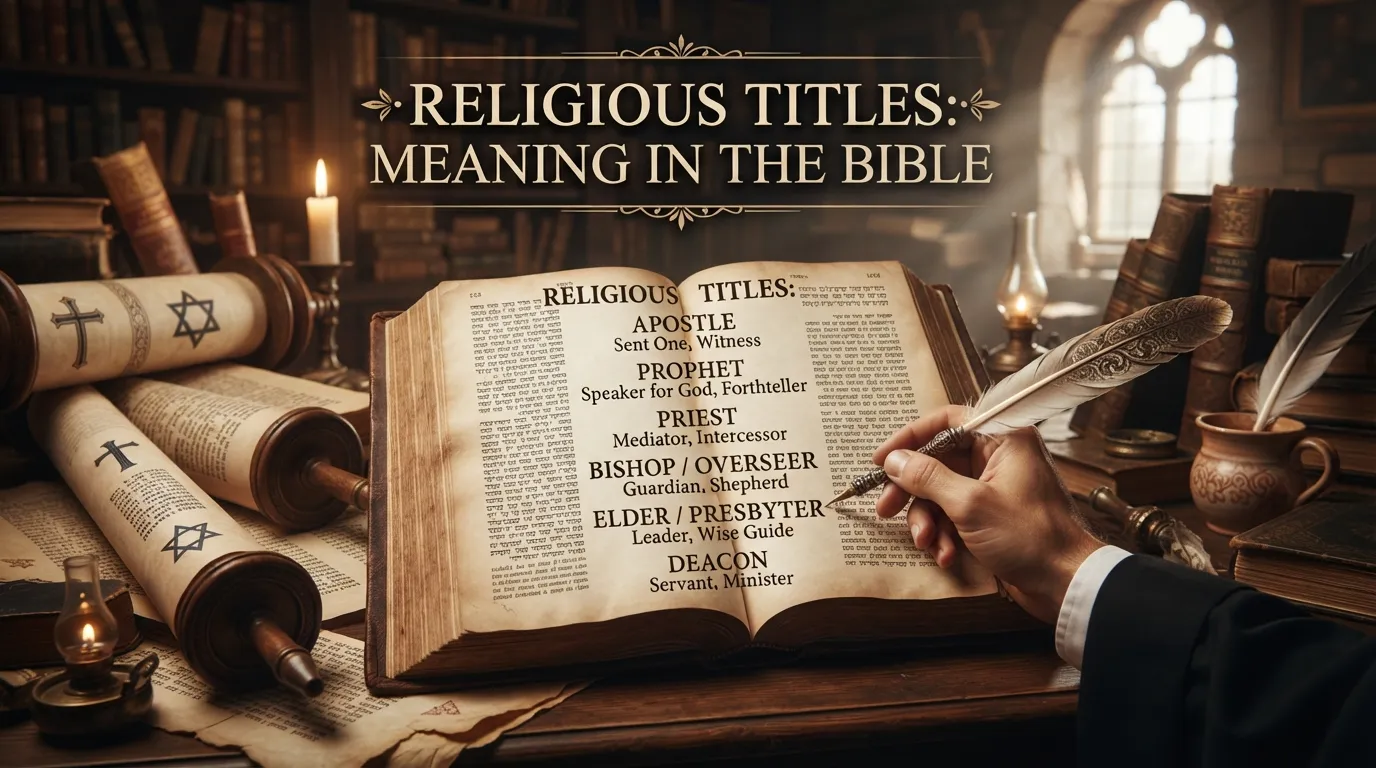
The New Testament uses a range of titles for church leaders: apostle, prophet, evangelist, pastor (shepherd), teacher (Ephesians 4:11), elder (presbyteros), overseer (episkopos), deacon (diakonos, meaning “servant”). Notice what these titles emphasize: the word for pastor means shepherd — someone who feeds, guards, and guides sheep. The word for deacon means servant. The word for minister means one who serves tables. The New Testament’s leadership titles are job descriptions, not aristocratic ranks.
The Bible also gives titles to all believers, not just leaders. Christians are called saints (holy ones), priests (“a royal priesthood” — 1 Peter 2:9), children of God (1 John 3:1), brothers and sisters, and ambassadors (2 Corinthians 5:20). The priesthood of all believers means every Christian has direct access to God through Christ — no human mediator required. Titles for leaders never cancel the titles that belong to every believer.
Jesus’ Warning: Titles and Pride
Return to Matthew 23. Why did Jesus forbid the titles “rabbi,” “father,” and “instructor”? The context is the Pharisees’ love of status: the best seats, the public greetings, the honorifics. Jesus was not banning the words themselves — the New Testament uses “teacher” and “father” in legitimate ways. He was banning the spirit behind them: the use of religious titles to elevate one person above others, to create a spiritual caste system, and to claim an authority that belongs to God alone.
The principle is clear: no human leader should be treated as if he were the ultimate teacher, the ultimate father, or the ultimate instructor. Christ alone holds those places. Human leaders are brothers and sisters who serve — “you are all brothers” (Matthew 23:8). The moment a title makes a leader untouchable, unaccountable, or superior, it has crossed the line Jesus drew.
This is why the New Testament pairs leadership titles with servanthood language so insistently. Jesus told His disciples, “Whoever would be great among you must be your servant, and whoever would be first among you must be your slave, even as the Son of Man came not to be served but to serve” (Matthew 20:26–28). The greatest title in the kingdom is servant. The highest seat is the lowest place. The truest mark of spiritual authority is a towel around the waist, washing feet (John 13).
Titles That Belong to No One Else
Some titles are shared; others are reserved. The Bible is careful about the difference. Only God is called Almighty (El Shaddai). Only Jesus is called the “only begotten Son” (John 3:16) — the unique, one-of-a-kind Son. Only the Holy Spirit is called the Comforter or Advocate (Parakletos) who indwells believers (John 14:16). When humans claim titles that belong to God alone — when a leader demands unquestioning obedience, claims infallibility, or presents himself as the only channel to God — Scripture’s warning lights flash. The apostles themselves refused such honors. When the people of Lystra tried to worship Paul and Barnabas as gods, the two men tore their clothes and shouted, “We also are men, of like nature with you” (Acts 14:15). When Cornelius fell at Peter’s feet, Peter lifted him up: “Stand up; I too am a man” (Acts 10:26). The mark of a true servant of God is refusal to accept the worship that belongs to God alone. Any leader who welcomes it has already failed the test of the title he claims.
Using Titles Wisely
So how should Christians handle religious titles today? First, use them to honor, not to flatter. Calling a pastor “Pastor” or a priest “Father” (in traditions that use the term) can be a legitimate expression of respect for an office. The problem is not the word. It is the heart behind it — whether the title is used to honor service or to feed ego.
Second, never let a title substitute for character. A title says what a person does. Character says who a person is. The Bible repeatedly warns that people can hold religious titles and be corrupt — the sons of Eli were priests who despised God’s offerings (1 Samuel 2:17); the Pharisees were teachers who devoured widows’ houses (Mark 12:40). A title without integrity is a mask.
Third, remember that the titles that matter most are the ones God gives. “Beloved,” “child of God,” “friend” (John 15:15), “saint,” “heir” (Romans 8:17). These are not printed on business cards. They are written in heaven. A Christian who knows what God calls them will not be desperate for what people call them — and a leader who knows he is a servant will not need a title to prove his worth.
Titles in the Bible point to God, to Christ, and to service. They are signposts, not thrones. The greatest among us is the one who serves — and the One who served most is the One whose titles are highest of all. For a survey of how religious titles have developed across Christian traditions, see the Wikipedia article on religious titles.










