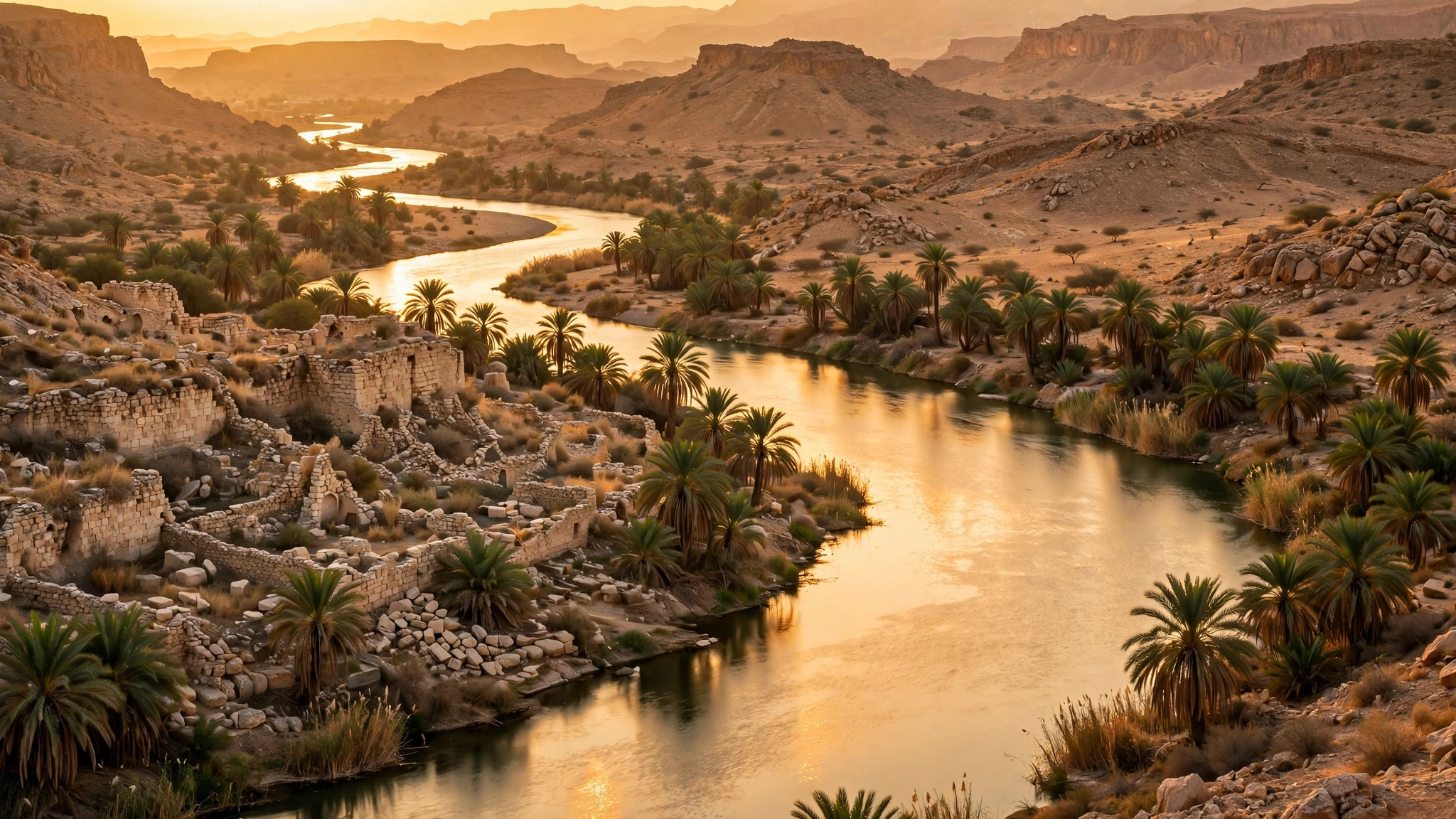
Close your eyes and picture a river winding through desert hills — narrow, muddy, and unimpressive by the world’s standards. Now picture that same river parting its waters, washing a prophet’s leprosy away, and carrying the Savior of the world into his baptism. That is the Jordan River. And along its banks stood cities where some of the Bible’s greatest moments happened.
The Jordan River cities in the Bible are a story of crossings, cleansings, and new beginnings — all flowing from one humble river. Follow the river downstream, and you will walk through the whole story of redemption.
The River Itself: Small, Muddy, and Chosen
The Jordan is not the longest or grandest river in the world. It runs about 150 miles from the Sea of Galilee to the Dead Sea, dropping over 600 feet — the lowest river on earth. Its name means “the descender,” and it descends indeed: from the mountains of the north to the lowest point on the planet’s surface.
But God has always chosen small, unimpressive things. A shepherd boy. A stable. A cross. The Jordan fits the pattern: a muddy little river that became the stage for the greatest crossings in Scripture. Its very smallness is the point. God does not need grandeur. He needs faith.
Upstream: Where Jacob Wrestled and Israel Crossed
Our journey begins near the Jordan’s northern reaches, where Jacob wrestled with God at the ford of the Jabbok, a tributary of the Jordan (Genesis 32:22-32, in substance). Jacob came to the river as a deceiver and left it as Israel — “he struggles with God.” The river was his turning point. It is the first of many: the Jordan is where people cross over from who they were to who God calls them to be.
Centuries later, Israel itself stood on the Jordan’s eastern bank, staring at the Promised Land. The river was at flood stage. God told Joshua the priests would carry the ark into the water — and when their feet touched it, the river would stop. “As soon as the priests who carried the ark reached the Jordan and their feet touched the water’s edge, the water from upstream stopped flowing” (Joshua 3:15-16, in substance). Israel crossed on dry ground, and Joshua set up twelve stones as a memorial: “In the future, when your children ask you, ‘What do these stones mean?’ tell them that the flow of the Jordan was cut off before the ark of the covenant of the Lord” (Joshua 4:6-7).
The crossing was Israel’s baptism as a nation. Behind them was the wilderness; ahead was the promise. Behind them was slavery; ahead was inheritance. Every Christian crossing has the same shape: we leave an old life behind and step into a new one, and the river is the line between them.
Jericho: The City That Fell Without a Fight
Just west of the Jordan stood Jericho, the oldest city in the world and the first obstacle in the Promised Land. Its walls were legendary. Its gates were shut. And God gave Israel the strangest battle plan in military history: march around the city, blow trumpets, shout — and the walls would fall (Joshua 6:3-5, in substance). They did. “The wall collapsed; so everyone charged straight in, and they took the city” (Joshua 6:20).
Jericho teaches us that the first stronghold in the new life is not taken by strength but by faith. The walls that block your promise — the addiction, the fear, the broken pattern — will not fall to striving. They fall to obedient, worshiping trust. Jericho is the proof: the battle belongs to the Lord.
Gilgal: Where the Shame Rolled Away
After crossing the Jordan, Israel camped at Gilgal, and God said, “Today I have rolled away the reproach of Egypt from you” (Joshua 5:9). The name Gilgal sounds like the Hebrew word for “roll away.” There, the new generation was circumcised, the Passover was celebrated, and the manna stopped — because they were now eating the fruit of the land. Gilgal was the place of new beginnings, where the shame of the old life was rolled away and a new identity began.
Every Jordan crossing needs a Gilgal. The crossing is the moment of decision; Gilgal is the season of healing that follows. If you have crossed your Jordan — come to faith, left an old life, stepped into a new calling — do not rush past Gilgal. Let God roll away the reproach. Let him heal what Egypt left behind.
Bethany Beyond the Jordan: Where John Preached
Centuries later, the Jordan became the stage for a new beginning. John the Baptist preached at “Bethany on the other side of the Jordan” (John 1:28), calling people to repentance and baptizing them in the river. The crowds came out — tax collectors, soldiers, Pharisees, ordinary people — and confessed their sins in the same waters where Israel had crossed into the land.
John’s baptism was a baptism of repentance, a sign that the people were ready for the Messiah. And then the Messiah came to the river himself. “Jesus came from Galilee to the Jordan to be baptized by John” (Matthew 3:13). John protested: “I need to be baptized by you, and do you come to me?” Jesus answered, “Let it be so now; it is proper for us to do this to fulfill all righteousness” (Matthew 3:14-15). Jesus had no sin to repent of. He was baptized to identify with us — to step into the river with sinners, so that sinners could step into the family of God.
And as he came up from the water, heaven opened. “He saw the Spirit of God descending like a dove and alighting on him. And a voice from heaven said, ‘This is my Son, whom I love; with him I am well pleased'” (Matthew 3:16-17). The Jordan, where Israel had crossed into the land, became the place where the Son was anointed for his mission. The river of crossings became the river of commissioning.
Naaman’s Cleansing: Seven Dips in a Muddy River
The Jordan’s most unlikely story belongs to Naaman, the Syrian general — a great man, a mighty warrior, and a leper. He came to Israel expecting a grand healing ceremony: the prophet would wave his hand, call on God, and cure him. Instead Elisha sent a message: “Go, wash yourself seven times in the Jordan, and your flesh will be restored and you will be cleansed” (2 Kings 5:10).
Naaman was furious. The rivers of Damascus were cleaner than the Jordan! Why wash in a muddy ditch? But his servants reasoned with him: if the prophet had asked something great, he would have done it; why not do the small thing? Naaman dipped himself seven times in the Jordan, “and his flesh was restored and became clean like that of a young boy” (2 Kings 5:14).
Naaman’s story is the gospel in miniature: healing comes not by grandeur but by obedience, not by impressing God but by humbling yourself in the river he chose. The Jordan was muddy. The command was simple. The healing was complete. God’s methods are often unimpressive — and always effective.
Jericho Again: Zacchaeus and Bartimaeus
Jesus passed through Jericho on his final journey to Jerusalem, and the old city by the Jordan gave him two more stories. Bartimaeus, the blind beggar, cried out, “Jesus, Son of David, have mercy on me!” (Mark 10:47). Jesus stopped, healed him, and Bartimaeus followed him down the road (Mark 10:46-52, in substance). Zacchaeus, the hated tax collector, climbed a tree to see Jesus — and Jesus invited himself to Zacchaeus’s house: “Today salvation has come to this house” (Luke 19:9). The city that had once fallen to trumpets now fell to mercy. The Jordan road had become the road of salvation.
Elijah’s Crossing: The Chariot of Fire
Near the Jordan’s eastern bank, Elijah struck the river with his cloak and crossed on dry ground with Elisha (2 Kings 2:8). On the far side, a chariot of fire swept Elijah to heaven (2 Kings 2:11), and Elisha picked up the fallen cloak, struck the river, and cried, “Where now is the Lord, the God of Elijah?” (2 Kings 2:14). The waters parted again. The Jordan was the place of succession — where one prophet’s ministry ended and another’s began. Every generation stands at the Jordan, receiving the cloak of those who went before.
Questions Readers Often Ask
Why did so much happen at the Jordan? The Jordan was the boundary between the wilderness and the Promised Land — the line between the old life and the new. God used it again and again as the place of crossing, cleansing, and commissioning, because its geography carried the theology: to enter the promise, you must cross the river.
Was Jesus baptized in the same place Israel crossed? The Bible does not give the exact spot, but tradition places Jesus’ baptism near the lower Jordan, not far from where Israel crossed and where John preached. The geography is less important than the meaning: the Son entered the same river his people had crossed, identifying himself with them completely.
What does the Jordan mean for Christians today? It means that crossings are God’s specialty. The river that parted for Israel, cleansed Naaman, and carried Jesus into his mission still flows — and the God of the Jordan still brings his people through.
Your Jordan Is Waiting
The Jordan River cities teach one great lesson: God meets his people at the river. At the place of crossing, of cleansing, of commissioning, of new beginnings. You may be standing at your own Jordan right now — a decision, a confession, a step of faith, a letting-go. The water looks deep. The current looks strong. But the God who parted the river for Joshua, who cleansed Naaman in its muddy water, and who anointed his Son in its flow is standing on the bank with you. Step in. The river will part. For geographical background on this remarkable river, the Wikipedia article on the Jordan River offers a helpful overview.










