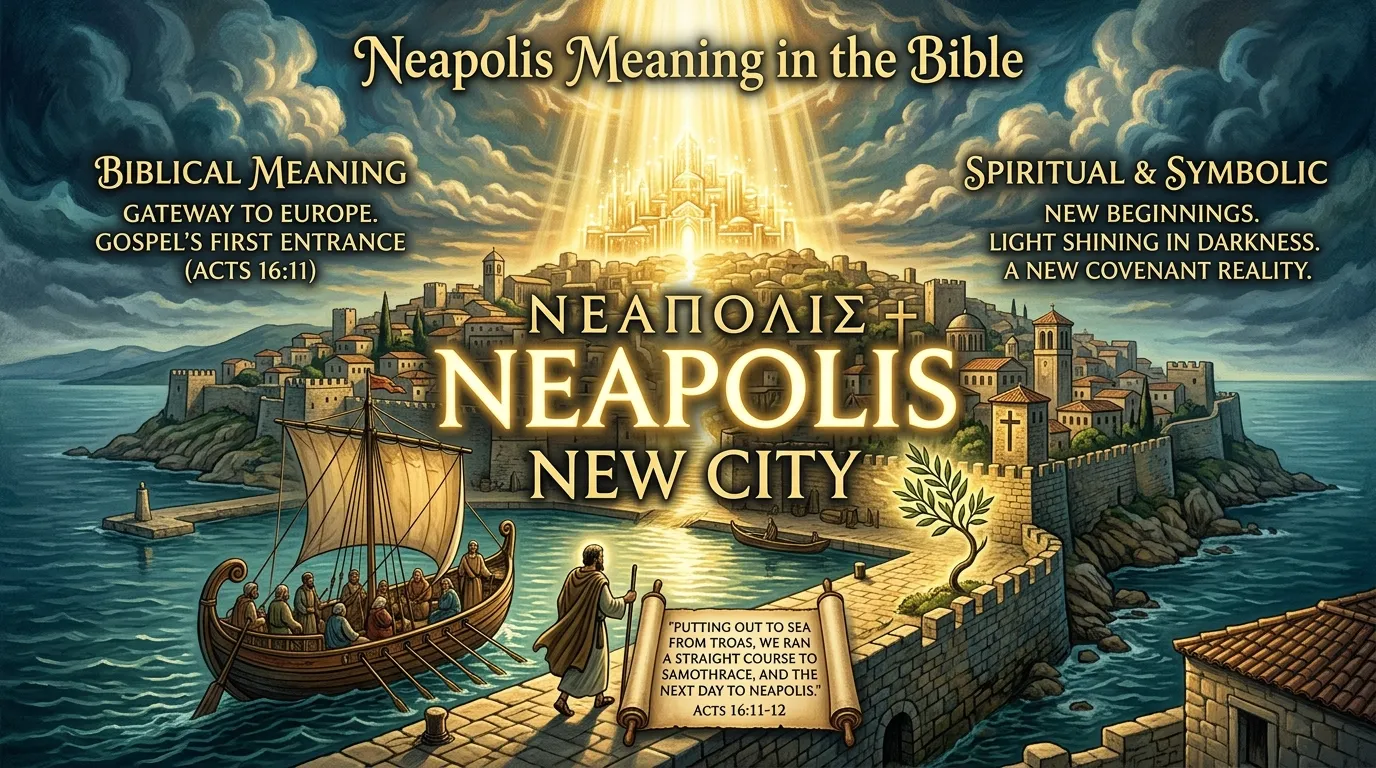
Neapolis gets one verse in the Bible. Just one. “And from there to Philippi… and from there we sailed to Neapolis” is not even the wording; the actual text is simpler still: Paul and his companions “sailed from Troas” and arrived at Neapolis (Acts 16:11). Then they went on to Philippi, and Neapolis disappears from the story. Yet that single verse marks one of the greatest turning points in Christian history: the moment the gospel stepped onto European soil. Neapolis was the door, and the door matters even when the story hurries through it.
The Vision That Sent Paul West
To understand Neapolis, you have to start at Troas, on the far side of the Aegean. Paul had been traveling through Asia Minor, and Luke tells us that the Holy Spirit had twice prevented him from going where he planned: first into Asia, then into Bithynia (Acts 16:6-7). He arrived at Troas not knowing where to go next. Then came the vision: a man of Macedonia standing and urging him, “Come over to Macedonia and help us” (Acts 16:9). Paul concluded that God was calling them to preach the gospel there, and the party set sail immediately.
The voyage took them from Troas to the island of Samothrace, and from Samothrace to Neapolis. The journey was short and, by ancient standards, fast. The wind was favorable. Luke’s account moves quickly, the way a traveler moves when the road has finally opened. Neapolis was the first landfall in Europe, the harbor where the ship touched the continent that would become the gospel’s second home.
What Neapolis Was
Neapolis means “new city” in Greek. It was the port of Philippi, about ten miles inland, and it served as the harbor through which Philippi’s trade and travel passed. The city stood on the coast of Macedonia, on the Via Egnatia’s eastern approach, and it was a working port rather than a famous one. Ships from Asia Minor made landfall there before their passengers continued on foot to Philippi.
There is a pleasing symmetry in the name. The gospel was entering a new continent, and its first port was called “new city.” Luke does not comment on the name, and Christians should not build a doctrine on it. But the coincidence is worth noticing. The arrival at Neapolis was a new beginning in the most literal sense: a new land, a new mission field, and a new chapter in the book of Acts.
The Threshold Moment
Neapolis matters because thresholds matter. Every great journey has a moment when it passes from one world into another, and that moment often looks unimpressive. The crossing of the Aegean was not dramatic. There was no storm, no shipwreck, no angelic visitation on the voyage. The party simply sailed, landed, and walked inland. The drama was in what the landing meant, not in how it felt.
Think of what followed from that landing. Philippi, Lydia, the jailer, the church that would support Paul for the rest of his life, the letter to the Philippians, and eventually the spread of the gospel through Greece and on to Rome all trace back to the ship that docked at Neapolis. The gospel’s European story begins at a harbor most readers skip over. God often works that way, placing the hinge of history in an unremarkable place.
Why Luke Recorded a One-Verse Stop
Luke’s precision is part of his credibility. He names the ports, the islands, and the landing places because he was writing about a real journey, and real journeys have ports. The mention of Neapolis is not a theological symbol. It is a travel detail, and its value is historical: it anchors the Macedonian call in geography. Paul really sailed. He really landed. The gospel really arrived in Europe at a particular harbor on a particular day.
That historical grounding matters for faith. The Christian message is not a set of timeless ideas that float free of place and time. It is news about events that happened in specific cities, on specific roads, through specific harbors. Neapolis is one of the small pins that hold the map to the table. Remove it, and the story becomes slightly vaguer. Keep it, and the journey stays real.
The Lesson of the Doorway
If Neapolis teaches anything, it teaches the importance of the doorway moments in a life of faith. Most of the Christian life is not spent in the dramatic center of the story. It is spent in the thresholds: the decision to go, the landing, the walk inland, the first conversation. Paul’s Macedonian ministry is remembered for Philippi, Thessalonica, Berea, and Corinth. But it began at Neapolis, a harbor where nothing happened except arrival.
Many Christians live in Neapolis moments without knowing it: the first step into a new city, a new job, a new church, a new season of life. The moment feels ordinary, even anticlimactic. But the story that follows may be anything but. The gospel’s European chapter opened with a landing at a small port. The next chapter of your own story may open just as quietly.
The Harbor Today and the Journey It Started
The harbor at Neapolis is still a working port. Ships still cross the Aegean to Kavala, and travelers still walk inland toward Philippi, where the ruins of the ancient city, the forum, the theater, and the traditional site of the prison can be seen. The geography has not changed much. The sea is the same sea Paul sailed. The hills are the same hills. Standing in Kavala’s harbor, a modern traveler can feel the shape of Paul’s journey: the short sail from Asia, the landing, the road inland, and the city where the gospel took root in Europe.
That continuity is part of the power of the place. The New Testament is not a story set in a mythical landscape. It happened in harbors that still have ships, on roads that still carry travelers, in cities whose ruins can still be walked. Neapolis is one of the smallest pins on that map, a single verse in a long book. But it holds the map to the table at a crucial point: the crossing from Asia to Europe, from one continent to another, from the world Paul knew to the world he was about to enter.
Small Places in a Big Story
The Bible is full of small places that carry large weight. Bethlehem was a village. Nazareth was a town no one expected anything from. The riverbank at Philippi was not a synagogue or a temple. Neapolis was a port of one verse. Yet the gospel’s story turns on these places again and again. God does not seem to share the human preference for the grand stage. He works in villages, harbors, riverbanks, and upper rooms, and the great movements of His kingdom begin in places the world overlooks.
Neapolis is a reminder to pay attention to the small places in our own stories: the ordinary harbors where we land, the unremarkable decisions that turn out to matter, the quiet arrivals that precede the great work. The gospel arrived in Europe not with a trumpet but with a docking. The next chapter of the story may begin the same way.
The Road From Neapolis to Philippi
From Neapolis, Paul’s party walked about ten miles inland to Philippi, following the road that connected the port to its city. The walk itself was the beginning of the European mission: a group of men, led by a vision, traveling on foot into a continent where no one had preached the gospel before. They arrived in Philippi on the Sabbath and went outside the city gate to a riverside prayer meeting, where they met Lydia, a dealer in purple cloth, whose heart the Lord opened. The first European convert was a businesswoman at a prayer meeting by a river, and the first European church met in her house. The great European story began with a walk from a small harbor and a conversation by a stream.
That is the pattern of Neapolis. The great things begin with small arrivals. The gospel’s European chapter did not open with a miracle or a crowd. It opened with a docking, a walk, and a prayer meeting. The harbor matters because it was the door, and the door matters because everything that followed came through it. Neapolis is a reminder that the thresholds of our lives, the landings, the arrivals, the first steps into a new place, are often the moments that matter most, even when they feel like nothing at all.
Neapolis and the Call to Go
The Macedonian call that brought Paul to Neapolis is one of the most quoted guidance passages in the Bible, and it is worth asking what it teaches about calling in general. The call was specific: a man, a place, a plea for help. It was confirmed by the party, by the open sea route, and by the gospel purpose that was clear. And it was obeyed immediately. The party did not wait for further confirmation, hold a committee meeting, or ask for a second vision. They sailed. The Neapolis story suggests that when God’s guidance is clear, the right response is not delay but movement. The ship was waiting. The wind was favorable. The door was open. They went through it.
The modern city on the site of ancient Neapolis is Kavala, a port in northern Greece whose harbor still serves the same coastline Paul sailed. Its history, including its origins as Neapolis, is covered in the Wikipedia article on Kavala.










