Rome was the city Paul longed to visit, the city he was carried to in chains, and the city where the book of Acts ends with him preaching “without hindrance.” No other city in the New Testament carries that combination of longing, suffering, and triumph. Rome was the capital of the empire that crucified Jesus, and it became the home of a church Paul loved. Its meaning in the Bible is therefore double: a picture of worldly power at its most impressive and most brutal, and a picture of the gospel taking root in the hardest soil on earth.
The City at the Center of the World
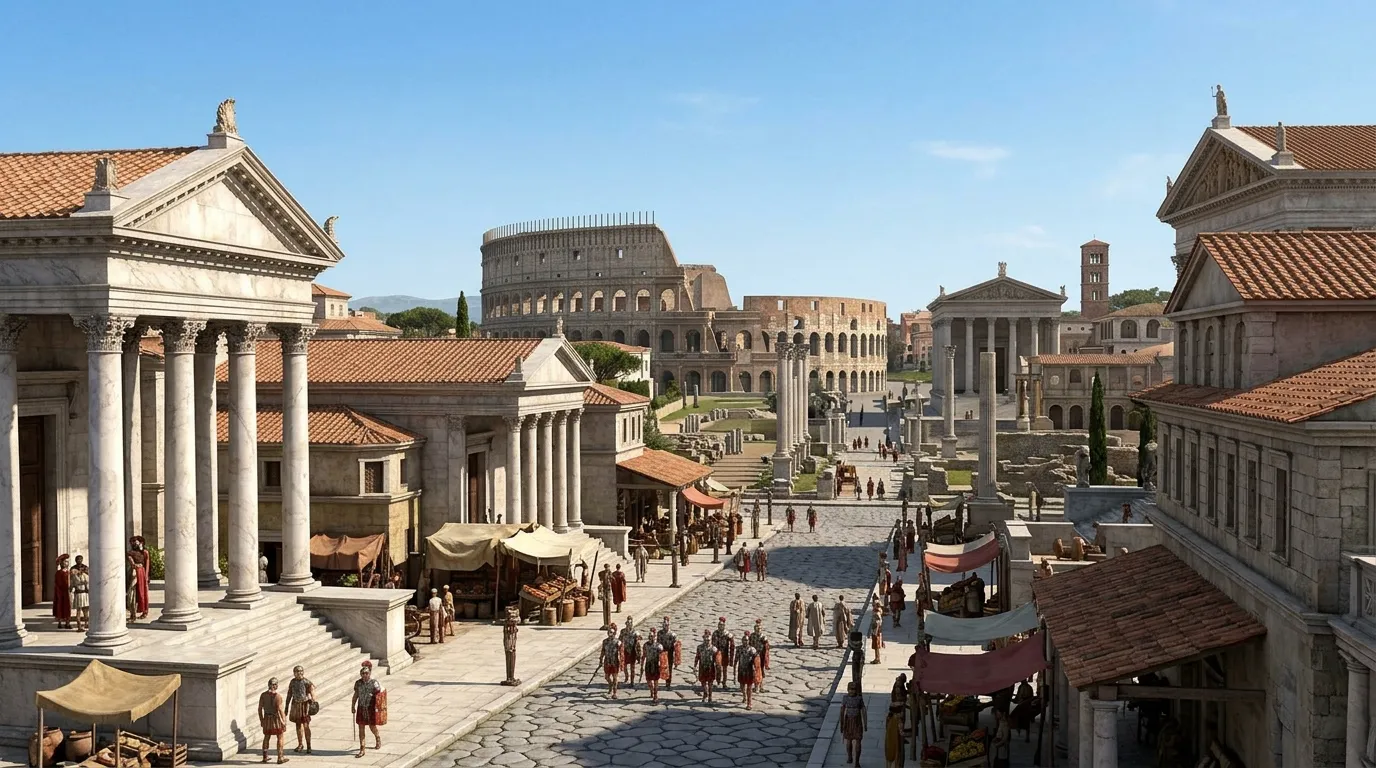
In the first century, Rome was the largest city in the Mediterranean world, home to perhaps a million people. It was the seat of the emperor, the Senate, the armies, and the law. Its aqueducts, temples, forums, and arenas announced the power of an empire that ruled from Britain to Egypt. For most people in the ancient world, Rome was not just a city. It was the center of the world, the place where decisions were made that shaped life in every province.
The church in Rome grew up in that shadow. We do not know who founded it. Paul had not visited when he wrote his letter to the Romans, and he names more than two dozen believers there, including Priscilla and Aquila, who had been expelled from Rome under Claudius and later returned (Romans 16:3). The church was a mix of Jews and Gentiles, slaves and free, rich and poor, living in the capital of the empire that had executed their Lord. Their faith was not a private hobby. It was a loyalty that competed with the empire’s demand for ultimate allegiance.
Paul’s Longing to Come to Rome
Paul’s letter to the Romans is the most systematic statement of the gospel in the New Testament, and it was written to a church he had never visited. “I long to see you,” he wrote, “that I may impart to you some spiritual gift to strengthen you” (Romans 1:11). He had planned to come many times and had been prevented (Romans 1:13). He hoped to visit on his way to Spain, using Rome as a base for further mission (Romans 15:24).
God answered the longing, but not in the way Paul expected. Paul came to Rome as a prisoner, after two years of detention in Caesarea, a shipwreck, and a winter on Malta. He arrived in chains, under guard, appealing to Caesar. The letter he had written to the Romans years earlier had prepared the church for his coming. The coming itself was nothing like the triumphant missionary visit he had imagined. Yet the gospel advanced through the chains more effectively than it might have through a free visit, because the chains put Paul in contact with the imperial guard and the household of Caesar itself (Philippians 1:12-13; 4:22).
The Letter That Defined the Gospel
It is worth pausing on the letter itself, because the letter is Rome’s greatest contribution to the Bible. In Romans, Paul sets out the whole arc of salvation: the universality of sin, justification by faith, the gift of righteousness, the hope of glory, the mystery of Israel, and the shape of the Christian life. The letter’s most famous sentences, “For I am not ashamed of the gospel, for it is the power of God for salvation to everyone who believes” (Romans 1:16), were written to believers living in the city where the gospel would be most contested.
Rome’s church needed that letter because Rome’s pressures were unique. Believers there lived among the empire’s monuments, its gods, its games, and its emperor cult. The temptation was not persecution alone but assimilation: to blend in, to keep faith private, to avoid the cost of being different. Paul’s letter gave them a theology strong enough to stand in the capital: a gospel that was public, powerful, and sufficient.
Paul Under House Arrest
Acts closes with Paul in Rome under house arrest, living at his own expense for two whole years, welcoming all who came to him (Acts 28:30). He was guarded by a soldier, chained to him, and he used the situation as a pulpit. Soldiers rotated through his guard, and each one heard the gospel. Visitors came and went. Letters went out to churches across the empire. Luke’s final sentence is a deliberate contrast: the prisoner was preaching “with all boldness and without hindrance” (Acts 28:31). The empire that had tried to contain the gospel had given it a headquarters in its own capital.
Tradition holds that Paul was eventually executed in Rome under Nero, beheaded as a Roman citizen rather than crucified. The tradition is plausible, and it fits the pattern of his life: the man who came to Rome in chains left his blood in its soil. The church that began in Rome would later become the center of Western Christianity, for good and for ill, but that later history should not obscure the New Testament picture: a community of ordinary believers, loved by God and called to be saints (Romans 1:7), living faithfully in the empire’s capital.
Rome as Warning and Promise
Rome’s meaning in the Bible is therefore twofold. As a warning, Rome shows that human power, however grand, is temporary and often cruel. The empire that built the roads and kept the peace also crucified Jesus, persecuted His followers, and eventually collapsed. The book of Revelation pictures Rome as Babylon, a city drunk on its own luxury and violence, destined to fall (Revelation 17-18). No city, however great, is exempt from God’s judgment.
As a promise, Rome shows that the gospel can take root anywhere. If the church could grow in the emperor’s city, it can grow anywhere. The gospel is not a message for the margins only. It belongs in the centers of power as much as in the villages of Galilee. Paul’s chains in Rome became the means by which the gospel entered Caesar’s household. The empire’s attempt to silence the message became the megaphone that spread it.
What Rome Means for Christians Today
Christians today live in their own Romes: cities of power, wealth, entertainment, and competing loyalties. The temptation is the same one the Roman church faced: to privatize faith, to blend in, to avoid the cost of being different. Paul’s letter to Rome is still the antidote: a gospel that is the power of God, a righteousness that comes by faith, and a life offered to God as a living sacrifice (Romans 12:1).
Priscilla, Aquila, and the Network of Rome
The Roman church was not an abstract community. It was a network of real people, and Paul’s letter names them: Priscilla and Aquila, who had risked their necks for Paul; Andronicus and Junia, his relatives and fellow prisoners; Rufus and his mother, who had been a mother to Paul; and more than twenty others (Romans 16). These were the people who made the church in Rome real: tentmakers, freed slaves, families, and former prisoners. The church in the capital was not built by the powerful. It was built by ordinary believers whose names Paul remembered and honored.
Priscilla and Aquila are especially important. They had been expelled from Rome under Claudius, met Paul in Corinth, worked with him in tentmaking, traveled with him to Ephesus, and then returned to Rome, where they hosted a church in their house (Romans 16:5). Their story shows how the Roman church was connected to the whole mission: a couple who moved between Rome, Corinth, and Ephesus, carrying the gospel and the church’s fellowship with them. The empire’s roads carried them. The gospel’s network held them.
Nero and the First Persecution
Rome’s meaning in the Bible also includes the persecution under Nero, which tradition dates to the mid-60s AD. After the great fire of Rome in AD 64, Nero blamed the Christians, and the historian Tacitus describes the horrors that followed: Christians covered in animal skins and torn apart by dogs, crucified, and set on fire to serve as lamps in Nero’s gardens. Tradition holds that Peter and Paul were both executed in Rome during this persecution. The city that had received Paul’s letter and hosted his house arrest became the city that killed him.
The persecution under Nero is the dark side of Rome’s story, and it belongs in any honest account of the city. The same empire that gave Paul a hearing and a platform also gave him a grave. The church in Rome survived Nero, just as it had survived Claudius’s expulsion and would survive later persecutions. But it survived by the same means it had always used: the gospel, the Spirit, and the courage of ordinary believers like the ones Paul named in Romans 16.
Rome also reminds Christians that the church’s strength does not depend on the empire’s favor. The Roman church grew under suspicion, under Nero’s persecution, and under centuries of pressure. It did not need the empire’s permission. It needed the gospel, the Spirit, and the courage to stand. The same is true today. The kingdoms of this world rise and fall. The gospel remains. For the history of the ancient city, its empire, and its legacy, see the Wikipedia article on Rome.