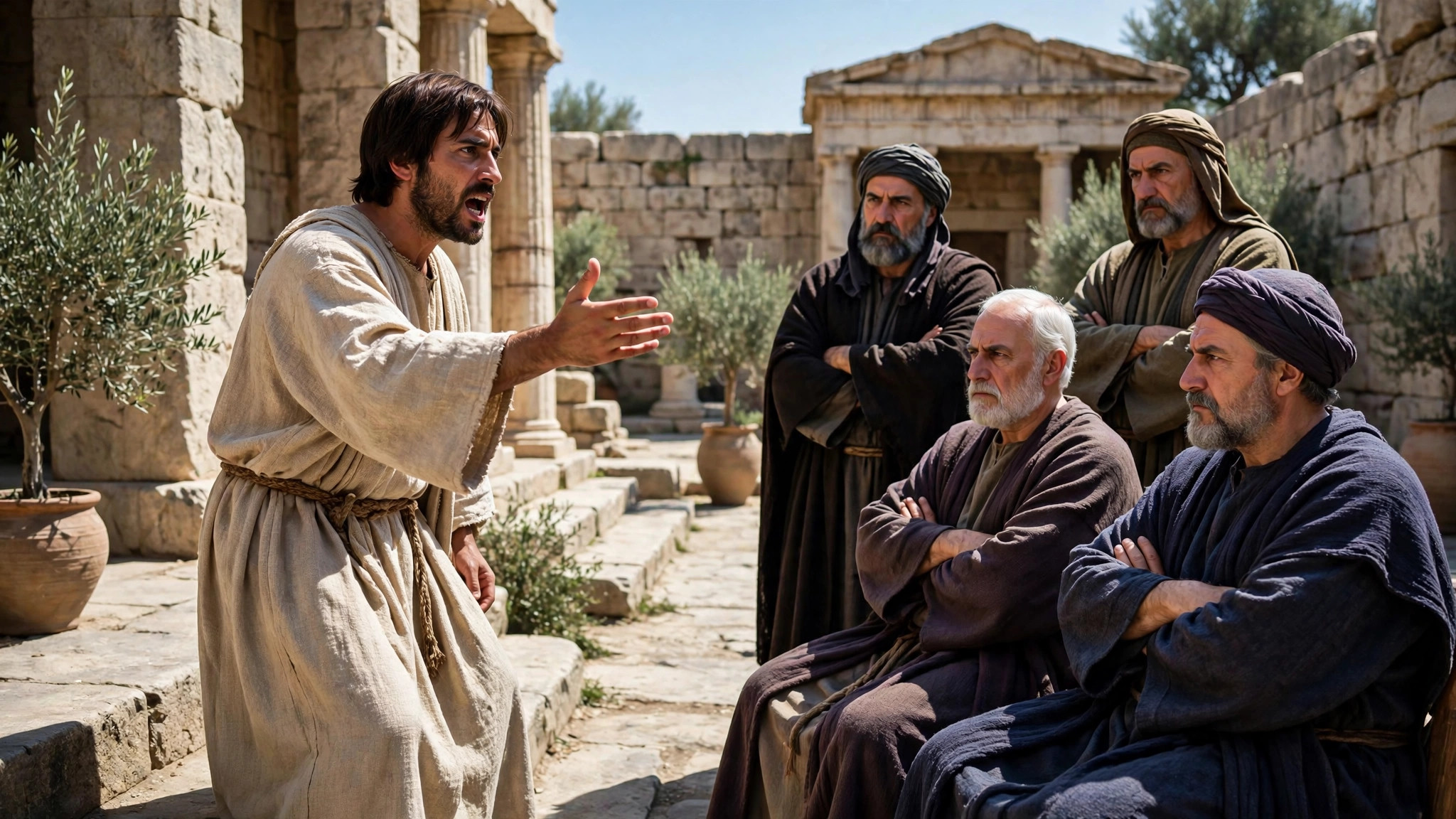
He called them whitewashed tombs. He overturned their tables. He told them to their faces that they were shutting the door of heaven in people’s faces. If you have ever read the Gospels and felt a shock at how boldly Jesus spoke to the most powerful religious figures of His day, you are not alone. Understanding Jesus confronting leaders meaning in the Bible reveals one of the most courageous — and most misunderstood — parts of Christ’s ministry. Was Jesus being disrespectful? Was He picking fights? Or was something deeper happening?
When we look carefully at what Scripture actually says, we find that Jesus confronted leaders not out of anger or pride, but out of love — love for the truth, love for God the Father, and love for the ordinary people those leaders were crushing. His example teaches us how to stand for truth with both courage and grace.
The Language of Rebuke: Prophets, Not Bullies
The New Testament word often translated “rebuke” is the Greek epitimaō, meaning to rebuke, reprove, or warn sternly. Jesus used it against demons, against the wind and waves (Mark 4:39), and against Peter when Peter tried to turn Him from the cross (Matthew 16:23). His confrontations were authoritative, not abusive.
The Hebrew background gives us the word yakach, meaning to reprove, correct, or argue a case — it is a legal term, like presenting evidence in court. The prophets exercised yakach constantly: Nathan confronting David over his sin with Bathsheba (2 Samuel 12:7, “You are the man!”) is the classic example. When Jesus confronted the Pharisees, He stood in this prophetic tradition — speaking God’s truth to power, exactly as the Hebrew prophets had done for centuries. Another key Hebrew concept is mishpat (justice, righteous judgment). Jesus confronted leaders because they had perverted mishpat — they used God’s law as a weapon against the vulnerable while excusing their own corruption. His confrontations were acts of divine justice, defending the oppressed.
The Cleansing of the Temple
The Gospels record many confrontations. Let us look at the major ones with their context.
The cleansing of the temple (John 2:13–17; Matthew 21:12–13). Jesus drove out the money changers and overturned their tables, declaring, “My house will be called a house of prayer, but you are making it a den of robbers.” The context: merchants were exploiting worshipers — especially the poor — by price-gouging on sacrificial animals and currency exchange. Jesus’ anger was not a loss of control; it was righteous zeal for God’s house and for the exploited. Note that this happened twice in His ministry — once near the beginning (John 2) and once near the end (Matthew 21) — a sign of how deep the corruption ran.
The Seven Woes
The seven woes (Matthew 23) are Jesus’ longest, strongest confrontation. He pronounced seven “woes” on the scribes and Pharisees, calling them hypocrites, blind guides, and whitewashed tombs — “beautiful on the outside but full of dead men’s bones on the inside” (Matthew 23:27). The context matters: He spoke these words publicly to warn the crowds and His disciples (Matthew 23:1), because these leaders were blocking ordinary people from God’s kingdom (Matthew 23:13). He charged them with devouring widows’ houses (Mark 12:40), with taking away the key to knowledge (Luke 11:52), and with straining out a gnat while swallowing a camel — obsessing over tiny rules while neglecting “the more important matters of the law — justice, mercy and faithfulness” (Matthew 23:23).
Confronting Sabbath Legalism
When the Pharisees condemned Jesus for healing on the Sabbath, He asked, “Which is lawful on the Sabbath: to do good or to do evil, to save life or to kill?” (Mark 3:4). He healed the man with the shriveled hand right in front of them. Jesus confronted their legalism to show that mercy outranks ritual (Matthew 12:7). He was not breaking the Sabbath; He was restoring its meaning. The Sabbath was made for man’s good, not as a cage for man’s compassion.
Parables Aimed at the Powerful
Jesus told parables aimed directly at the chief priests and Pharisees — the wicked tenants (Matthew 21:33–46), the great banquet (Luke 14:15–24). Matthew 21:45 explicitly says, “When the chief priests and the Pharisees heard Jesus’ parables, they knew he was talking about them.” He used stories to expose their rejection of God’s messengers. The wicked tenants parable was devastating: the tenants who beat and killed the owner’s servants — and finally his son — were a mirror held up to Israel’s leaders, who had done the same to the prophets and were about to do the same to Christ.
Before the High Priest and Pilate
At His trial, Jesus answered the high priest with calm dignity (John 18:19–23), and told Pilate, “You would have no power over me if it were not given to you from above” (John 19:11). Even facing death, He spoke truth to power without hatred. He did not flinch, and He did not return evil for evil. The Lamb who would die for His enemies still told the most powerful men in Judea the truth about where their power came from.
What His Confrontations Were Not
The Bible explicitly shows Jesus confronting religious leaders who were hypocritical, oppressive, and blocking people from God. His confrontations were always truthful, purposeful, and motivated by love for God and neighbor. What Scripture does not teach is that Jesus was anti-authority in general. In fact, He told the crowds to obey the Pharisees’ teaching of Moses’ law — “do and observe whatever they tell you” — while warning them not to imitate their hypocrisy (Matthew 23:2–3). He paid the temple tax (Matthew 17:27) and told Pilate that his authority came from above (John 19:11). Jesus confronted corrupt leadership; He never taught rebellion against all authority. Romans 13 and 1 Peter 2 confirm that Christians are to respect governing authorities.
Christians commonly interpret Jesus’ confrontations as permission to be harsh or combative toward leaders they dislike. That misses the point badly. Jesus confronted from a position of perfect love, perfect knowledge of hearts, and perfect timing — and even then, His goal was repentance, not destruction. He wept over Jerusalem (Luke 19:41) in the same week He cleansed the temple. Confrontation without tears is not Christlike.
Some also claim Jesus never confronted sinners, only leaders. That is false — He told the woman caught in adultery to “go and sin no more” (John 8:11) and told the Samaritan woman the truth about her life (John 4:17). The difference is tone: to the broken, He offered mercy first; to the proud who blocked the broken from mercy, He spoke with severity.
How to Confront Like Jesus
Check your heart before you confront. Jesus said to remove the plank from your own eye first (Matthew 7:3). Ask: Am I motivated by love for God and for this person, or by wounded pride? Paul’s rule applies: restore gently, watching yourself (Galatians 6:1).
Speak truth specifically, not vaguely. Jesus named the exact sin — shutting the kingdom, devouring widows’ houses, neglecting justice. Vague complaints wound; specific truth can heal. Speak the truth in love (Ephesians 4:15).
Defend the vulnerable, not your ego. Jesus’ harshest words were reserved for those who harmed the helpless. If your confrontation is really about your reputation, step back. If it is about protecting others, step forward.
Respect authority even when you challenge it. Jesus honored the office even while rebuking the office-holder. Paul followed the same pattern when he appealed to Caesar (Acts 22:25) and instructed Timothy to treat elders with honor even in rebuke (1 Timothy 5:1, 19). Challenge the sin; honor the structure God put in place.
Leave room for repentance. Even the Pharisees were not beyond hope — Nicodemus came by night (John 3:1), Joseph of Arimathea buried Jesus’ body (John 19:39), and some Pharisees believed (John 7:50). Your goal is never to win an argument; it is to win a brother.
Do not be ruled by sinful anger. Ephesians 4:26 permits anger but forbids sinning in it. Righteous anger is controlled, truthful, aimed at injustice, and followed by grief. Sinful anger is uncontrolled, selfish, and aimed at hurting others.
Conclusion: Courage Wrapped in Love
Jesus confronting leaders shows us the perfect balance the world rarely sees: absolute courage and absolute love in the same person. He never flinched from truth, and He never stopped loving the people He confronted. He overturned tables on Monday and wept over the city on the way there. He pronounced woes on hypocrites and died for them on Friday. If God is calling you to speak truth in a hard situation, take heart from His example. Be as brave as Jesus and as tender as Jesus — at the same time. Pray first. Speak truth. Love the person. Trust God with the outcome. Pray today: “Lord Jesus, give me Your courage and Your compassion. Where I see injustice, make me bold. Where I see broken leaders, make me prayerful. Keep my heart pure, my words truthful, and my motives loving.” The One who faced down the powerful and then died for them walks with you — and He will give you both the backbone and the heart you need. For background on the religious party Jesus most often confronted, see the Wikipedia article on the Pharisees.










