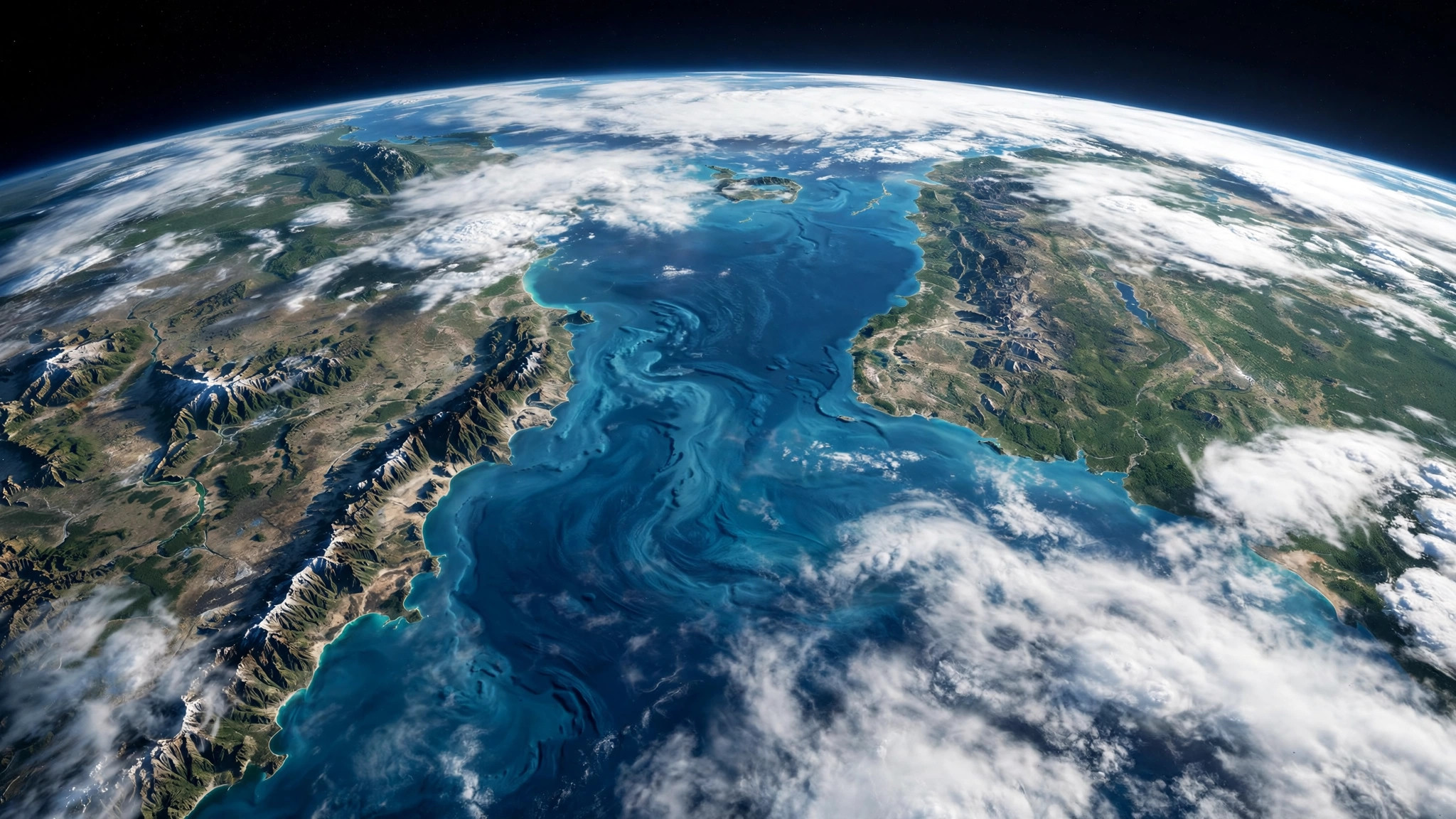
Look at a world map. Notice how the eastern coast of South America seems to fit into the western coast of Africa like puzzle pieces. Scientists call this continental drift — the theory that the continents were once joined in a single landmass and later separated. But long before modern geology, the Bible contained a fascinating verse that many Christians believe describes this very event. The separation of continents meaning in the Bible centers on a mysterious passage in Genesis about the earth being “divided” — and it opens a window into how Scripture and science can illuminate each other. Let us explore what the Bible says, what science has discovered, and how Christians can think about both with faith and intellectual honesty.
The Key Verse: Genesis 10:25
The central text is Genesis 10:25: “Two sons were born to Eber: One was named Peleg, because in his time the earth was divided; his brother was named Joktan.” This verse appears in the Table of Nations, the genealogy tracing humanity’s spread after the Flood.
The name Peleg is the key. In Hebrew, it means “division.” His parents named him to commemorate something so significant that it defined his generation: the earth was divided. But what kind of division? Two main interpretations exist among Bible-believing Christians.
Interpretation 1: The division of languages at Babel. Genesis 11 describes how God confused human language at the Tower of Babel, scattering people across the earth. Since Peleg’s genealogy (Genesis 10:25) appears just before the Babel account (Genesis 11:1–9), many scholars believe “the earth was divided” refers to the division of peoples by language. The “earth” (erets in Hebrew) can mean “people of the land” as well as physical land.
Interpretation 2: The physical division of the continents. Other Christians believe Peleg’s name commemorates the actual splitting of the earth’s landmasses — what scientists now call continental drift. On this view, the single continent that existed after the Flood broke apart during Peleg’s lifetime, and his name memorialized the event.
Both interpretations are held by faithful Christians. Let us examine the evidence for each with open minds.
What Science Says About Continental Drift
The scientific theory of plate tectonics teaches that the earth’s continents were once joined in a supercontinent called Pangaea. Over millions of years (according to conventional dating), the continents drifted apart to their current positions. The evidence includes: the matching coastlines of South America and Africa; identical fossils found on continents now separated by oceans; matching rock formations and mountain ranges across the Atlantic; and the ongoing movement of tectonic plates, measurable today with GPS.
Most Christians who accept an old earth see no conflict here — God could have separated the continents gradually over long ages. Young-earth creationists, who believe the earth is thousands (not billions) of years old, propose a different model called catastrophic plate tectonics. They suggest that during Noah’s Flood, runaway geological processes rapidly separated the continents in a matter of months or years. Both groups agree on the basic observation: the continents were once joined and are now separated. The debate is about when and how fast it happened.
The Case for a Physical Division in Peleg’s Time
Those who see Genesis 10:25 as describing continental separation offer several arguments. The meaning of “earth.” While erets can mean people or land, the phrase “the earth was divided” most naturally reads as a physical description. If Moses meant the division of languages, he might have said “the people were divided.” The wording suggests something happened to the earth itself.
The timing. Peleg was born about 100 years after the Flood (based on the genealogies in Genesis 11). This fits a model where catastrophic geological changes continued after the Flood year itself. The earth was still settling, reshaping, and dividing.
The memorial name. Parents in the Bible often named children after major events — Isaac (“laughter”), Jacob (“deceiver”), Perez (“breach”). Naming a child “Division” suggests something dramatic and physical happened. A gradual language shift seems less likely to inspire such a name than a cataclysmic splitting of land.
Psalm 104 as a creation hymn. Psalm 104:8 describes waters and mountains in language some connect to dramatic geological reshaping: “they flowed over the mountains, they went down into the valleys, to the place you assigned for them.” This pictures a world being shaped by powerful forces.
However, we must be honest: the Bible does not explicitly say “the continents separated in Peleg’s day.” This is an interpretation — a thoughtful one, but an interpretation. Christians should not present it as certain doctrine.
The Words Themselves: Peleg, Erets, and Division
The Hebrew words in Genesis 10:25 deserve close attention. The name Peleg comes from the Hebrew root palag, meaning “to split,” “to divide,” or “to channel.” The same root appears in Psalm 46:4: “There is a river whose streams [pelagim] make glad the city of God.” The root describes division by water channels — strikingly fitting for continents divided by oceans.
The Hebrew word for “earth” is erets. It can mean the physical earth, a specific land or country, or the inhabitants of the earth. In Genesis 1:1, “God created the heavens and the erets” — clearly the physical earth. In Genesis 10:25, the context must determine the meaning, and scholars disagree. The Hebrew word for “divided” is niphlagah, the passive form of the root, indicating the earth was divided by an outside force — not that it divided itself. Whatever happened, God was behind it.
The Tower of Babel Connection
Genesis 11:1–9 tells how humanity, united in one language, set out to build a tower to make a name for themselves: “Come, let us build ourselves a city, with a tower that reaches to the heavens” (Genesis 11:4). God saw their unified rebellion and said, “If as one people speaking the same language they have begun to do this, then nothing they plan to do will be impossible for them” (Genesis 11:6). So He confused their language (Genesis 11:7) and scattered them over the face of the earth (Genesis 11:8).
On the Babel reading of Genesis 10:25, the “division” in Peleg’s time is this scattering — the moment one human family became many nations. That is why the genealogy of chapter 10 and the Babel story of chapter 11 sit side by side: one lists the nations, the other explains how they came to be. On this view, the division that defines Peleg’s generation is linguistic and national, not geological.
Notice something important: both readings agree on the deeper point. Whether God divided the land or the languages, He divided a rebellious, unified humanity — and He did it to limit evil, spread people across the earth He had commanded them to fill (Genesis 1:28), and keep His redemptive plan on track. Division, in God’s hands, is not destruction. It is discipline with a purpose.
What the Division Teaches Us About God
God is sovereign over the physical world. “The earth is the Lord’s, and everything in it” (Psalm 24:1). The God who said “Let the water under the sky be gathered to one place, and let dry ground appear” (Genesis 1:9) can shape continents as easily as He shapes coastlines. The earth is His workshop.
God humbles human pride. At Babel, humanity tried to climb to heaven by its own effort. God’s answer was confusion and scattering. “God opposes the proud but shows favor to the humble” (James 4:6). Every empire that has tried to make itself God has learned the same lesson.
God’s plan survives every scattering. Babel’s division looked like disaster, but it was the seedbed of Pentecost. At Pentecost, people from every nation heard the gospel in their own languages (Acts 2:6) — the reversal of Babel. And Revelation pictures the final result: a multitude “from every nation, tribe, people and language” worshiping God together (Revelation 7:9). What was divided at Babel is reunited at the cross.
God’s kingdom cannot be shaken. Mountains may move — Isaiah says “though the mountains be shaken and the hills be removed, yet my unfailing love for you will not be shaken” (Isaiah 54:10). Earthquakes shook the ground at Jesus’ death (Matthew 27:51) and resurrection (Matthew 28:2). Creation itself trembles before its Maker. The believer’s hope is an “unshakeable kingdom” (Hebrews 12:28) — a kingdom that will never be divided.
Practical Lessons from the Divided Earth
Trust God with what feels immovable. If God can move continents — whether slowly over ages or swiftly in judgment — He can move the obstacles in your life. The mountain in your path is not bigger than the God who made mountains. Hold secondary views humbly. Christians disagree about whether Genesis 10:25 describes continental drift. That is okay. Major on the majors: God created, God judges, God saves. Do not break fellowship over Peleg. Let creation fuel worship. Psalm 95 declares, “The sea is his, and he made it, and his hands formed the dry land” (Psalm 95:5). The next time you look at a map and see those puzzle-piece coastlines, let them remind you of the Architect. Build on the rock. Jesus warned that the house built on sand falls when the storm comes (Matthew 7:24–27). Build your life on Christ, the solid rock who does not shift.
Conclusion: The God Who Shapes Worlds
The separation of continents meaning in the Bible points us to a God so powerful He can split the earth itself — whether by dividing languages, shifting landmasses, or both. The same hands that formed the dry land (Psalm 95:5) are the hands that hold your life today. If God can move continents, He can move the obstacles in your life. If He could scatter rebellious nations and still work His plan, He can redirect your detours into His purposes. Nothing is too big, too fixed, or too immovable for Him. Pray with confidence in this mighty God. Reflect on His power displayed in creation. And trust that the One who divided the earth in Peleg’s time is perfectly able to guide your steps today — and to bring you safely to the unshakeable kingdom that will never be divided (Hebrews 12:28). The science behind the drifting continents is summarized in the Wikipedia article on continental drift.










