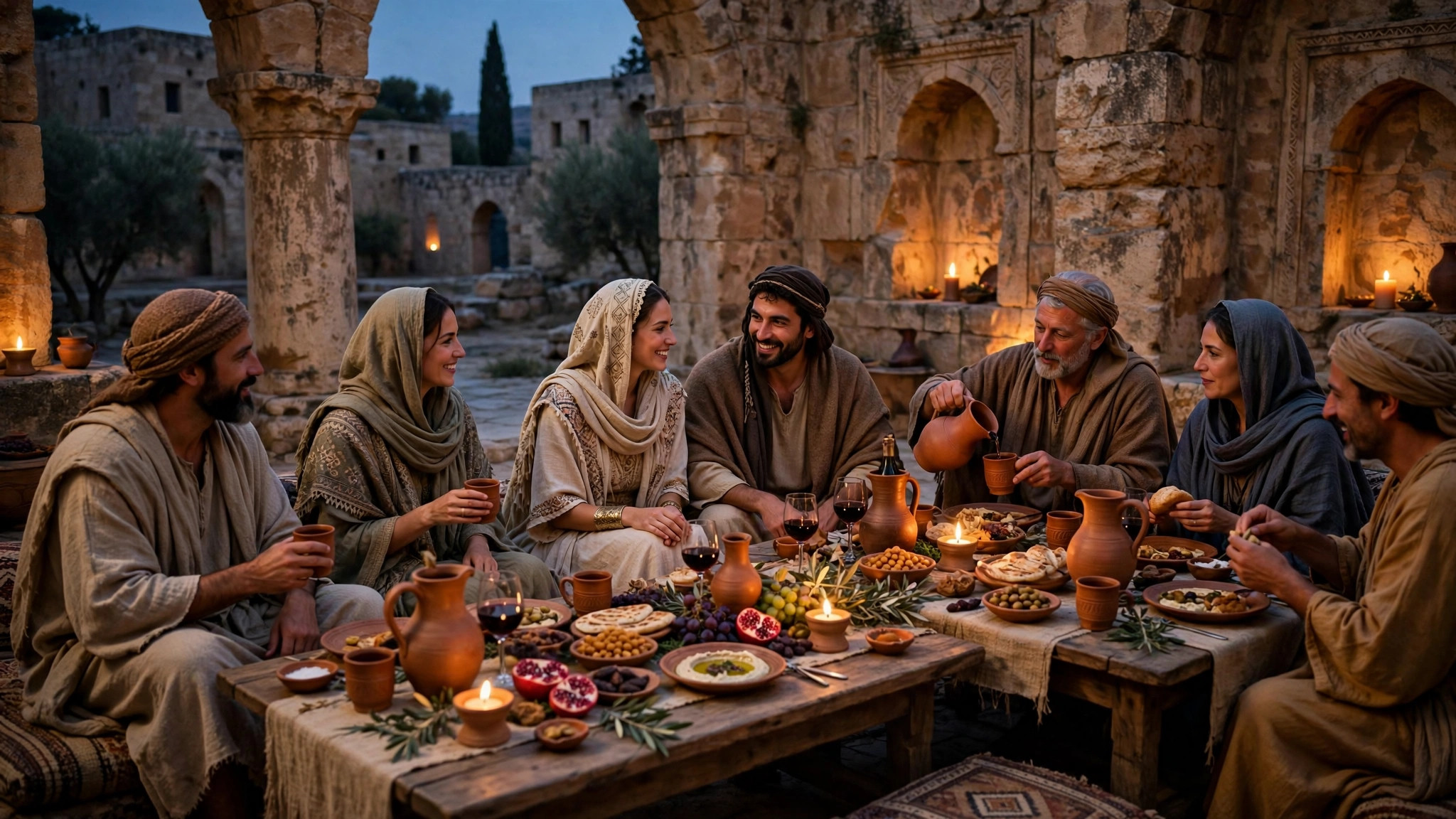
Few topics spark more debate at Christian dinner tables than this one. Did Jesus drink wine? What does it mean for us today? The question deserves a careful, honest look at Scripture — not at traditions, opinions, or assumptions. Let us walk through the Gospels together and see exactly what they show, what they do not show, and what it all means for your life.
Four Facts the Gospels State Plainly
The Bible is clear on the basic facts. Let us start there.
Jesus turned water into wine. In John 2:1–11, at a wedding in Cana, Jesus performed His first miracle: He turned about 120 gallons of water into wine. The master of the banquet tasted it and said it was the best wine of the feast. This was real wine — the text gives no hint otherwise — and Jesus made it joyfully, for a celebration.
Jesus drank wine. In Matthew 11:19 (and Luke 7:34), Jesus said, “The Son of Man came eating and drinking, and they say, ‘Here is a glutton and a drunkard.'” His enemies accused Him of being a drunkard because He drank wine openly — at meals, with tax collectors and sinners. The charge was false and slanderous, but it confirms the fact: Jesus drank wine in social settings.
Jesus used wine at the Last Supper. In Matthew 26:27–29, Jesus took the cup, gave thanks, and said, “Drink from it, all of you. This is my blood of the covenant.” The Passover cup contained wine. Jesus then said He would not drink of “this fruit of the vine” again until the kingdom — confirming it was wine.
Jesus refused wine on the cross. In Mark 15:23, soldiers offered Jesus wine mixed with myrrh — a drink meant to dull pain. He refused it. He chose to face the cross with a clear mind, fully bearing our sin.
These are the facts. Everything else is interpretation.
Wine in Bible Times: Gift, Not Idol
To understand these passages, we need to know what wine meant in the ancient world. In Israel, wine was a normal part of daily life — a gift from God. Psalm 104:15 says God gives “wine that gladdens human hearts.” At harvest time, wine meant joy, celebration, and God’s blessing. The wedding at Cana fits this perfectly: wine was the drink of joy, and Jesus added to the joy. Wine also appears at the table of blessing in the patriarchs’ stories — Melchizedek brought bread and wine to Abraham (Genesis 14:18) — and Deuteronomy lists wine among the blessings of the land (Deuteronomy 7:13). Nehemiah could write of “the joy of the Lord” as strength at a feast where wine was served (Nehemiah 8:10), and Proverbs speaks of vats brimming with new wine as a picture of God’s provision (Proverbs 3:10).
But wine in Bible times was different from today. It was usually diluted with water, and daily wine was weaker than modern wine. More importantly, drunkenness was always condemned. The Bible draws a sharp line: wine as God’s gift is good; drunkenness as abuse of that gift is sin. Proverbs 20:1 warns, “Wine is a mocker and beer a brawler; whoever is led astray by them is not wise.” Ephesians 5:18 commands, “Do not get drunk on wine, which leads to debauchery.” The Bible never praises drunkenness — not once.
What Jesus’ Example Does Teach
First, Jesus was fully human. He ate and drank like everyone else. He was not distant or strange — He joined real life, real meals, real celebrations (John 1:14; Hebrews 4:15). Second, Jesus came for sinners. He drank wine at tables with tax collectors and outcasts. His presence there was mercy, not endorsement of sin. He was “a friend of tax collectors and sinners” (Matthew 11:19) — and that is good news for us. Third, creation is good. By making wine at a wedding, Jesus affirmed that God’s gifts — food, drink, celebration — are good when received with thanksgiving.
What His Example Does Not Teach
It does not teach that Christians must drink wine. The Bible never commands it. It does not teach that drunkenness is acceptable. Scripture condemns it clearly and repeatedly — drunkenness even appears in the list of the works of the flesh (Galatians 5:21). It does not settle every question about alcohol for every believer in every situation. Romans 14 teaches that love and conscience must guide our freedoms.
Here is the balanced truth: Jesus drank wine, but He was never drunk. He enjoyed God’s gifts, but He was never controlled by them. His life shows freedom and self-control — and that is the model for us.
The Deeper Symbolism: Wine in Scripture
Wine carries rich spiritual meaning throughout the Bible. Wine pictures joy. As Psalm 104:15 says, wine “gladdens human hearts.” When Jesus made wine at Cana, He was picturing the joy He brings — the joy of salvation, of sins forgiven, of God’s kingdom.
Wine pictures the blood of Christ. At the Last Supper, Jesus held up the cup and said, “This is my blood of the covenant, which is poured out for many for the forgiveness of sins” (Matthew 26:28). Every communion cup since has pointed back to the cross. The wine spoke of sacrifice — of life poured out for others.
Wine pictures the coming kingdom. Jesus said He would drink the fruit of the vine “new” with His disciples “in my Father’s kingdom” (Matthew 26:29). There is a wedding feast coming — the marriage supper of the Lamb (Revelation 19:9) — and its joy will make Cana look like a rehearsal.
New wine pictures the new covenant. In Matthew 9:17, Jesus said you do not put new wine into old wineskins. The gospel is new wine — it cannot be contained by old religious structures. The old wineskins of legalism would burst; the new wine needs new hearts.
Wine also pictures God’s abundance. At Cana, Jesus did not make a small amount — He made about 120 gallons of the finest wine (John 2:6–10). God’s grace is not stingy. He gives in abundance, and the best is yet to come: the wine at Cana was a foretaste of the wedding feast of the Lamb (Revelation 19:9), where the joy will be complete and the celebration will never end. Every wedding feast, every harvest, every table of joy in this life is a preview of that table.
Christians and Alcohol Today
So what should a believer do today? Scripture gives principles, not a single rule for every conscience. Do not get drunk (Ephesians 5:18). Do not let any created thing master you — your freedom in Christ (Galatians 5:13) is freedom from bondage, not freedom to be bound. Do not cause a brother or sister to stumble: “It is better not to eat meat or drink wine or to do anything else that will cause your brother or sister to fall” (Romans 14:21). And do not judge one another over disputable matters (Romans 14:3). Leaders carry a special weight here: overseers must not be given to drunkenness (1 Timothy 3:3).
A related question concerns communion. Both wine and grape juice have been used by faithful churches; the meaning of communion — remembering Christ’s death — is the same. Paul’s instruction at the table is to examine oneself before partaking (1 Corinthians 11:28). The cup points to the cross either way.
Two Questions Worth Asking Honestly
Does Jesus’ example justify drinking? It proves drinking wine is not in itself sin — Jesus did it without sin (Hebrews 4:15). It does not prove that drinking is wise for every person in every setting. If you struggle with alcohol, if your family has been wrecked by it, or if your drinking would wound a weaker brother, abstaining is the loving choice. The freedom Jesus modeled was never freedom from wisdom.
Does abstaining make someone more spiritual? No. Scripture nowhere ranks abstainers above moderate drinkers, and it warns against the opposite pride too. What matters is a heart that says, “Whether you eat or drink or whatever you do, do it all for the glory of God” (1 Corinthians 10:31). Self-control, love, and gratitude are the marks of maturity — not the contents of your glass.
Conclusion: The Savior at the Table
Jesus drinking wine shows us a Savior who is fully human and fully holy — who joins our celebrations, who turns water into joy, and who lifts the cup of suffering for our sake. Do not use His example as an excuse for excess. Do not use it as a weapon to judge others. Instead, let it draw you to Him: the One who brings true joy, who poured out His blood for you, and who will one day drink the fruit of the vine new with you in His Father’s kingdom. Until that day, live in His freedom, walk in His self-control, and love others the way He loved — all the way to the cross, and all the way to joy. For a wider look at how wine has figured in religious practice across traditions, see the Wikipedia article on wine in religion.










