Imagine feeling as if your past has ruined your future. You may have made choices you regret, hurt people, or even walked far away from God. Then you read the story of a man who once hated the followers of Jesus but later became one of the greatest messengers of the gospel.
That man was Paul.
The Paul the apostle meaning in the Bible is deeply connected with grace, redemption, faith, obedience, courage, and God’s power to change a life. Paul did not begin as a Christian leader. He began as a fierce opponent of the early church. Yet Jesus met him, changed his direction, and gave him a mission to preach the gospel.
His story reminds Christians of a beautiful truth: God can redeem a person’s past and use that person for His purposes.
Paul’s life is recorded mainly in the Book of Acts, while many New Testament letters bear his name. His story teaches us about God’s grace, the power of faith, the cost of following Christ, and the hope of a transformed life.
Who Was Paul the Apostle in the Bible?

Paul was a Jewish man from Tarsus who became one of the most important apostles and missionaries of the early Christian church.
Before becoming a follower of Jesus, Paul was known as Saul. He was a Pharisee and strongly opposed the early Christians. Acts 8:3 says that Saul tried to destroy the church by entering homes and taking believers to prison.
His opposition was serious.
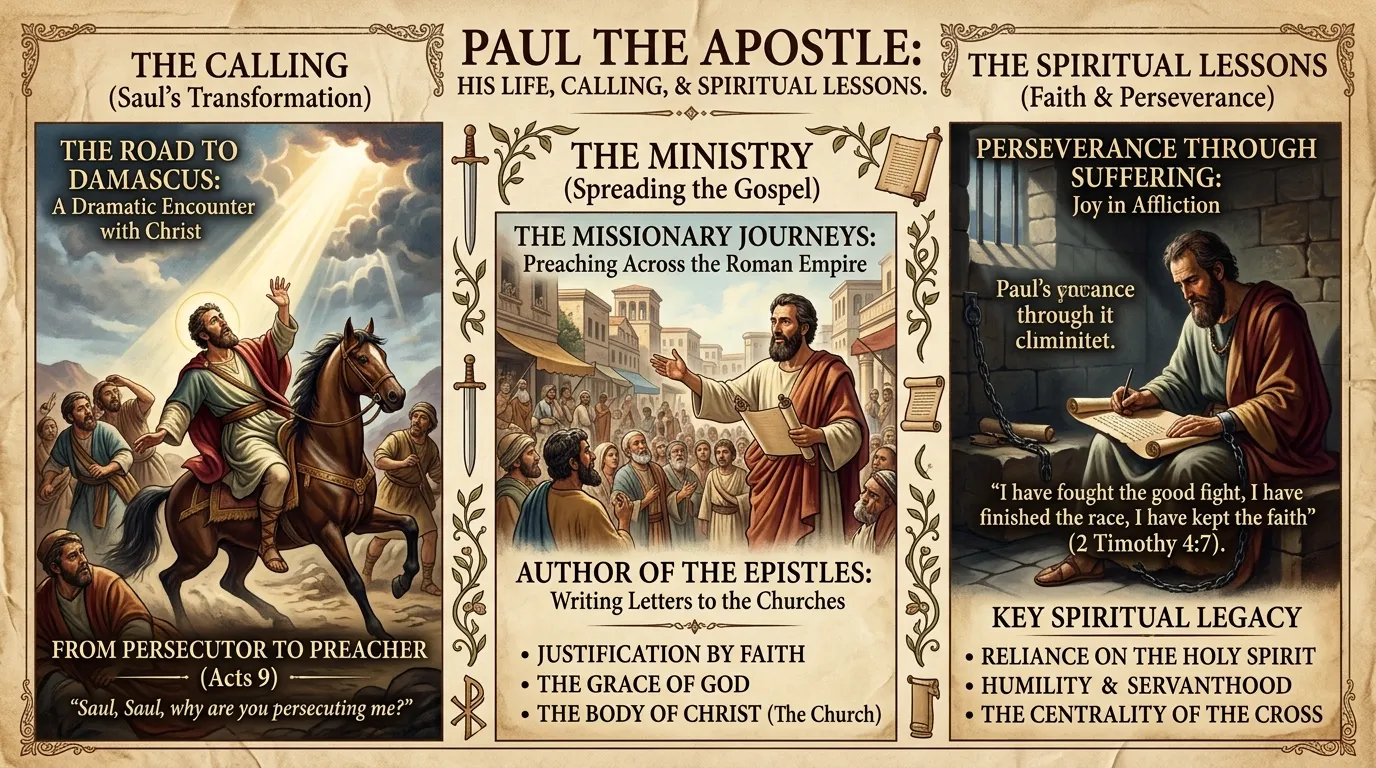
However, everything changed when Paul encountered the risen Jesus while traveling to Damascus. Acts 9 describes how a bright light surrounded him and how Jesus asked, Why are you persecuting me?
Paul was blinded for a time. A disciple named Ananias later prayed for him, and Paul’s sight returned.
After this encounter, Paul was baptized and began preaching that Jesus is the Son of God.
The Bible presents Paul’s transformation as an act of God’s grace, not human goodness.
What Does Paul the Apostle Mean in the Bible?
The Bible does not give a single symbolic definition for the phrase Paul the apostle. Instead, Paul’s life and ministry reveal several important biblical themes.
His story can point us toward:
- God’s grace
- Repentance and transformation
- Faith in Jesus Christ
- Redemption
- Christian service
- Courage during suffering
- Obedience to God’s calling
- The power of the gospel
- Hope for people with difficult pasts
These themes come directly from Paul’s life and teachings.
Paul himself described his past honestly. In 1 Timothy 1:13–16, he explained that he had once been a persecutor and violent opponent of Christians. Yet he received mercy.
He then connected his own story to God’s patience and grace.
This gives Paul’s story a powerful message: your past does not have to be the final word over your life when you turn to Christ.
Paul the Apostle Hebrew Meaning
The name Paul does not come from Hebrew. It comes from the Greek form Paulos, which is related to the Latin name Paulus, commonly understood as small or humble.
Before he was commonly known as Paul, the Bible calls him Saul. Saul is a Hebrew name derived from the Hebrew Sha’ul, meaning asked for, requested, or prayed for.
So, if you are searching for the Paul the apostle Hebrew meaning, it is important to make this distinction:
- Paul — from Greek/Latin, commonly associated with “small” or “humble”
- Saul — Hebrew, meaning “asked for” or “requested”
- Paul the apostle — a biblical title describing Paul’s role as a messenger of Jesus Christ
Scripture does not say that Paul changed his name because he became more humble. Acts 13:9 simply says, Saul, who also is called Paul.
Therefore, Christians should be careful not to claim that the Bible teaches a hidden spiritual meaning behind his name change.
The important biblical message is not the name itself but the transformation of the person who carried it.
Why Was Saul Called Paul?
A common question is why Saul became known as Paul.
Acts 13:9 gives us the clearest answer: “Saul, who also is called Paul.” This shows that he had both names.
Paul was a Jewish man who also had Roman citizenship, as Acts 22:25–28 explains. His Roman background and his ability to move among different cultures were useful during his missionary work.
The Bible does not specifically say, “Saul changed his name when he became a Christian.”
Instead, Luke begins using the name Paul prominently as Paul’s ministry among Gentiles develops.
This is important because it prevents us from building a teaching on something Scripture does not actually say.
What Was Paul’s Calling?
Paul’s calling was to proclaim Jesus Christ, especially among the Gentiles.
In Acts 9:15, Jesus tells Ananias that Paul is a chosen instrument who would carry Christ’s name before Gentiles, kings, and the children of Israel.
Paul later described himself as an apostle to the Gentiles. Romans 11:13 says, “I speak to you Gentiles, inasmuch as I am the apostle of the Gentiles.”
His mission was not simply to travel and speak.
Paul preached that salvation comes through faith in Jesus Christ. He taught churches how to live in unity, holiness, love, humility, and faith.
His letters helped early Christians understand the gospel and apply it to everyday life.
What Can Paul’s Conversion Teach Christians?
Paul’s conversion is one of the strongest examples of transformation in the New Testament.
Before Damascus, Saul believed he was doing the right thing by opposing Christians. But his encounter with Jesus exposed his error.
He did not simply change his opinion.
His entire direction changed.
This teaches Christians that real repentance involves turning toward God.
God Can Change a Hard Heart
Sometimes we look at another person and think they will never change.
Paul’s story challenges that idea.
The man who once persecuted Christians later suffered greatly for preaching Christ. His life became evidence of the mercy he had received.
This does not mean every person will change in the same way Paul did. But Scripture clearly teaches that God’s grace can transform sinners.
Your Past Does Not Disqualify You
Paul never pretended his past did not exist.
Instead, he openly remembered it as evidence of God’s mercy.
In 1 Corinthians 15:9–10, Paul called himself the least of the apostles because he had persecuted the church. Yet he immediately emphasized God’s grace working through him.
Grace does not deny the past. Grace gives the past a new place in the story.
God’s Calling May Require Courage
Paul knew that following Christ would bring suffering.
In Acts 20:24, he said that his life was not more important than completing the ministry Jesus had given him.
This kind of commitment can encourage Christians who are facing pressure at work, school, family life, or ministry.
Faith does not always make life easy.
Sometimes faith gives us the courage to keep going when life is hard.
What Does Paul Teach About God’s Grace?
Grace is one of the strongest themes in Paul’s writings.
Ephesians 2:8–9 teaches that believers are saved by grace through faith, not because of their own works.
Paul knew this personally.
He had no reason to boast about his past. Instead, he saw God’s mercy as a gift.
In 2 Corinthians 12:9, Paul records Christ’s words:
“My grace is sufficient for thee: for my strength is made perfect in weakness.”
The immediate context concerns Paul’s weakness and suffering.
The lesson is powerful: God’s strength does not depend on human perfection.
When Christians feel weak, ashamed, or inadequate, Paul’s teaching points them back to God’s grace rather than their own ability.
Paul and the Meaning of Suffering
Paul’s life was not free from pain after he became a Christian.
He faced imprisonment, beatings, rejection, danger, hunger, and many other hardships. Second Corinthians 11:23–28 gives a striking picture of the difficulties he experienced.
Yet Paul continued preaching Christ.
His example does not mean Christians should seek suffering or believe every hardship has a specific hidden meaning.
Instead, Paul’s life shows that suffering does not automatically mean God has abandoned you.
Romans 8:38–39 teaches that nothing can separate believers from the love of God in Christ Jesus.
That truth can bring comfort when life feels overwhelming.
What Does Paul Mean Spiritually?
When Christians ask about the spiritual meaning of Paul, they may be asking what his story represents in their own walk with God.
The Bible supports several meaningful applications.
Paul Can Represent Transformation
Paul’s life shows a dramatic change from persecutor to preacher.
Spiritually, his story can remind us that God is able to redirect a life.
Paul Can Represent Grace
Paul never treated his salvation as something he earned.
His testimony points back to mercy.
When you feel unworthy, Paul’s story can remind you that God’s grace is greater than your failures.
Paul Can Represent Faithful Service
Paul used his life to serve Christ.
His example encourages Christians to use their gifts, time, words, and opportunities to honor God.
Paul Can Represent Perseverance
Paul continued serving even when the road became painful.
His life encourages believers not to give up when obedience becomes difficult.
These are reasonable spiritual applications. However, Scripture does not teach that Paul represents one secret symbol or that every mention of Paul has a hidden prophetic meaning.
What Does It Mean to Dream About Paul the Apostle?
Some people may dream about Paul, read about him repeatedly, or feel that his story connects strongly with something happening in their lives.
A dream about Paul could lead someone to think about faith, calling, repentance, courage, preaching, grace, or spiritual growth.
However, the Bible does not give a fixed meaning for dreaming about Paul.
Therefore, Christians should avoid saying, “If you dream about Paul, God definitely means this.”
Scripture gives a safer approach.
Test spiritual impressions against God’s Word.
First John 4:1 tells believers to test the spirits. First Thessalonians 5:21 also encourages Christians to test everything and hold on to what is good.
A dream may reflect things you have been thinking about, reading, fearing, or hoping for. It does not automatically carry a message from God.
If a dream causes you to think about repentance, forgiveness, prayer, or following Christ, you can bring those thoughts to God without assuming the dream itself was a divine revelation.
Paul the Apostle and Everyday Christian Life
Paul’s story is not only for Bible scholars or church leaders.
It speaks to ordinary life.
Imagine someone who made serious mistakes before coming to Christ. They may think, “God could never use someone like me.”
Paul’s life offers a different perspective.
Or imagine a Christian who feels weak while caring for a sick family member, struggling at work, or facing rejection because of faith.
Paul’s words about God’s grace and strength can offer comfort.
Consider these everyday applications:
- When you feel guilty: Remember God’s grace and seek genuine repentance.
- When you feel weak: Depend on God’s strength rather than pretending you are strong.
- When you feel rejected: Remember that faithfulness is more important than popularity.
- When you have a difficult past: Let God’s redemption shape your future.
- When you have an opportunity to serve: Use it faithfully and humbly.
- When you face hardship: Pray for endurance instead of assuming God has left you.
What Are the Main Lessons From Paul’s Life?
Paul’s life gives Christians many practical lessons.
God’s Grace Can Transform Anyone
Paul’s past was serious, but God’s mercy was greater.
This does not make sin unimportant. Instead, it shows the depth of God’s grace toward those who turn to Him.
Humility Matters
Paul repeatedly pointed away from himself and toward Christ.
In Galatians 2:20, he described his life as one centered on Christ living in him.
Christian service should not become a search for personal glory.
Faith Requires Action
Paul did not stop at believing.
He traveled, preached, taught, encouraged churches, endured suffering, and cared deeply about other believers.
Faith affected how he lived.
The Gospel Is for All People
Paul’s ministry to Gentiles helped show the universal reach of the gospel.
Galatians 3:28 emphasizes the unity believers have in Christ. The gospel crosses human divisions and brings people together under Christ.
Perseverance Is Part of Christian Growth
Paul’s life reminds us that following Jesus can require patience.
Growth may take time.
Faithfulness often means taking the next right step even when we cannot see the whole road.
What Is the Difference Between Paul and Saul in the Bible?
Saul and Paul refer to the same person.
Saul is the name used often earlier in his story, especially in Acts 7–13. Acts 13:9 identifies him as Saul, also called Paul.
After this point, Luke generally refers to him as Paul.
Paul was his Roman name, while Saul was his Jewish name.
The Bible does not present two different people.
Why Is Paul Important to Christianity?
Paul is important because God used his ministry to spread the gospel widely throughout the ancient world.
The Book of Acts records several missionary journeys. Paul preached in cities, taught new believers, helped establish churches, and wrote letters that became part of the New Testament.
Letters traditionally associated with Paul include Romans, 1 and 2 Corinthians, Galatians, Ephesians, Philippians, Colossians, 1 and 2 Thessalonians, 1 and 2 Timothy, Titus, and Philemon.
Paul’s writings address subjects such as:
- Salvation
- Faith
- Grace
- Love
- Christian freedom
- The church
- Spiritual gifts
- Resurrection
- Marriage and family
- Christian conduct
- Suffering
- Hope
- The return of Christ
His writings continue to guide Christians around the world.
Frequently Asked Questions About Paul the Apostle
What does Paul mean in the Bible?
Paul is the name of the apostle who preached Jesus Christ throughout much of the ancient Mediterranean world. The name Paul is commonly associated with the meaning small or humble, although the Bible’s main focus is on Paul’s life, calling, and ministry rather than the symbolic meaning of his name.
What is the Hebrew meaning of Paul?
Paul is not originally a Hebrew name. It comes from Greek and Latin usage and is commonly connected with the meaning small or humble. Paul’s earlier name, Saul, comes from the Hebrew Sha’ul, meaning asked for or requested.
Why did Saul become Paul?
Acts 13:9 says, “Saul, who also is called Paul.” This indicates that he had both names. Scripture does not specifically say that his name was changed because of his conversion.
What does Paul symbolize spiritually?
Paul’s biblical story can remind Christians of grace, repentance, transformation, courage, faithful service, and redemption. These applications are grounded in his biblical life and teachings rather than in a secret symbolic code.
What can Paul’s conversion teach us?
Paul’s conversion teaches that God can dramatically redirect a person’s life. It also shows that salvation and ministry are gifts of God’s grace rather than rewards for human perfection.
What did Paul suffer for his faith?
Paul experienced imprisonment, beatings, danger, rejection, hunger, and other hardships because of his ministry. Second Corinthians 11 describes many of these trials. Yet he continued to serve Christ.
Does dreaming about Paul have a biblical meaning?
The Bible does not give a universal meaning for dreaming about Paul. A dream should not automatically be treated as a message from God. Christians should test spiritual impressions against Scripture and respond with prayer and wisdom.
Final Thoughts on Paul the Apostle Meaning in the Bible
The story of Paul is ultimately not a story about a perfect man.
It is a story about a merciful God.
Paul had a painful past. He made serious mistakes. He once fought against the very people he later served. Yet Christ met him, forgave him, changed his direction, and gave him work to do.
That does not mean every Christian will have a Damascus-road experience. God works in different ways in different lives. But Paul’s story gives us a lasting reason to hope.
Your past does not have to define your future.
If you feel weak, remember Paul’s words: God’s grace is sufficient.
If you feel lost, ask God for wisdom and direction.
If you feel unworthy, remember that salvation is rooted in grace.
If you are facing hardship, keep trusting Christ one step at a time.
And if you believe God is calling you to serve, begin faithfully with what He has placed in front of you.
The deepest Paul the apostle meaning in the Bible is found not in a hidden code, but in the gospel Paul preached: Jesus Christ saves, God’s grace transforms, and a surrendered life can be used for God’s glory.
Take Paul’s story to prayer. Ask God to show you where you need repentance, where you need courage, and where you can serve others with love. Then trust Him with the next step.
The God who transformed Paul’s life is still a God of grace, redemption, wisdom, and hope.