Before we say anything about the number 5, we need to say something about numbers. The Bible never assigns fixed meanings to numbers the way a dictionary assigns definitions to words. There is no verse that says “5 means grace” the way a verse says “God is love.” Anyone who tells you otherwise is reading a system into Scripture that Scripture itself never teaches. That honesty matters, because the internet is full of confident charts declaring what each number “means,” and much of it is numerology dressed in Bible verses.
The Honest Disclaimer: What Scripture Does Not Do
Numerology, the belief that numbers carry hidden mystical powers or secret codes, is not a biblical discipline. The Bible warns against divination and omen-reading (Deuteronomy 18:10-12), and treating numbers as fortune-telling devices falls uncomfortably close to that territory. Seeing 5:55 on a clock is not a message from heaven. It is a clock doing what clocks do.
This does not mean numbers in the Bible are meaningless. It means their meaning comes from how Scripture uses them, not from a secret codebook. When a number recurs in significant contexts, thoughtful readers notice the pattern. But a pattern is an observation, not a doctrine. The difference matters enormously.
So what follows is not a decoder ring. It is a tour of where the number 5 shows up in Scripture, what those appearances have in common, and why generations of readers have associated the number with God’s grace. Take it as devotional reflection, not as revelation.
Five Books: The Foundation of Everything
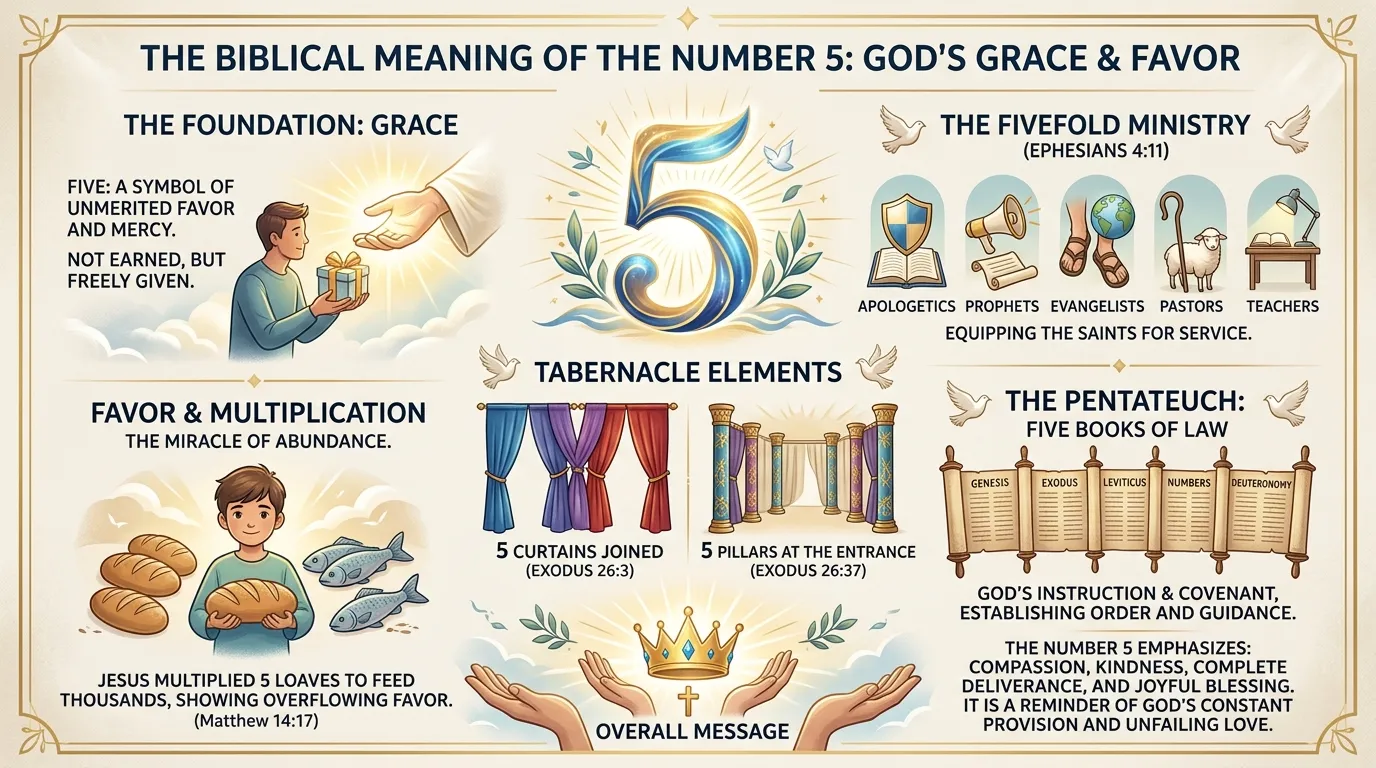
The most structural appearance of five in the Bible is the Pentateuch: the five books of Moses, Genesis through Deuteronomy. These five books are the foundation of the entire Bible. Every prophet, every psalm, every apostle builds on what these five establish: creation, fall, covenant, law, and the promise of redemption.
The number five here is not mystical; it is literary and historical. But it is significant that God’s foundational revelation came in five parts. The Torah in five scrolls became the pattern for later fives: the Psalms are divided into five books, deliberately mirroring the Pentateuch. The shape of Scripture itself keeps returning to five, as if the number had become, by usage, a signature of God’s foundational work.
For the devotional reader, the connection is suggestive rather than dogmatic: the five books that lay the foundation of God’s Word are the books of grace, the story of a God who creates, chooses, rescues, and provides for people who deserve none of it.
Five Loaves: Grace Multiplied
The most famous five in the New Testament sits in a boy’s lunch: five barley loaves and two fish, offered to Jesus before a crowd of thousands (John 6:9). What happened next is the only miracle recorded in all four Gospels: Jesus multiplied the small offering until five thousand men, plus women and children, ate their fill, with twelve baskets left over.
Notice the pattern. Human insufficiency, five loaves for a multitude, meets divine abundance, and the result is more than enough. This is the shape of grace: God takes what is small and inadequate and makes it overflow. Readers have long seen in the five loaves a picture of grace itself, not because the number 5 is magic, but because the story is about grace, and the number happens to be five.
Jesus Himself drew the lesson the next day: “I am the bread of life. Whoever comes to me will never go hungry” (John 6:35). The miracle pointed beyond full stomachs to the true bread from heaven. The five loaves were a signpost, and signposts matter, but only because of where they point.
Five Stones, Five Wounds, Five Virgins: The Other Fives
David walked down to the brook and chose five smooth stones before facing Goliath (1 Samuel 17:40). He needed only one, but he took five, prepared, trusting, ready. The story is not about the number; it is about a shepherd boy whose confidence was in the Lord. Still, the five stones have become, in Christian imagination, a picture of God-given preparation meeting God-sized problems.
Tradition speaks of Christ’s five wounds: the nail prints in His hands and feet and the spear wound in His side. Scripture does not number them this way, and we should be honest about that. But the devotional tradition is pointing at something real: the completeness of Christ’s suffering, grace purchased at every point.
Jesus’ parable of the ten virgins divides them into five wise and five foolish (Matthew 25:2). Five were ready for the bridegroom; five were not. The number here is simply half of ten, a narrative device, not a symbol. But the parable’s warning is real: readiness cannot be borrowed, and the door closes.
The lesson across these examples is consistency: sometimes five is just five. Wisdom means knowing when a number is doing symbolic work and when it is simply counting.
Five Cubits: The Measurements of Worship
The tabernacle, God’s dwelling place among Israel, was full of fives. The altar of burnt offering was five cubits long and five cubits wide (Exodus 27:1). The courtyard hangings, the pillars, the sockets, the details of the sacred furniture return to five again and again. This is not accident or mysticism; it is design. The place where atonement happened, where sin was dealt with and fellowship restored, was measured in fives.
For the reflective reader, there is a quiet symmetry here: the God who dwells among His people does so in a house marked by the number that keeps showing up wherever He gives generously. The tabernacle was grace made architectural, a place where guilty people could approach a holy God and live. Its fives are worth noticing, not as a code, but as one more brushstroke in the portrait.
Why Readers Associate Five With Grace
So where does the “five means grace” idea come from? Partly from the patterns above: the five books of foundational revelation, the five loaves of multiplied provision, and the general biblical pairing of fives with God’s generous acts. Partly, too, from the Hebrew word for grace and related numerical observations that are more clever than convincing.
Here is the responsible way to hold this association: as a devotional observation, not a doctrine. It is fine, even fruitful, to notice that fives in Scripture often show up where God is giving generously. It is not fine to build teachings, predictions, or spiritual authority on the number. The moment “five means grace” becomes a rule for interpreting dreams, dates, or decisions, it has crossed from observation into superstition.
The Bible’s actual teaching about grace needs no numerical support. “For it is by grace you have been saved, through faith” (Ephesians 2:8). That sentence carries more weight than every number chart on the internet combined. If the fives of Scripture remind you of grace, let them. Just let Scripture, not the number, define what grace is.
How to Read Numbers Wisely
A few principles will keep any reader on solid ground. First, let clear passages interpret unclear patterns. If a number seems significant, check whether Scripture itself draws attention to it. The Bible explicitly highlights seven as completeness and three as divine fullness in ways it never does for five.
Second, distinguish description from prescription. The Bible describes fives appearing in various stories. It never prescribes five as a spiritual tool. You cannot pray “in fives” to unlock blessing, and no verse suggests you should try.
Third, beware of systems that make you feel like an insider. Numerology’s appeal is partly the thrill of secret knowledge, of seeing what others miss. But the gospel is public truth, proclaimed openly. “We have not received the spirit of the world but the Spirit who is from God, so that we may understand what God has freely given us” (1 Corinthians 2:12). What God wants you to know, He has said plainly.
Finally, enjoy the patterns without worshipping them. There is genuine delight in noticing how often five accompanies God’s generous acts in Scripture. Delight is fine. Devotion to the pattern is not. The fives are signposts; grace itself is the destination.
The Grace the Fives Point To
In the end, the number 5 in the Bible is valuable the way a frame is valuable: it draws your eye to the picture. And the picture is always the same. A God who gives what is not deserved. Five books laying the foundation of His Word. Five loaves feeding a multitude. Five stones in a shepherd’s pouch. A Savior whose wounds purchased our peace.
If the number 5 has been catching your eye lately, let it do what the loaves did: point you to Jesus. Not to a code, not to a prediction, not to a secret, but to the bread of life, who satisfies every hunger. That is the only message any number in the Bible was ever meant to deliver. Readers interested in the mathematical and cultural history of the number itself, quite apart from biblical interpretation, can explore the Wikipedia article on the number 5 for a fascinating tour of its many appearances in human thought.