The prophet walks into the palace with a story about a rich man, a poor man, and a stolen lamb. King David — the most powerful man in the nation — listens, burns with anger at the injustice, and declares the rich man deserves to die. Then Nathan drops the four most devastating words in the Old Testament: “Thou art the man” (2 Samuel 12:7).
That is a rebuke. Not a suggestion, not feedback, not a gentle observation — a direct, unmistakable confrontation of sin, delivered to a king who could have ordered the prophet’s execution. And it worked: “David said unto Nathan, I have sinned against the LORD” (2 Samuel 12:13), and Psalm 51 was born. The Bible treats rebuke not as rudeness but as rescue — one of God’s appointed means of saving people from themselves.
What Rebuke Actually Is
The Hebrew word most often translated “rebuke” is yakach — to argue, convince, correct, judge. It is a legal word as much as a relational one: to rebuke is to present the case against someone’s course and call for a verdict. The Greek New Testament uses elenchō — to expose, convict, refute — the same word Jesus uses for the Holy Spirit’s work: “he will reprove the world of sin” (John 16:8).
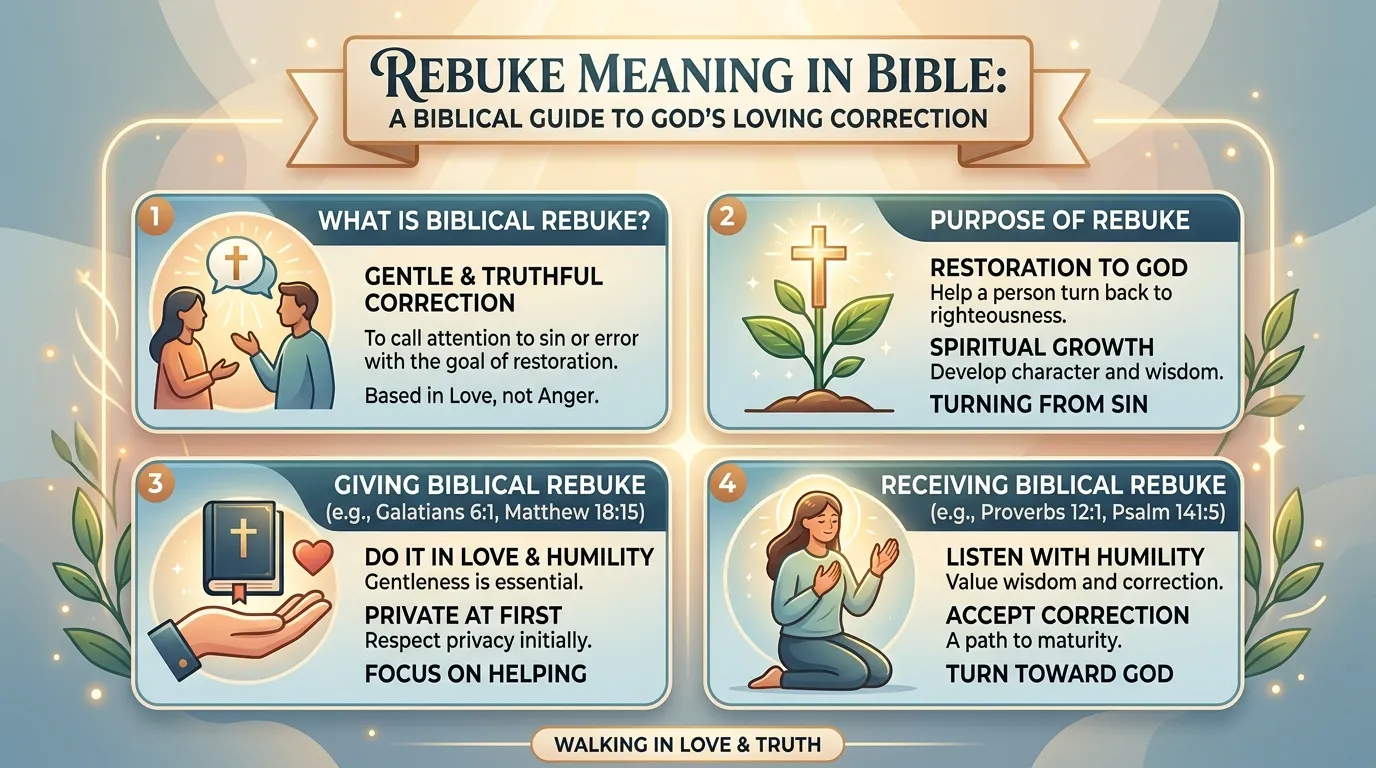
Notice what rebuke is not. It is not nagging, which repeats without aim. It is not slander, which speaks about rather than to. It is not venting, which serves the speaker’s feelings. Biblical rebuke is truth spoken directly to the person, for the person’s good, with the aim of restoration. Every element matters; remove one and it becomes something else — flattery without truth, cruelty without love, or noise without purpose.
Nathan’s Masterclass: How to Rebuke a King
Nathan’s confrontation of David is the textbook, and its technique deserves study:
He earns the hearing first. Nathan does not open with accusation. He tells a story — the rich man with many flocks, the poor man with one beloved lamb — and lets David’s own sense of justice engage. By the time the trap springs, David has already pronounced his own sentence. The best rebukes awaken the conscience before they name the sin.
He is specific. “Thou art the man” leaves no wiggle room, and what follows is itemized: the stolen wife, the murdered husband, the despised commandment (2 Samuel 12:9-10). Vague rebuke (“you need to do better”) produces vague guilt; specific rebuke produces specific repentance.
He speaks for God, not himself. “Thus saith the LORD God of Israel” (2 Samuel 12:7). Nathan’s authority is borrowed, and he knows it. Rebuke curdles into self-righteousness the moment it becomes my offense rather than God’s truth. The rebuker is a messenger, not a judge.
He leaves room for grace. The confrontation includes consequences — the sword will not depart from David’s house — but also immediate forgiveness: “The LORD also hath put away thy sin; thou shalt not die” (2 Samuel 12:13). Rebuke that offers no path back is not biblical; it is just punishment with religious language.
Proverbs: The Theology of Being Corrected
No book celebrates rebuke like Proverbs — which tells you how countercultural the Bible is here. “Reprove not a scorner, lest he hate thee: rebuke a wise man, and he will love thee” (Proverbs 9:8). The mark of wisdom is not never needing correction; it is loving the one who gives it.
“He that hateth reproof is brutish” (Proverbs 12:1) — strong language for a common condition. “The ear that heareth the reproof of life abideth among the wise” (Proverbs 15:31). “As an earring of gold, and an ornament of fine gold, so is a wise reprover upon an obedient ear” (Proverbs 25:12). Correction, in Proverbs’ economy, is jewelry — an adornment, a gift, a sign of honor. The person with no one willing to rebuke them is not fortunate; they are abandoned.
And the motive is love, explicitly: “For whom the LORD loveth he correcteth; even as a father the son in whom he delighteth” (Proverbs 3:12). Hebrews quotes this to suffering Christians (Hebrews 12:6): divine rebuke — including the painful kind — is paternal, not hostile. God corrects His children because they are His children.
Jesus, Who Rebuked Everything
Christ’s rebukes survey the whole range of the practice. He rebukes nature: “he arose, and rebuked the wind, and said unto the sea, Peace, be still” (Mark 4:39) — authority over chaos itself. He rebukes demons: “he rebuking them suffered them not to speak” (Luke 4:41) — no negotiation with evil. He rebukes people He loves — which is the point. He rebukes Peter: “Get thee behind me, Satan” (Matthew 16:23), the sharpest words He ever spoke to a friend, aimed at a well-meant but God-contradicting suggestion. He rebukes James and John for wanting to call down fire on Samaritans: “Ye know not what manner of spirit ye are of” (Luke 9:55). He rebukes the disciples’ ambition, their exclusiveness, their slowness to believe.
Yet His rebukes never crush. Peter, rebuked as “Satan,” becomes the rock. The pattern holds: Jesus wounds to heal, confronts to restore. “As many as I love, I rebuke and chasten” (Revelation 3:19) — love and rebuke in the same sentence, from His own mouth.
Paul: Rebuke as Ministry
Paul commands rebuke as a pastoral duty: “Preach the word; be instant in season, out of season; reprove, rebuke, exhort with all longsuffering and doctrine” (2 Timothy 4:2). Three verbs — reprove (convince of error), rebuke (confront sharply), exhort (call forward) — held together by “longsuffering.” Sharpness without patience is not the apostolic model.
And Paul practices it at the highest level: when Peter withdraws from Gentile believers under pressure, Paul “withstood him to the face, because he was to be blamed” (Galatians 2:11) — a public rebuke of the most senior apostle, over gospel truth. The incident proves that no one outranks correction, and that the gospel itself is worth a confrontation.
When Rebuke Fails: The Scorning Heart
Proverbs is honest that rebuke does not always work — and the reason is never the rebuke’s fault. “He that reproveth a scorner getteth to himself shame: and he that rebuketh a wicked man getteth himself a blot” (Proverbs 9:7). The scorner (luts in Hebrew — the mocker, the cynic) does not merely reject correction; he punishes the corrector. “Reprove not a scorner, lest he hate thee” (Proverbs 9:8).
Jesus gives the same warning in His most quoted sermon: “Give not that which is holy unto the dogs, neither cast ye your pearls before swine, lest they trample them under their feet, and turn again and rend you” (Matthew 7:6). There comes a point where continued rebuke is not faithfulness but futility — and where the rebuker becomes the victim. Paul instructs Titus: “A man that is an heretick after the first and second admonition reject” (Titus 3:10). Two admonitions, then release.
This is not permission to give up quickly. Nathan did not get one hearing with David; the prophets spent lifetimes rebuking Israel. But wisdom knows the difference between a wise man who will love you for the rebuke (Proverbs 9:8) and a scorner who will hate you for it. Rebuke the first persistently; rebuke the second biblically — and then, like Paul shaking the dust (Acts 13:51), move on. You are responsible for the faithfulness of the rebuke, not for the softness of the heart.
One final word for both sides: pray before you speak, and pray after you hear. The rebuker needs the Spirit’s timing; the rebuked needs the Spirit’s softening. Rebuke works best as a three-way conversation — you, your brother, and God — and worst as a two-way collision.
Giving and Receiving: The Practical Art
When you must rebuke: Check your heart first — “considering thyself, lest thou also be tempted” (Galatians 6:1). Go privately first (Matthew 18:15). Be specific about the fault and clear about the hope. Speak “the truth in love” (Ephesians 4:15) — truth without love is brutality, love without truth is sentimentality. Aim at restoration, always: “restore such an one in the spirit of meekness.”
When you are rebuked: Listen before defending — “be swift to hear, slow to speak” (James 1:19). Ask whether there is truth in it even if the delivery was poor; God has spoken through flawed messengers before. Thank the rebuker if you can; Proverbs says the wise man will love you for it (Proverbs 9:8). And repent specifically — David named his sin; so should we.
Rebuke is love refusing to stay silent while someone you care about walks toward a cliff. Nathan risked his life for David’s soul, and David’s repentance gave the church Psalm 51. Somewhere in your life there is a Nathan you need to hear — and somewhere, perhaps, a David who needs you to speak. The Christian tradition has long called this mutual care by a formal name, and the Wikipedia article on fraternal correction traces how the church has practiced it; the practice itself begins with four words, spoken in love: thou art the man — and the humility to hear them.










