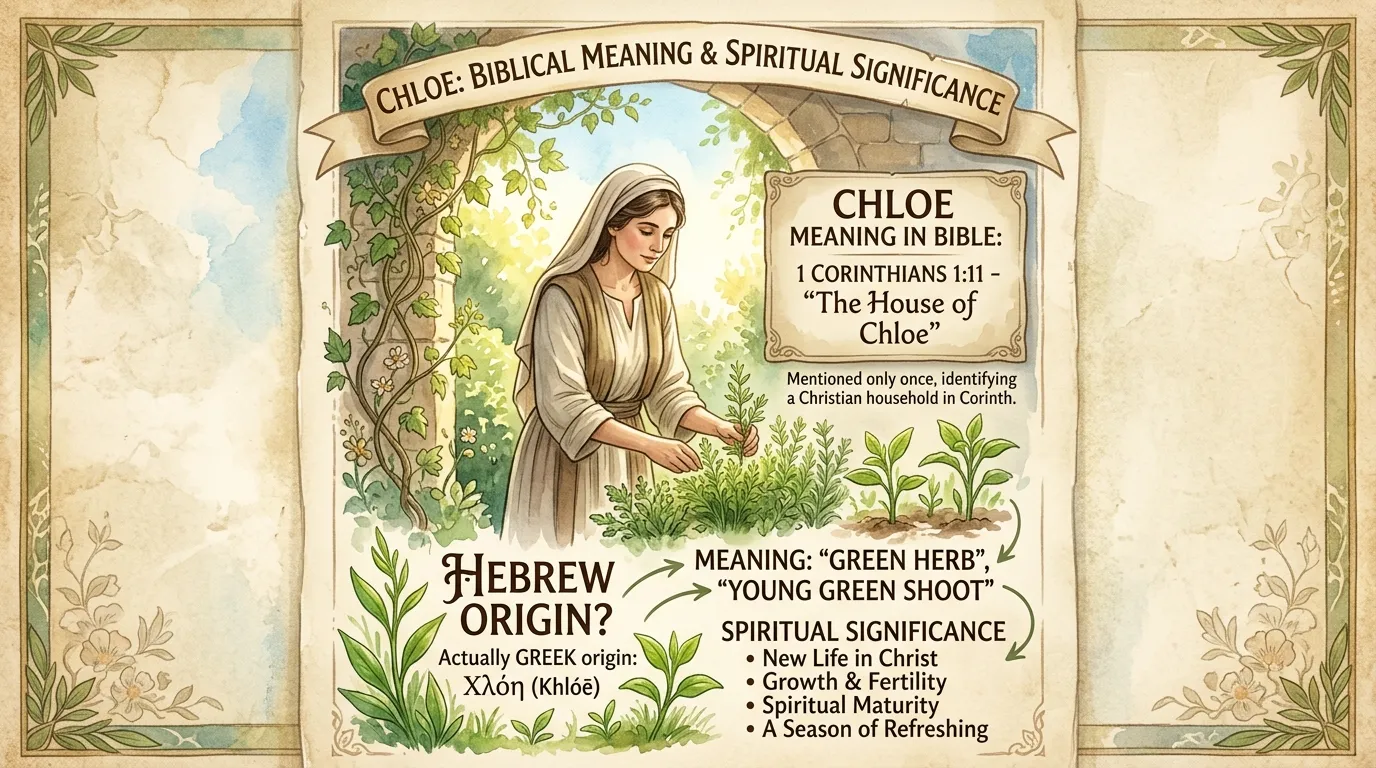
The apostle Paul is writing the most problem-heavy letter of his career. The church in Corinth is fracturing — into factions, into lawsuits, into arguments about marriage, food, worship, and resurrection. And in the opening chapter, as he diagnoses the divisions, Paul names his source with striking casualness: “it hath been declared unto me of you, my brethren, by them which are of the house of Chloe, that there are contentions among you” (1 Corinthians 1:11).
By them which are of the house of Chloe. One verse. One name. And from that single mention, a whole world opens — a woman, a household, a church connection, and a name whose meaning turns out to be a quiet sermon on exactly what Corinth needed: new growth.
The Name: A Green Shoot
Chloe is Greek, not Hebrew — fitting, since she belongs to the Greek-speaking world of the New Testament. The word chloē means fresh green vegetation: the young shoot, the new blade, the first green of spring. It was also an epithet of Demeter, goddess of agriculture, in the wider culture — but in Christian use, the agricultural image is what matters: new life pushing through old ground.
This is worth pausing over because the Bible returns to the green-shoot image again and again. “He shall be like a tree planted by the rivers of water, that bringeth forth his fruit in his season; his leaf also shall not wither” (Psalm 1:3). “I am the vine, ye are the branches” (John 15:5). Growth, freshness, fruitfulness — the vocabulary of the Christian life is botanical. A woman named “green shoot” reporting church divisions to Paul is almost too perfect: the new growth diagnosing the disease in the old branches.
The Household: What One Verse Reveals
Paul says “them which are of the house of Chloe” — her household. In the ancient world, a household meant family, servants, dependents, perhaps business associates: a network, not just a nuclear family. That Paul knows this household by name, and that its members have direct access to him in Ephesus, tells us several things.
First, Chloe was almost certainly a person of standing. Households are identified by their heads, and a household known across the Aegean suggests wealth, organization, and respect. Some scholars picture her as a businesswoman with agents traveling between Corinth and Ephesus; others as a well-connected Christian matron. Either way, obscurity does not get named in apostolic letters.
Second, her household was engaged. They did not merely observe the Corinthian quarrels; they reported them — to Paul, for action. This is not gossip. Gossip circulates downward and outward, feeding on division. What Chloe’s people did was the opposite: they carried the problem upward, to the one person who could address it with authority. There is a world of difference between talking about a church’s problems and reporting them to someone who can help.
Third, the household’s action was courageous. Informing on factional leaders in a status-obsessed city carried social risk. Chloe’s people chose the health of the church over their own comfort — the very definition of the “green shoot” spirit: new life willing to break hard ground.
The Quarrels: What Chloe’s People Reported
What were the “contentions”? Paul spells them out in the next verses: “every one of you saith, I am of Paul; and I of Apollos; and I of Cephas; and I of Christ” (1 Corinthians 1:12). Personality cults. The Corinthians had turned their teachers into team jerseys, dividing the church by loyalty to human leaders.
Paul’s response is withering: “Is Christ divided? was Paul crucified for you? or were ye baptized in the name of Paul?” (1 Corinthians 1:13). The factions are absurd on their face — no leader died for them, no leader’s name is on their baptism. And the whole sixteen-chapter letter that follows is, in a sense, Paul’s answer to Chloe’s household’s report: a systematic treatment of division, pride, immorality, disorder, and doubt.
Consider what this means: one of the most important letters in the New Testament exists because a household cared enough to speak up. Without Chloe’s people, there is no 1 Corinthians — no teaching on spiritual gifts, no love chapter, no resurrection chapter. Faithfulness in reporting a problem became, in God’s hands, Scripture for the ages. You never know what your small act of courage will become.
Green-Shoot People: The Biblical Company Chloe Keeps
Chloe’s name — green shoot — places her in a long biblical line of new-growth people: those through whom God brings fresh life into old situations.
Joseph the fruitful bough. Jacob blesses him: “Joseph is a fruitful bough, even a fruitful bough by a well; whose branches run over the wall” (Genesis 49:22). Betrayed, enslaved, imprisoned — and green through it all, nourished by a well others could not see. Chloe’s household, reporting division in a fractured church, shows the same resilience: green shoots do not wait for ideal conditions; they grow through the rubble.
The remnant shoot of Isaiah. “There shall come forth a rod out of the stem of Jesse, and a Branch shall grow out of his roots” (Isaiah 11:1). When the Davidic line is cut down to a stump, God grows a shoot from it — the Messiah Himself, the ultimate green shoot. Every act of new growth in God’s people participates in this pattern: stumps sprout, ruins revive, dead churches live again.
The Thessalonians: Paul’s green shoots. To another divided, struggling church Paul writes with the same delight he must have felt receiving Chloe’s report: “ye are our glory and joy” (1 Thessalonians 2:20). Young believers, fresh growth in hard soil — and Paul calls them his crown. God does not despise green shoots; He crowns Himself with them.
Chloe belongs to this company: the fruitful boughs, the stump-sprouts, the young churches. Her household’s single act of courage — carrying bad news to the right person — is exactly what green shoots do: break the hard ground so new life can emerge.
What Happened to Chloe? The Dignity of Obscurity
Here is the honest footnote: we do not know. Scripture never mentions Chloe again. No tradition reliably traces her later life; no letter answers her; no martyrology records her end. She appears in one verse, through other people’s report, and vanishes.
And that is precisely the encouragement. The kingdom of God runs on Chloes — faithful people whose names appear once, or never, in any record but heaven’s. “God is not unrighteous to forget your work and labour of love” (Hebrews 6:10). The household that gave the church 1 Corinthians is remembered for a single courageous act, and that is enough.
Most believers will be Chloes, not Pauls. Your faithfulness may never trend, never publish, never be thanked publicly. It may consist of one difficult conversation, one report to the right person, one refusal to let division stand. Do it anyway. The green shoot does not need to become a cedar to matter — it needs to grow, right where God planted it, toward whatever light it can find. Heaven keeps the records; history keeps the footnotes; faithfulness is its own reward, and then some.
The Green Shoot’s Lessons
New life confronts old decay. The meaning of Chloe’s name is the method of her household: fresh growth breaking into a rotting situation. Revival often comes not from the entrenched but from the newly green — those still tender enough to be grieved by what others have grown used to.
Unity is worth fighting for. Chloe’s household did not shrug at division. They treated quarrels as the emergency they are. “Endeavouring to keep the unity of the Spirit in the bond of peace” (Ephesians 4:3) is not passive; it is endeavour — effort, action, sometimes difficult conversations.
Report upward, not outward. The next time you see division in a church, a family, or a friendship, ask the Chloe question: am I talking about this to people who cannot fix it, or to someone who can? Gossip spreads the disease; godly reporting seeks the cure.
Growth is the goal. A green shoot does not stay a shoot — it grows toward fruit. The end of division is not merely peace but productivity: “that ye might walk worthy of the Lord unto all pleasing, being fruitful in every good work” (Colossians 1:10). Chloe’s name points past the quarrel to the harvest.
She appears once, speaks through others, and vanishes from the narrative — yet her household’s faithfulness gave the church one of its foundational letters, and her name still preaches: be the green shoot. In a divided church, a divided family, a divided heart — be the fresh growth that breaks the ground and reaches for the light. The Wikipedia entry on Chloe as a given name traces the name’s journey from ancient Greece to modern nurseries; its biblical moment, brief as it is, reminds us that God often does His largest work through the most briefly mentioned people.










