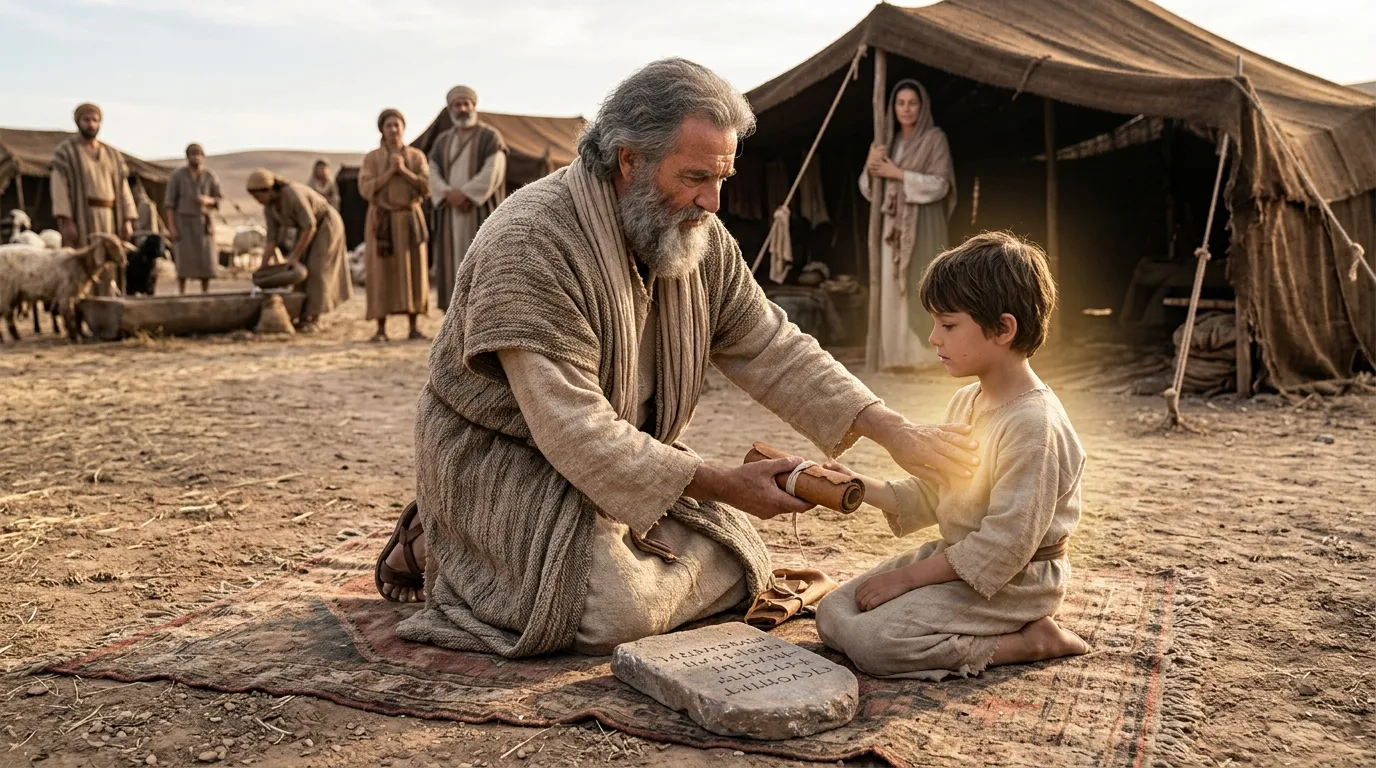
Abram is ninety-nine years old. He has waited a quarter-century for the promised son, watched his household grow complicated through Hagar and Ishmael, and received the same promise so many times it must have felt like an echo. Then God appears with a new name for him — Abraham, “father of multitudes” — and a new requirement: “This is my covenant, which ye shall keep, between me and you and thy seed after thee; Every man child among you shall be circumcised” (Genesis 17:10).
It is a startling command: a physical mark, intimate and permanent, as the sign of an eternal covenant. To modern readers it can seem strange or even off-putting. But Scripture treats circumcision with utter seriousness for two thousand years — and then, in the New Testament, reinterprets it so profoundly that the physical rite gives way to a spiritual reality. Understanding that journey is understanding how the whole Bible handles the relationship between outward signs and inward truth.
The Sign Given: Belonging Made Visible
Circumcision enters the story as the sign of the Abrahamic covenant — not the covenant itself, but its seal. “And ye shall circumcise the flesh of your foreskin; and it shall be a token of the covenant betwixt me and you” (Genesis 17:11). Abraham is circumcised at ninety-nine, Ishmael at thirteen, and every male in the household, “he that is born in the house, or bought with money of any stranger” (Genesis 17:12-13) — the sign covers the whole household, family and servants alike.
The timing matters: it is performed on the eighth day (Genesis 17:12). Before a child can choose, understand, or earn anything, he is marked as belonging. The sign declares grace before the recipient can respond to it — a pattern God will repeat in every covenant. And its placement — on the organ of generation — speaks of the seed: the promise runs through offspring, ultimately to the one Seed, Christ (Galatians 3:16).
The sign also means separation. To be circumcised is to be cut off from the nations and marked as God’s own — “a peculiar people” (Deuteronomy 14:2). The mark says: this one does not belong to Egypt, or Canaan, or himself. He belongs to Yahweh.
The Prophets’ Provocation: “Circumcise Your Hearts”
Within a generation, the danger appears: the sign without the reality. Israel bears the mark in the flesh while worshiping idols in the heart. So Moses — Moses, in the law itself — delivers the corrective: “Circumcise therefore the foreskin of your heart, and be no more stiffnecked” (Deuteronomy 10:16).
Jeremiah sharpens it to a warning: “Circumcise yourselves to the LORD, and take away the foreskins of your heart, ye men of Judah and inhabitants of Jerusalem: lest my fury come forth like fire” (Jeremiah 4:4). The prophets’ logic is relentless: a marked body with an unmarked heart is not covenant faithfulness — it is covenant hypocrisy. The outward sign was always meant to signify an inward cutting away of stubbornness, pride, and resistance to God.
This is the Bible’s permanent principle about all religious signs: the symbol must never be mistaken for the substance. The moment the mark becomes a substitute for the heart, it becomes an offense.
The Crisis: Must Gentiles Be Circumcised?
The question explodes in the early church. As Gentiles flood into the faith, some Jewish believers insist: “Except ye be circumcised after the manner of Moses, ye cannot be saved” (Acts 15:1). The Jerusalem Council convenes — the most important meeting in church history — and the verdict is decisive: Gentiles are not required to be circumcised (Acts 15:19-20, 28-29). Salvation never came through the sign; it always came through faith, as Abraham himself proves — he “believed God, and it was counted unto him for righteousness” (Romans 4:3) before he was circumcised (Romans 4:10).
Paul fights this battle most fiercely in Galatians, where requiring circumcision of Gentiles becomes, in his words, a different gospel — “which is not another” (Galatians 1:6-7). His argument is devastating: to add circumcision as a requirement is to declare Christ’s work insufficient. “If ye be circumcised, Christ shall profit you nothing” (Galatians 5:2) — not because the rite is evil, but because trusting in it displaces trusting in Christ. “In Jesus Christ neither circumcision availeth any thing, nor uncircumcision; but faith which worketh by love” (Galatians 5:6).
The True Circumcision: Made Without Hands
Paul does not discard the concept — he fulfills it. “For we are the circumcision, which worship God in the spirit, and rejoice in Christ Jesus, and have no confidence in the flesh” (Philippians 3:3). The true circumcision is not ethnic or physical; it is the community of those whose hearts have been cut away from self-reliance.
Colossians 2:11 gives the definitive statement: “In whom also ye are circumcised with the circumcision made without hands, in putting off the body of the sins of the flesh by the circumcision of Christ.” Notice — made without hands. No knife, no rite, no human ceremony. The cutting is done by God Himself, in union with Christ: the old self crucified, the “body of sin” stripped off (Romans 6:6).
And the sign of the new covenant? Baptism. “Buried with him in baptism, wherein also ye are risen with him through the faith of the operation of God” (Colossians 2:12) — Paul places baptism in the very sentence as circumcision’s successor. The outward sign remains (God still marks His people visibly), but the sign now declares what Christ has done, not what we must do.
The Eighth Day: Why the Timing Preaches
Why the eighth day? The command is specific — “he that is eight days old shall be circumcised among you” (Genesis 17:12) — and the specificity repays attention. Seven is the number of completeness in Scripture: seven days of creation, the seventh day of rest. The eighth day is the day beyond completeness — the first day of the new week, the day of new beginning.
The symbolism gathers force across the canon. Circumcision on the eighth day whispers that the covenant is about new creation, not merely improved old creation. And the New Testament picks up the eighth-day thread explicitly: Jesus rises on the first day of the week — the eighth day, the day after the Sabbath (John 20:1). The early church worships on the eighth day (Acts 20:7; 1 Corinthians 16:2). Peter calls the resurrection “the eighth day” hope in all but name: we are “begotten… again unto a lively hope by the resurrection of Jesus Christ from the dead” (1 Peter 1:3).
So the infant marked on the eighth day was being signed, unknowingly, with the number of resurrection. The old covenant’s sign pointed forward to the new covenant’s reality: a circumcision “made without hands” (Colossians 2:11), performed not on the eighth day of life but in the eighth-day event of history — the resurrection. The timing was never arbitrary. It was prophetic.
What “Circumcised Hearts” Look Like
The ancient rite, rightly understood, still preaches — because the heart-condition it pictured is permanent:
- Cut away stubbornness. The “stiffnecked” heart (Deuteronomy 10:16) is the heart that will not bend — to correction, to conviction, to God’s clear word. The circumcised heart yields.
- Cut away self-reliance. “No confidence in the flesh” (Philippians 3:3) — not in pedigree, performance, ritual, or morality. The heart stripped of its own righteousness is ready for Christ’s.
- Marked as belonging. The sign said God’s own; the reality says it louder. “Ye are not your own… ye are bought with a price” (1 Corinthians 6:19-20). Belonging shapes behavior: the marked life looks different.
- Received, not achieved. Eighth-day circumcision marked infants who had done nothing. New-covenant grace marks sinners who have done nothing to deserve it. The sign always pointed to gift, never to wage.
- Open to all. The sign was given to infants, servants, and foreigners bought with money (Genesis 17:12-13) — the covenant’s mark was never restricted by achievement or ethnicity. So the heart-reality: “there is neither Jew nor Greek… for ye are all one in Christ Jesus” (Galatians 3:28). The circumcised heart belongs to whoever believes.
From Abraham’s tent to the Jerusalem Council to the baptismal waters, the story of circumcision is the story of God teaching His people to look past the mark to the meaning — past the flesh to the heart, past the sign to the Savior. The knife is laid down; the reality remains — and the reality is better than the rite, being God’s own work on the heart, forever. “He is a Jew, which is one inwardly; and circumcision is that of the heart, in the spirit, and not in the letter; whose praise is not of men, but of God” (Romans 2:29). For the broader religious and historical context of the practice across traditions, the Wikipedia article on religious male circumcision provides useful background; the Bible itself provides the theology — a covenant sign that always pointed beyond itself, to the heart God would one day circumcise Himself.










