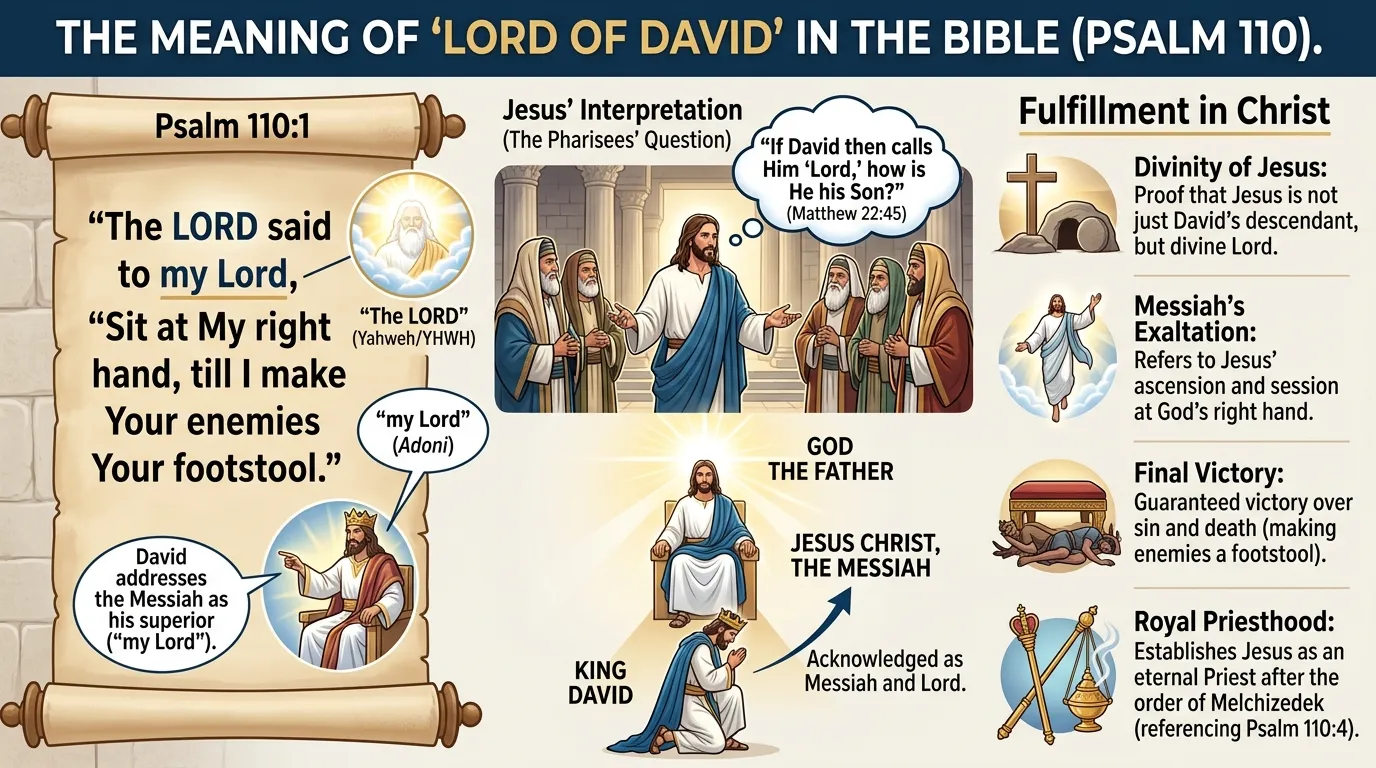
“The Lord said to my Lord: ‘Sit at my right hand until I make your enemies a footstool for your feet.'” Those words — Psalm 110:1 — are the most quoted Old Testament verse in the New Testament. Jesus Himself quoted them to silence His critics: “If David calls him ‘Lord,’ how can he be his son?” (Matthew 22:45). The riddle is the key to one of the Bible’s most important titles: Jesus is the Lord of David. He is David’s descendant, and He is David’s superior. He is the Son of David, and He is the Lord of David. Both are true, and both matter.
This article unpacks that riddle: what “Lord of David” means, how Psalm 110 works, how Jesus used it, and why it is central to the Christian claim about who Jesus is.
The Riddle in the Temple
The scene is Matthew 22. Jesus had silenced the Sadducees and the Pharisees in a series of confrontations. Then He asked them a question of His own: “What do you think about the Messiah? Whose son is he?” They answered, “The son of David.” That was the standard, correct answer. Every Jew knew the Messiah would be David’s descendant — the prophets had promised it. Then Jesus quoted Psalm 110: “How is it then that David, speaking by the Spirit, calls him ‘Lord’? For he says, ‘The Lord said to my Lord: Sit at my right hand.’ If then David calls him ‘Lord,’ how can he be his son?”
The crowd was stunned. “No one could say a word in reply, and from that day on no one dared to ask him any more questions” (Matthew 22:46). The riddle was not a trick. It was a revelation. The Messiah could not be merely David’s descendant. A father does not call his son “Lord” in the ancient world — the hierarchy runs the other way. David was confessing that the Messiah was greater than himself. The Messiah would be David’s son by descent, but David’s Lord by nature.
Psalm 110: The Most Quoted Psalm
Psalm 110 is a royal psalm, written by David, and it contains two oracles. The first is the enthronement: “The Lord said to my Lord: Sit at my right hand until I make your enemies a footstool for your feet.” The second is the priesthood: “The Lord has sworn and will not change his mind: ‘You are a priest forever, in the order of Melchizedek.'” The psalm combines two offices — King and Priest — that were strictly separated in Israel. Kings came from Judah; priests came from Levi. No one could hold both. But the Messiah would hold both, in the order of Melchizedek, the mysterious priest-king of Genesis 14 who blessed Abraham.
The New Testament quotes or alludes to Psalm 110 more than any other Old Testament passage. Peter quoted it at Pentecost to explain the resurrection and ascension. Paul echoed it in 1 Corinthians 15 to describe Christ’s reign. The writer of Hebrews built an entire argument on it, devoting chapters 5 through 7 to the Melchizedek priesthood. The psalm is the New Testament’s favorite proof text, because it says in one verse what the whole gospel says in full: the Messiah is enthroned, victorious, and priestly.
Son of David: The Human Line
The “Son of David” half of the riddle is the human half. Jesus was born in Bethlehem, the city of David. Matthew’s genealogy traces His legal line through Joseph to David. Luke’s genealogy traces His bloodline through Mary to David. The blind men cried, “Son of David, have mercy on me!” The crowds at the triumphal entry shouted, “Hosanna to the Son of David!” The title meant: the promised King has come, the heir of David’s throne, the one who will fulfill the covenant God made with David in 2 Samuel 7 — “Your house and your kingdom will endure forever before me; your throne will be established forever.”
The Son of David title grounds Jesus in history. He is not a myth, a philosophy, or a spirit. He is a man with a genealogy, a hometown, a family, and a throne to inherit. The incarnation is real. The blood is real. The descent from David is real.
Lord of David: The Divine Claim
The “Lord of David” half is the divine half. David, speaking by the Spirit, called the Messiah “my Lord.” The Hebrew word is Adonai, the word used for God. David was confessing that his descendant would be his superior — not merely a greater king, but a divine Lord. Jesus’s question forced His hearers to reckon with that claim. If the Messiah is David’s Lord, then the Messiah is more than a man. He is the God who made David, come as David’s son.
This is the Christian doctrine of the incarnation in embryo: fully human (Son of David) and fully divine (Lord of David), one person, two natures. The riddle of Psalm 110 is the seed of the creeds. The church would spend centuries unpacking it, but Jesus planted it in a single question in the temple.
Seated at the Right Hand: What the Enthronement Means
“Sit at my right hand” is the language of enthronement and victory. The right hand is the place of honor, power, and authority. When the New Testament says Jesus is seated at the right hand of God, it means He is reigning now — not waiting to reign, not hoping to reign, but reigning. His enemies are being made a footstool. The victory is certain, even though the final subjugation is still unfolding. Paul writes that Christ “must reign until he has put all his enemies under his feet. The last enemy to be destroyed is death” (1 Corinthians 15:25–26).
The enthronement also means intercession. The One seated at the right hand is the priest forever, interceding for His people. Hebrews says He “always lives to intercede for them” (Hebrews 7:25). The Lord of David is not a distant monarch. He is a present priest, praying for His people, offering His own blood as the sacrifice, and guaranteeing their access to God.
Why the Title Still Matters
The title “Lord of David” matters because it forces a decision. A merely human Messiah is a political hope. A merely divine being is a distant god. The Lord of David is both — the God who became a man, the King who became a servant, the Priest who became the sacrifice. To confess Jesus as Lord of David is to confess that the man from Nazareth is the God of David, and that the God of David became the man from Nazareth.
David’s confession is ours to make. The shepherd-king who wrote the psalm looked forward to a Lord greater than himself. We look back to the Lord who came, died, rose, and reigns. He is David’s son. He is David’s Lord. And He is our Lord too.
Melchizedek: The Priest-King Pattern
Psalm 110’s second oracle — “You are a priest forever, in the order of Melchizedek” — introduces one of the most mysterious figures in the Bible. Melchizedek appears in Genesis 14, in just three verses. He was the king of Salem and priest of God Most High. He brought out bread and wine, blessed Abraham, and received a tenth of the spoils. Then he disappears from the narrative. He has no genealogy, no birth, no death recorded. The writer of Hebrews seizes on that silence: Melchizedek resembles the Son of God, remaining a priest forever.
The order of Melchizedek is superior to the order of Levi, Hebrews argues, for several reasons. Melchizedek blessed Abraham, and the lesser is blessed by the greater. Abraham paid tithes to Melchizedek, acknowledging his superiority. Melchizedek’s priesthood was not based on lineage but on an indestructible life. And Melchizedek was both king and priest — a combination forbidden in Israel, where kings came from Judah and priests from Levi. The Messiah, as a priest in the order of Melchizedek, holds both offices without violating the law, because His priesthood belongs to a different and older order.
The Melchizedek pattern explains why Jesus can be both King and Priest. He is not a Levite, so He cannot be a Levitical priest. He is a Melchizedekian priest — a priest by divine oath, not by descent, a priest forever, a priest whose sacrifice is Himself. The Lord of David is also the Priest of Melchizedek, and the two titles together declare His full sufficiency.
David’s Own Confession
David’s confession in Psalm 110 is remarkable because David was a king at the height of his power. Kings do not usually confess a greater Lord. They claim supremacy. David did the opposite. Speaking by the Spirit, he acknowledged that his throne was not the highest throne, and his kingdom was not the final kingdom. The humility of David — the great king confessing a greater King — is a model for every leader. True greatness knows its place. David’s greatest moment may not have been killing Goliath or capturing Jerusalem. It may have been writing a psalm that said: someone greater is coming, and I am not Him.
For the historical background of the king at the center of this title, the Wikipedia article on David provides a thorough survey.










