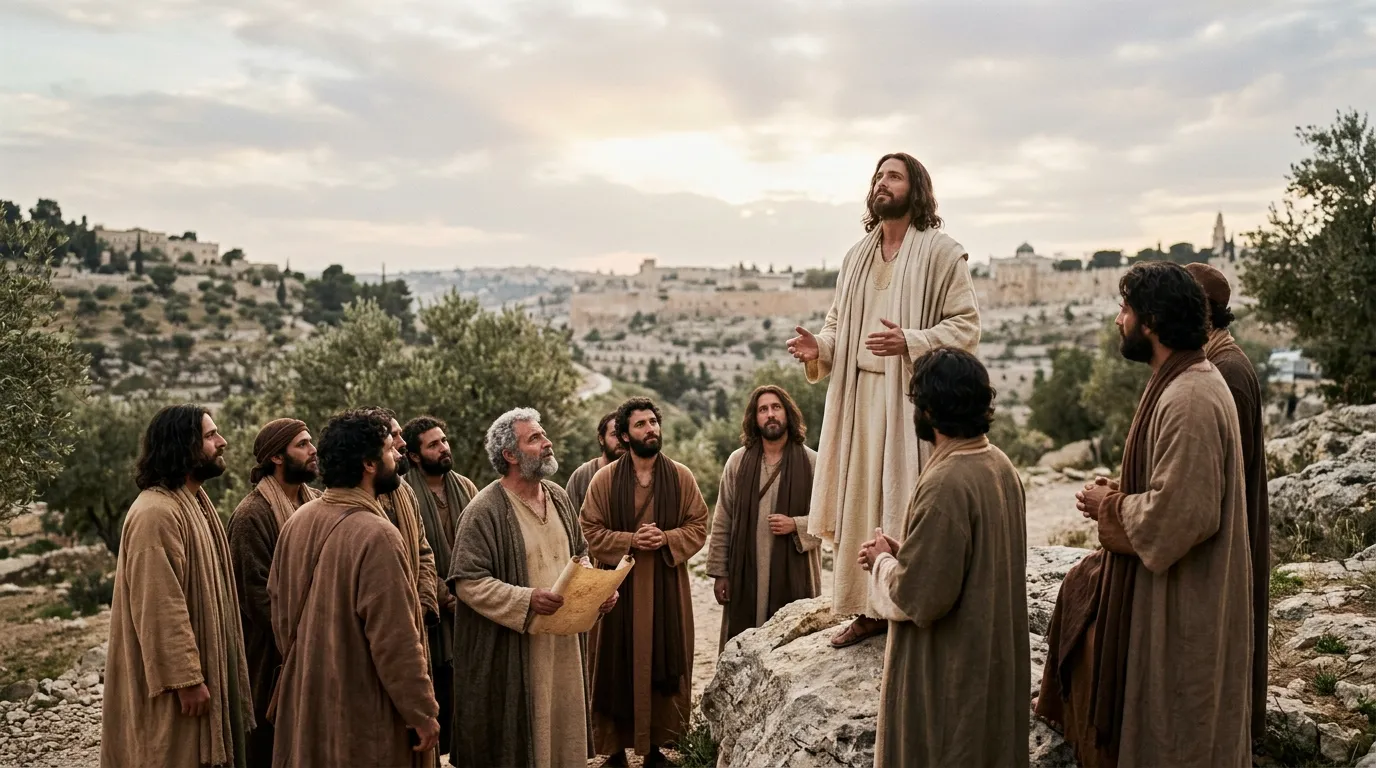
Jesus rose from the dead on the third day. Then He stayed for forty days. Why? If the resurrection was the victory, why not ascend immediately? Why forty days of appearances, conversations, meals, and instructions? The “delay” between the resurrection and the ascension — those forty days in Acts 1:3 — is not a gap in the story. It is one of the most purposeful periods in the New Testament. Jesus used those days to prove His resurrection, to teach His disciples about the kingdom, to restore the fallen, to commission the fearful, and to prepare the church for the Spirit.
This article explores why Jesus waited, what He did during those forty days, and what the delay means for believers who sometimes wonder why God does not move faster.
Forty Days: A Biblical Number with a Pattern
Forty is one of the Bible’s most significant numbers. It rained forty days on Noah. Moses spent forty days on Sinai. Israel wandered forty years in the wilderness. Elijah journeyed forty days to Horeb. Jesus fasted forty days in the wilderness. The number forty in Scripture often marks a period of testing, preparation, and transition — a bridge between one era and another.
The forty days between resurrection and ascension fit that pattern. They were a bridge between the earthly ministry of Jesus and the Spirit-empowered ministry of the church. The disciples were not ready on Easter morning. They were frightened, confused, and scattered. Forty days later, they were ready to wait in Jerusalem for the Spirit and then to turn the world upside down. The bridge mattered.
Proof: “Many Convincing Proofs”
Luke’s summary is explicit: “After his suffering, he presented himself to them and gave many convincing proofs that he was alive. He appeared to them over a period of forty days” (Acts 1:3). The Greek word for “convincing proofs” is tekmēria — decisive evidence, not vague impressions. Jesus did not merely appear. He ate with them. He let Thomas touch His wounds. He cooked breakfast on the shore. He walked with two disciples to Emmaus and broke bread. He stood among them and said, “Peace be with you,” and showed them His hands and side.
The proofs were necessary because the claim was extraordinary. The resurrection is not a metaphor. It is a historical event, and the disciples were the witnesses. Before they could testify to the world, they had to be certain. The forty days were God’s way of making them certain. Doubt was not rebuked and dismissed; it was met with evidence. Thomas was invited to touch. The Emmaus disciples were given a Bible study. The frightened room was given peace. The church’s faith was built on proof, not on wishful thinking.
Teaching: The Kingdom of God
Luke says Jesus “spoke about the kingdom of God” during those forty days. The content of that teaching is not recorded in detail, but the Gospels and Acts give us the shape of it. He opened their minds to understand the Scriptures (Luke 24:45). He explained how the Law, the Prophets, and the Psalms pointed to Him. He taught them that repentance and forgiveness would be preached to all nations. He commanded them to wait for the Spirit. He gave them the Great Commission.
The kingdom teaching corrected a misunderstanding. The disciples still expected a political kingdom — “Lord, are you at this time going to restore the kingdom to Israel?” (Acts 1:6). Jesus did not rebuke the question, but He redirected it: the kingdom would come not through political power but through the Spirit’s witness to the ends of the earth. The forty days were a re-education. The disciples had to unlearn the kingdom of force and learn the kingdom of the Spirit.
Restoration: Peter on the Beach
One of the most beautiful moments of the forty days happened on the shore of the Sea of Galilee. Peter, who had denied Jesus three times, was fishing — back to his old life, or so it seemed. Jesus appeared, directed a miraculous catch, cooked breakfast, and then asked Peter three times, “Do you love me?” Three denials, three restorations. Each time Peter said yes, Jesus gave him a commission: “Feed my lambs. Take care of my sheep. Feed my sheep” (John 21:15–17). Restoration was not merely forgiveness. It was recommissioning.
The forty days were not only about proof and teaching. They were about healing. The disciples who had fled, denied, and doubted were not discarded. They were restored, one by one, by the risen Lord who met them where they were — on a road, in a locked room, on a beach. The church’s first leaders were not chosen because they had been flawless. They were chosen because they had been restored.
Commission: Witnesses to the Ends of the Earth
The forty days ended with a commission and a promise. “You will receive power when the Holy Spirit comes on you; and you will be my witnesses in Jerusalem, and in all Judea and Samaria, and to the ends of the earth” (Acts 1:8). The witnesses were not sent out on their own strength. They were told to wait. The delay of the ascension was followed by a second delay — waiting in Jerusalem for the Spirit. God’s delays are not denials. They are preparations.
Then, on the Mount of Olives, Jesus was lifted up, and a cloud hid Him from their sight. Two angels asked, “Why do you stand here looking into the sky? This same Jesus, who has been taken from you into heaven, will come back in the same way you have seen him go into heaven” (Acts 1:11). The ascension was not an ending. It was a promise of return. The same Jesus who stayed forty days will come again.
Why God’s Delays Are Not Denials
The forty days teach believers to trust God’s timing. The disciples wanted the kingdom immediately. Jesus gave them forty days of preparation instead. We often want answers immediately — healing now, provision now, direction now, vindication now. God sometimes gives us a season of waiting instead. The waiting is not wasted. It is where proof is given, teaching is absorbed, restoration happens, and power is prepared. The God who waited forty days before ascending is the God who waits with us in our own in-between seasons.
If you are in a delay — between a promise and its fulfillment, between Easter and Pentecost — take heart. The delay is not evidence that God has forgotten you. It is evidence that He is preparing you. The risen Lord is still appearing, still teaching, still restoring, still commissioning. And the same Jesus who went up will come again.
The Appearances: A Catalog
The forty days were filled with appearances, and the Gospels and Acts record at least ten distinct ones. To Mary Magdalene at the tomb, weeping and then rejoicing. To the other women, on the road, with the command to tell the disciples. To Peter, privately — an appearance Paul singles out and the Gospels barely describe, suggesting a private restoration. To two disciples on the road to Emmaus, in a seven-mile Bible study. To the ten disciples in the upper room, with the greeting of peace. To the eleven, with Thomas present, and the invitation to touch. To seven disciples by the Sea of Galilee, with breakfast on the shore. To more than five hundred believers at once, an appearance Paul cites as evidence that most were still alive to confirm it. To James, the brother of Jesus, who had not believed during the ministry and later led the Jerusalem church. And to the disciples on the Mount of Olives, at the ascension itself.
The variety of the appearances is part of their credibility. They happened to individuals and to crowds, to men and to women, indoors and outdoors, in Jerusalem and in Galilee, to skeptics and to believers. They were not a single vision reported by a single person. They were a sustained, multi-witness, multi-setting pattern of encounters. The forty days were not a rumor. They were a campaign of evidence.
Each appearance also had a pastoral purpose. Mary received comfort. Thomas received proof. Peter received restoration. The Emmaus disciples received understanding. The five hundred received a shared experience. The ascension appearances were not random. They were tailored, personal, and purposeful — the risen Lord meeting each person at the point of their need.
Waiting in Jerusalem
After the ascension, the disciples returned to Jerusalem and waited, just as Jesus had told them. They waited in prayer, in unity, and in expectation. The waiting lasted ten days, until Pentecost. Those ten days of waiting were the final preparation for the church’s birth. The disciples who had been scattered, fearful, and doubting were now gathered, prayerful, and expectant. Waiting had done its work. The forty days of proof and the ten days of prayer together produced a church ready for the Spirit. God’s delays — all of them — are preparations.
For the historical and theological background, see the Wikipedia article on the Ascension of Jesus.










