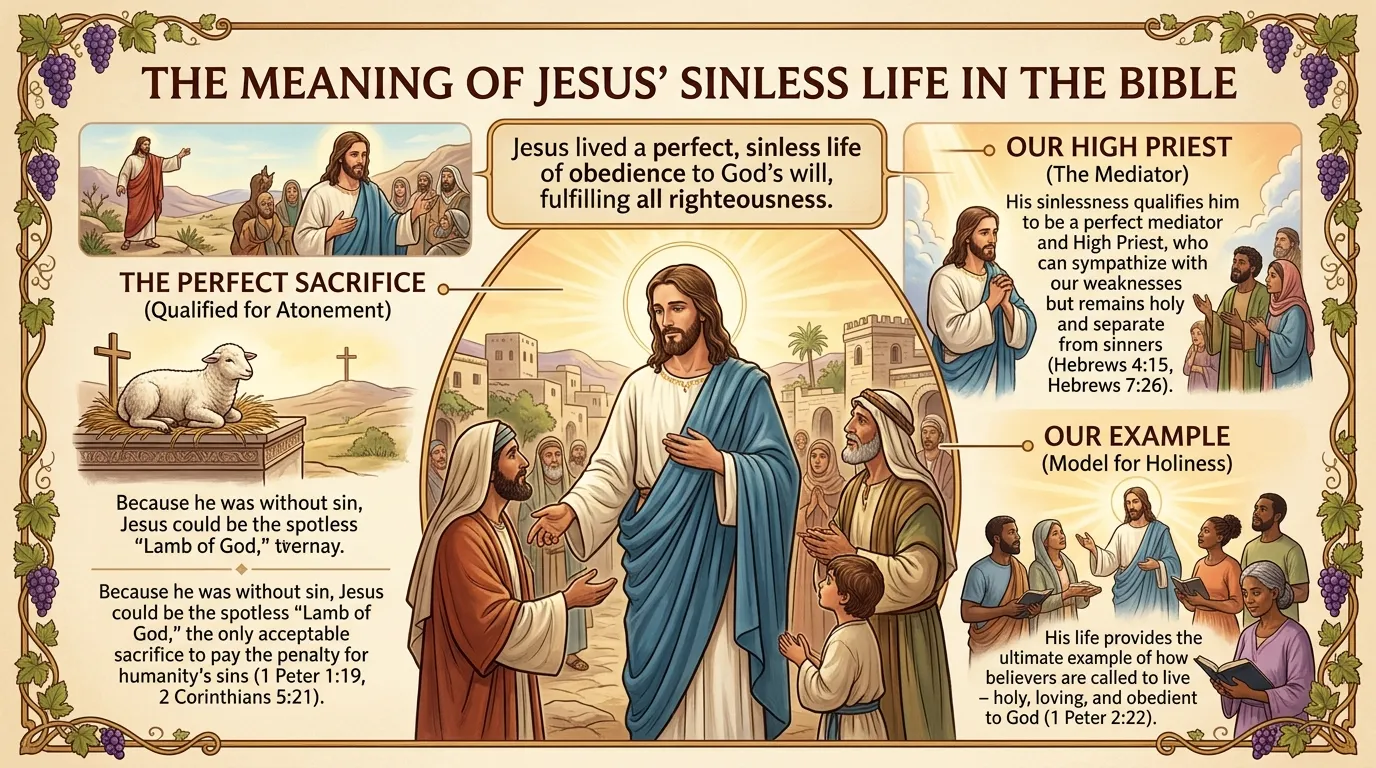
The claim is extraordinary, and the Bible makes it without hesitation: Jesus lived a life without sin. “He committed no sin, and no deceit was found in his mouth” (1 Peter 2:22). “He had no sin” (2 Corinthians 5:21). “We have one who has been tempted in every way, just as we are — yet he did not sin” (Hebrews 4:15). The sinless life of Jesus is not a decorative doctrine. It is the load-bearing wall of the Christian faith. If Jesus sinned, He could not be the spotless sacrifice, the perfect representative, or the trustworthy Savior. His sinlessness is what makes the cross effective and His example meaningful.
This article examines what the Bible means by Jesus’s sinlessness, how He was tempted without sinning, why it matters for salvation, and what it means for believers who still sin every day.
What Sinlessness Means — and What It Does Not
Sinlessness does not mean Jesus was untested. The Gospels show Him tested from the beginning: tempted by Satan in the wilderness, opposed by religious leaders, betrayed by a friend, denied by another, abandoned by His followers, and crucified by the state. It does not mean He was emotionless. He wept, He was angry, He was troubled in spirit, He groaned. It does not mean He was untouched by the world’s brokenness. He lived in a fallen world, in a real human body, with real hunger, thirst, fatigue, and grief.
Sinlessness means that in every test, every emotion, and every circumstance, Jesus never thought, spoke, or acted in a way that violated God’s character or God’s law. He never lied. He never lusted. He never envied. He never hated. He never doubted the Father’s goodness. He never acted selfishly. He never failed to love God with all His heart and His neighbor as Himself. His life was the law of God lived out in human flesh — not a performance, but a nature.
The Temptation in the Wilderness
The clearest test of Jesus’s sinlessness comes in Matthew 4 and Luke 4, where Satan tempts Him three times. The temptations are not random. They strike at the core of Jesus’s mission: turn stones to bread (use power for yourself), throw yourself from the temple (force God to prove Himself), worship me and I will give you the kingdoms (take the crown without the cross). Each temptation offered a shortcut — a way to be Messiah without suffering.
Jesus answered each temptation with Scripture. “Man shall not live on bread alone.” “Do not put the Lord your God to the test.” “Worship the Lord your God, and serve him only.” His resistance was not a matter of divine override. He resisted as a man, armed with the Word, trusting the Father. Hebrews says He “learned obedience from what he suffered” (Hebrews 5:8). The sinless life was not effortless. It was a life of constant, costly obedience.
Tempted in Every Way, Yet Without Sin
Hebrews 4:15 is the key text: Jesus was “tempted in every way, just as we are — yet he did not sin.” The phrase “in every way” does not mean Jesus experienced every specific temptation every human has faced. It means He experienced temptation in every category — physical appetite, pride, fear, anger, ambition, loneliness, the desire for approval, the pull of comfort. He knows what temptation feels like from the inside. He is not a Savior who watched temptation from a distance. He stood in it and did not fall.
This is why Hebrews presents Jesus as a sympathetic high priest. “Because he himself suffered when he was tempted, he is able to help those who are being tempted” (Hebrews 2:18). The sinless Jesus is not a scolding Jesus. He is a helping Jesus. He knows the weight of the temptation, and He knows the way through it, because He walked it.
Why Sinlessness Matters for Salvation
The theological stakes are high. The Old Testament sacrificial system required unblemished animals — lambs without defect. The principle was that the sacrifice must be pure. Jesus is called “the Lamb of God, who takes away the sin of the world” (John 1:29). If He had sinned, He would have needed a sacrifice for Himself, and He could not have been the sacrifice for others. His sinlessness is what qualifies Him to be the substitute.
Paul states the exchange at the heart of the gospel: “God made him who had no sin to be sin for us, so that in him we might become the righteousness of God” (2 Corinthians 5:21). On the cross, the sinless One was treated as if He were sin, so that sinners could be treated as if they were righteous. The exchange only works if Jesus was truly sinless. A sinful savior cannot save sinners. He would only add to the debt.
The Sinless Life as Example
Jesus’s sinlessness is not only a doctrine for salvation. It is a pattern for living. Peter writes that Christ “left you an example, that you should follow in his steps” (1 Peter 2:21). The example is not perfectionism. Believers will not achieve sinlessness in this life — John is clear that anyone who claims to be without sin deceives himself (1 John 1:8). The example is direction, not destination. We follow His steps: His love for enemies, His compassion for outcasts, His courage before power, His submission to the Father, His forgiveness from the cross.
The sinless life also gives believers hope for the future. The promise of the gospel is not merely forgiveness but transformation — and one day, glorification. “When Christ appears, we shall be like him” (1 John 3:2). The One who lived without sin will one day make us without sin. The sinless life of Jesus is the preview of what His people will become.
Living in the Light of the Sinless Savior
For believers who struggle with sin — which is all believers — the sinlessness of Jesus offers three gifts. First, confidence: your salvation does not rest on your record but on His. Second, sympathy: your High Priest understands your struggle from the inside. Third, power: the Spirit who empowered Jesus’s obedience now lives in you, and the same grace that kept Him will keep you. You will stumble. You will need confession and repentance daily. But you are following a Savior who never stumbled, and He will bring you home.
Could Jesus Have Sinned? The Theological Question
Theologians have long debated whether Jesus could have sinned — the question of impeccability. The two positions are often called “peccability” (Jesus could have sinned but did not) and “impeccability” (Jesus could not have sinned). The Bible does not answer the question directly, but its teaching points toward impeccability: Jesus is fully God as well as fully man, and God cannot sin. James writes that “God cannot be tempted by evil.” If Jesus is God, then in His divine nature He could not sin.
At the same time, the Bible insists that Jesus’s temptations were real. Hebrews says He was tempted in every way as we are. How can temptation be real if sin is impossible? The answer is that temptation is the experience of pressure, not the possibility of failure. A man who cannot be defeated can still feel the weight of the attack. A dam that cannot break can still feel the pressure of the water. Jesus felt the full force of temptation — hunger, power, fear, glory — and He resisted it fully. The temptations were real because the pressure was real, even though the outcome was certain.
For believers, the practical point is the same either way. Jesus never sinned. His obedience was complete. His sacrifice was spotless. And His sympathy is real. He knows what temptation feels like, and He is able to help those who are tempted. Whether we say He could not sin or He did not sin, the gospel stands: the sinless One died for sinners, and His righteousness is ours.
The Sinless Life and the Christian’s Struggle
Jesus’s sinlessness can feel discouraging to believers who sin daily. But it is meant to encourage, not to crush. The sinless One is not standing over you with a clipboard, tallying failures. He is standing beside you as your advocate. “If anybody does sin, we have an advocate with the Father — Jesus Christ, the Righteous One” (1 John 2:1). His righteousness is not a standard designed to condemn you. It is a gift designed to clothe you. You are not saved by matching His record. You are saved by receiving it. And the Spirit who empowered His obedience is now at work in you, slowly making you like Him.
For more on this doctrine, the Wikipedia article on the sinlessness of Jesus summarizes the biblical and historical evidence.










