Between the cross and the resurrection, there is a tomb. Christians often rush past it. Good Friday ends, Easter Sunday begins, and the Saturday in between gets forgotten — a blank day, a pause, a silence. But the Bible does not treat the burial of Jesus as a gap in the story. It treats it as part of the gospel itself. Paul’s summary of the gospel in 1 Corinthians 15 has four verbs: Christ died, He was buried, He was raised, and He appeared. The burial is not a footnote. It is a confession. To understand the burial of Jesus is to understand why His death was real, why His resurrection was real, and why the silence of Saturday matters as much as the agony of Friday and the glory of Sunday.
The burial itself: what the Gospels report
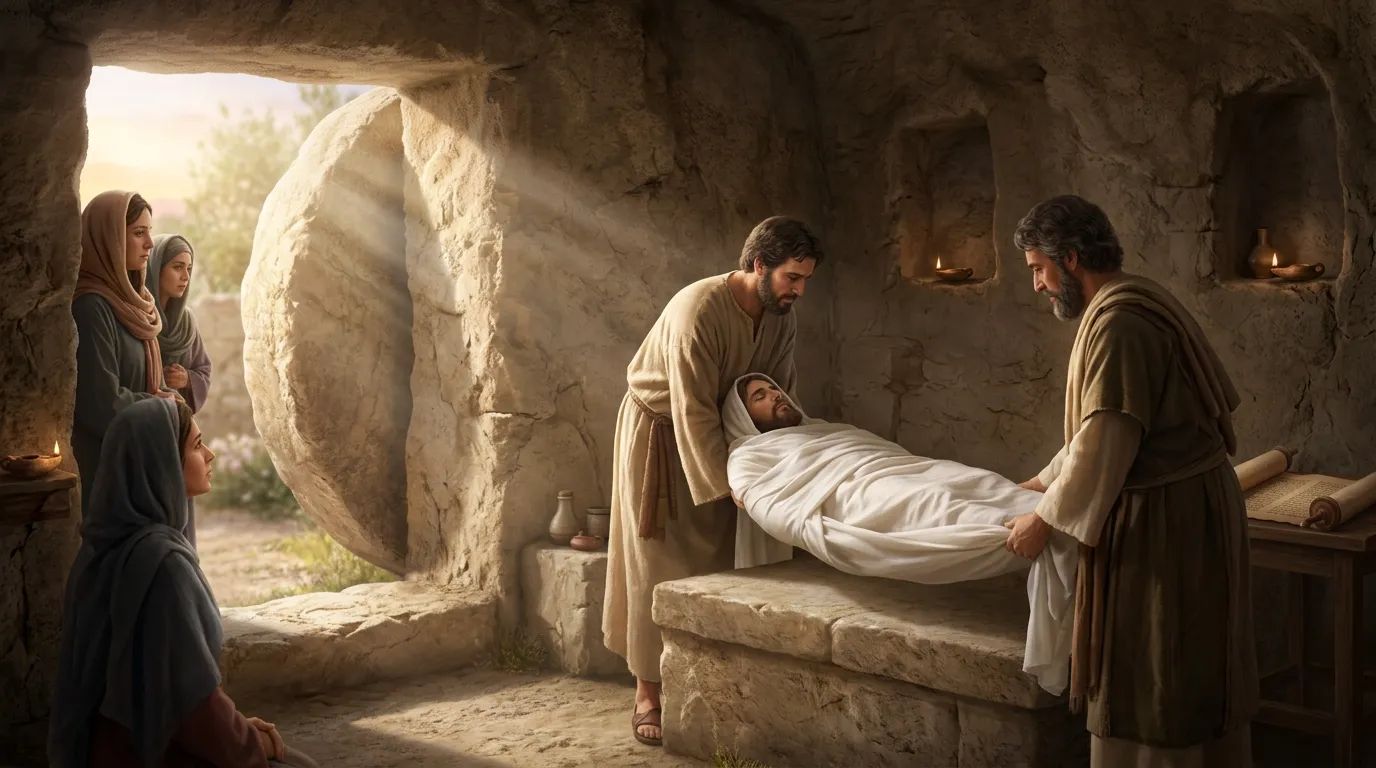
All four Gospels agree on the basic facts. After Jesus died, Joseph of Arimathea — a wealthy member of the Sanhedrin who had become a disciple, “waiting for the kingdom of God” (Mark 15:43) — went boldly to Pilate and asked for the body. Pilate, surprised that Jesus was already dead, confirmed it with the centurion and released the body. Joseph took it down, wrapped it in clean linen, and laid it in a new tomb he had cut out of rock. Nicodemus, who had first come to Jesus by night, brought a large quantity of myrrh and aloes, and together they wrapped the body with the spices in strips of linen, following Jewish burial customs (John 19:38–40).
The details matter. The tomb was new — no one had ever been laid in it (Luke 23:53). That detail answers a potential objection: if the tomb had been used before, someone might claim the resurrection was a case of mistaken identity. The stone was large — Mark emphasizes that the women worried about who would roll it away (Mark 16:3). The burial was hurried, because the Sabbath was approaching, but it was not careless. The women — Mary Magdalene, Mary the mother of James and Joses, and Salome — watched where the body was laid (Mark 15:47) and then went home to prepare spices and perfumes, intending to return after the Sabbath to anoint the body properly (Luke 23:56).
The burial was also a fulfillment of prophecy. Isaiah had foretold that the Servant would be “assigned a grave with the wicked, and with the rich in his death, though he had done no violence, nor was any deceit in his mouth” (Isaiah 53:9). Jesus was crucified between criminals — the grave with the wicked — and buried in the tomb of a rich man — the grave with the rich. The prophecy was fulfilled in the details of a Friday afternoon.
Why the burial matters: He truly died
The first reason the burial matters is that it proves the death was real. The ancient world had theories about Jesus’ death, just as the modern world does. Some said He only appeared to die. Some said He fainted and revived in the cool tomb. The burial answers those theories. The body was taken down by a member of the Sanhedrin, examined by a Roman centurion, wrapped by two men, placed in a tomb, and sealed with a stone. The women saw where it was laid. The Roman guard, posted at the request of the priests, sealed the stone (Matthew 27:62–66). The burial is the Bible’s way of saying: this was a real death, of a real body, in a real tomb.
The burial also matters because it shows that Jesus entered the full reality of human death. He did not merely appear to die, or die in a spiritual sense. He died as we die. His body was handled, wrapped, and laid in the ground. The Christian hope of resurrection is not the hope that death is an illusion. It is the hope that death, though real, is not final. The burial is what makes the resurrection meaningful. Without it, the resurrection would be a resuscitation. With it, the resurrection is a victory over the grave itself.
Joseph and Nicodemus: courage after the cross
The burial introduces two men who had been secret disciples. Joseph of Arimathea was a prominent member of the Sanhedrin who had not consented to the council’s decision against Jesus (Luke 23:51). Nicodemus had come to Jesus by night, afraid to be seen (John 3:1–2), and later defended Him before the Sanhedrin (John 7:50–51). Both men had believed in private. At the burial, they believed in public. Joseph went “boldly” to Pilate — Mark’s word is deliberate — and asked for the body of a condemned criminal, an act that could have cost him his position, his reputation, and possibly his life. Nicodemus brought a king’s quantity of spices, a public declaration of devotion. The burial is the moment when secret faith becomes open faith. The cross did what the miracles had not: it gave two frightened men the courage to identify with Jesus. Christians who have been silent about their faith should take heart from Joseph and Nicodemus. The time to step forward is not when it is safe. It is when the body needs burying — when faithfulness costs something.
The burial also fulfills the Passover timing. Jesus died at the hour when the Passover lambs were being slaughtered, and He was buried before the Sabbath began — the Sabbath that followed was a “special Sabbath” because it coincided with Passover (John 19:31). The haste of the burial was not carelessness. It was obedience to the Law, which required burial before sunset. Even in death, Jesus fulfilled the Law perfectly — and His followers honored it by resting on the Sabbath, even in their grief.
The silence of Saturday: God works in the dark
The day between the cross and the resurrection is the Bible’s great silence. The Gospels say almost nothing about Saturday. The disciples hid. The women rested, according to the commandment. The tomb was sealed. Heaven was silent. For the followers of Jesus, Saturday was the day the story seemed to end.
Christians who have lived through their own Saturdays — the days after a diagnosis, after a death, after a betrayal, after a prayer that seemed unanswered — know what that silence feels like. The burial of Jesus teaches that God is at work even when He seems absent. The tomb looked like the end, but it was the beginning. The silence was not emptiness; it was preparation. The greatest work in history was happening in the dark, where no one could see it.
Peter’s first letter adds a mysterious detail: after His death, Christ “went and made proclamation to the imprisoned spirits” (1 Peter 3:19). Christians have debated what this means — whether it refers to the spirits of Noah’s generation, to fallen angels, or to something else — and this article does not settle that debate. What is clear is that the Bible does not present the time in the tomb as wasted time. God was active even in the grave.
The burial and baptism: dying with Christ
Paul connects the burial of Jesus to the Christian’s own life. In Romans 6, he writes that believers “were therefore buried with him through baptism into death in order that, just as Christ was raised from the dead through the glory of the Father, we too may live a new life” (Romans 6:4). Baptism is a burial. When a believer goes under the water, they are identifying with Christ’s burial — dying to the old life, to sin, to the power of the flesh. When they come up, they are identifying with His resurrection — rising to a new life.
The burial is therefore not only something Jesus did. It is something Christians participate in. The old self is buried. The new self is raised. The tomb is not only a historical site; it is a spiritual reality. Every Christian has been to the tomb, and every Christian has come out of it.
The empty tomb: the burial’s proof
On the third day, the women came to the tomb and found the stone rolled away and the tomb empty. The burial is what makes the empty tomb significant. An empty tomb means nothing if there was no burial. But because the body was definitely there — placed, wrapped, sealed, and guarded — its absence is evidence. The empty tomb is not the whole resurrection argument, but it is the starting point. The burial proves the death; the empty tomb proves the resurrection; the appearances prove the risen Lord.
The burial also teaches Christians how to grieve. The women’s grief was real. They came to anoint a body. They expected to find a corpse. Jesus did not rebuke their tears. He met them in the garden and called Mary by name (John 20:16). The burial of Jesus does not tell Christians to skip grief. It tells them that grief is not the end. The tomb is real, the tears are real, and the resurrection is real — and the resurrection has the last word.
For the historical background on Jewish burial practices in the first century, including rock-cut tombs and the use of spices, the Wikipedia article on Burial of Jesus provides a useful survey.