Four Gospels tell the story of the crucifixion, and they do not tell it the same way. Matthew emphasizes the fulfillment of prophecy and the tearing of the temple curtain. Mark, the shortest account, stresses the darkness, the cry of abandonment, and the centurion’s confession. Luke highlights the forgiveness — “Father, forgive them” — and the promise to the thief: “Today you will be with me in paradise.” John presents a King in control, reigning from the cross, caring for His mother and finishing His work: “It is finished.” To understand the crucifixion, we need all four voices. Each one sees the same cross, and each one shows us a different facet of what happened there.
What crucifixion was
Crucifixion was a Roman method of execution designed to be slow, public, and humiliating. The victim was nailed or tied to a wooden cross, raised upright, and left to die of asphyxiation, shock, and blood loss — a process that could take hours or days. The cross was usually placed beside a road, where travelers could see it. The charge was posted above the victim’s head. The body was often left to rot or be eaten by birds. Rome used crucifixion for slaves, rebels, and non-citizens; Roman citizens were exempt. It was the empire’s ultimate deterrent: a billboard of terror that said, “This is what happens to those who defy Rome.”
For Jews, crucifixion carried an additional horror. Deuteronomy declared, “Anyone who is hung on a pole is under God’s curse” (Deuteronomy 21:23). To be crucified was not only to die painfully but to die cursed — cut off from God and from the covenant people. That is why Paul’s claim that Christ “redeemed us from the curse of the law by becoming a curse for us” (Galatians 3:13) was so shocking. The Messiah, Israel’s hope, had died the death of a curse.
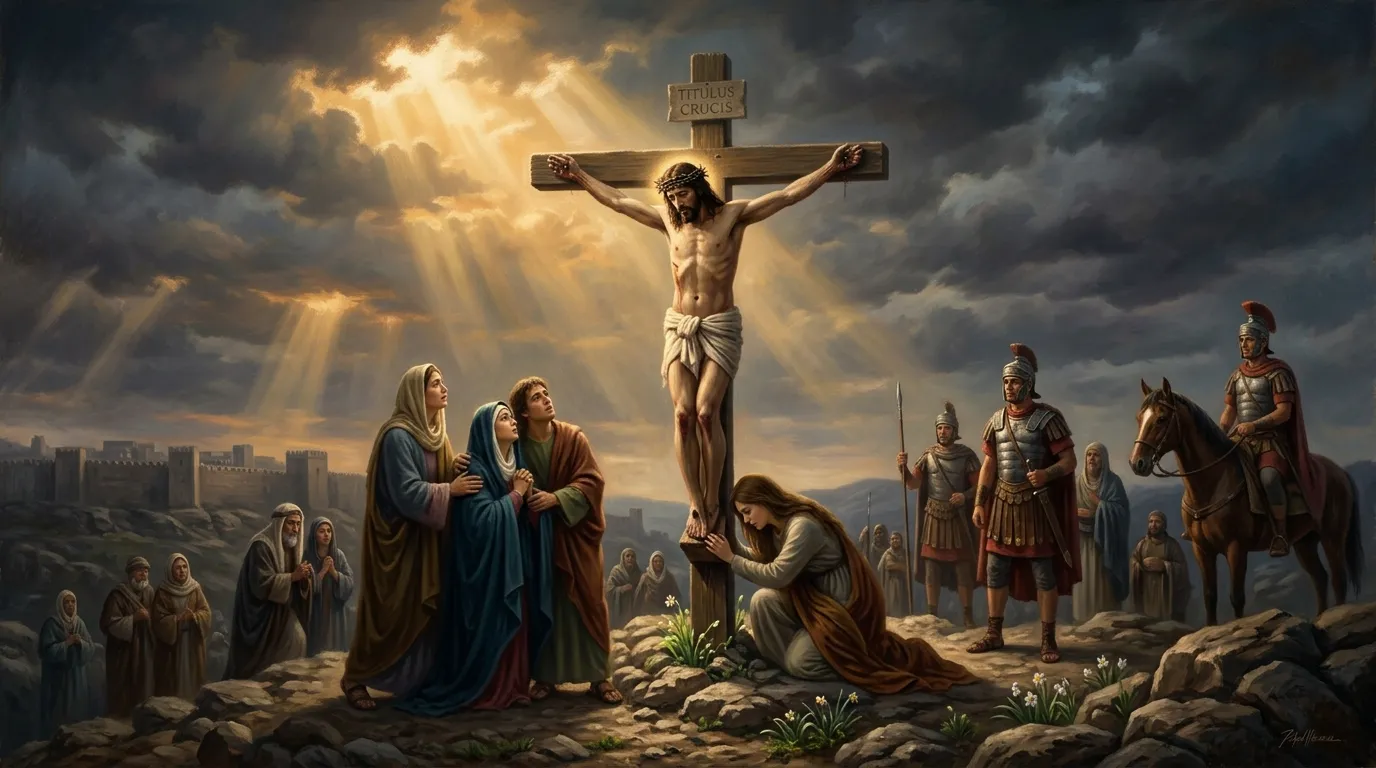
Jesus was crucified at Golgotha — “the Place of the Skull” — outside the walls of Jerusalem, on the morning of the Passover preparation day. He was flogged first, a punishment that could itself be fatal, and He carried His cross (or part of it) until Simon of Cyrene was pressed into service. He was nailed through the wrists and feet, raised between two criminals, and left to die. The whole process, from Gethsemane to the tomb, took roughly eighteen hours.
Matthew’s cross: the curtain torn
Matthew’s account is full of prophetic echoes. The soldiers cast lots for His clothing (Psalm 22:18). He was given wine mixed with gall (Psalm 69:21). The crowd mocked Him with the words of Psalm 22: “He trusts in God. Let God rescue him now if he wants him” (Matthew 27:43). Matthew wants us to see that the cross was not an accident. It was the fulfillment of Scripture, planned by God before the world began.
Matthew also records the cosmic signs: darkness over the land from noon to three, an earthquake, the splitting of rocks, and the tearing of the temple curtain from top to bottom (Matthew 27:45, 51). The curtain separated the Holy of Holies from the rest of the temple. Its tearing announced that the way into God’s presence was now open — not through the priesthood, not through the temple, but through the death of Christ. The direction matters: torn from top to bottom, by God’s hand, not man’s.
Mark’s cross: the cry and the confession
Mark’s account is the starkest. He gives the fewest details and the darkest tone. Jesus’ cry — “Eloi, Eloi, lema sabachthani?” (“My God, my God, why have you forsaken me?”) — is the center of Mark’s cross. The cry is a quotation of Psalm 22:1, but it is also a real expression of anguish. On the cross, Jesus experienced the forsakenness that sin causes — the separation from the Father that is the essence of hell. He who had never been separated from the Father was separated, so that we would never have to be.
Mark’s account ends with an unexpected confession. The Roman centurion, standing in front of Jesus, watching Him die, declares, “Surely this man was the Son of God!” (Mark 15:39). The first person in Mark’s Gospel to confess Jesus’ identity after the baptism is not a disciple, not a priest, not a Jew — it is a Roman soldier, a Gentile, an executioner. The cross is where the gospel’s first Gentile confession happens. The man who killed Jesus is the first to recognize Him.
Luke’s cross: forgiveness and paradise
Luke’s account is the most tender. Jesus prays for His executioners: “Father, forgive them, for they do not know what they are doing” (Luke 23:34). He speaks to the criminal beside Him who repents: “Truly I tell you, today you will be with me in paradise” (Luke 23:43). He entrusts His spirit to the Father: “Father, into your hands I commit my spirit” (Luke 23:46). Luke’s cross is a place of mercy. The thief who had nothing to offer — no baptism, no good works, no church membership — is promised paradise on the strength of a single sentence of faith. The cross is open to the last minute, to the worst sinner, to anyone who will turn and ask.
Luke also notes the crowd’s reaction: “When all the people who had gathered to witness this sight saw what took place, they beat their breasts and went away” (Luke 23:48). The cross convicted them. It still does.
John’s cross: “It is finished”
John’s account presents Jesus as a King in control. He carries His own cross. He speaks to His mother and the beloved disciple, entrusting them to each other. He declares, “I am thirsty,” fulfilling Scripture (John 19:28). And then He says the greatest word in the Bible: “It is finished” (John 19:30). The Greek word, tetelestai, was used on receipts to mean “paid in full.” The debt of sin was paid. The work of salvation was complete. Jesus then “bowed his head and gave up his spirit” — John’s language is deliberate. Jesus did not have His life taken; He gave it up. He was in control to the end.
John also records that the soldiers did not break Jesus’ legs — fulfilling the Passover rule that no bone of the lamb would be broken (Exodus 12:46) — and that blood and water flowed from His side when it was pierced (John 19:34). The blood and water are the signs of a real death, and for John they are also the signs of the sacraments: the blood of the Supper and the water of baptism, flowing from the Savior’s side.
The seven sayings: the cross in Jesus’ own words
Across the four Gospels, Jesus speaks seven times from the cross, and the sayings together form a portrait of His heart in suffering. “Father, forgive them, for they do not know what they are doing” — mercy for His murderers. “Today you will be with me in paradise” — salvation for a dying thief. “Woman, here is your son” — care for His mother. “My God, my God, why have you forsaken me?” — the agony of abandonment. “I am thirsty” — the reality of His humanity. “It is finished” — the triumph of His work. “Father, into your hands I commit my spirit” — the peace of His trust. No other collection of sentences in Scripture covers so much: forgiveness, salvation, family, abandonment, humanity, victory, and trust. Christians have meditated on these seven sayings for two thousand years because they contain the whole gospel in the words of the dying Savior. The cross is not silent. It speaks — and what it says is mercy.
What the cross means: the theology of atonement
The New Testament gives several pictures of what the cross accomplished, and Christians need all of them. The cross is a sacrifice: Christ is the Lamb of God who takes away the sin of the world (John 1:29). The cross is a substitution: He died in our place, bearing the punishment we deserved (Isaiah 53:5–6; 1 Peter 2:24). The cross is a reconciliation: God was reconciling the world to Himself in Christ (2 Corinthians 5:19). The cross is a victory: Christ disarmed the powers and authorities, triumphing over them by the cross (Colossians 2:15). The cross is a demonstration of love: “God demonstrates his own love for us in this: While we were still sinners, Christ died for us” (Romans 5:8).
No single image exhausts the cross. The sacrifice explains how sin is dealt with. The substitution explains how justice is satisfied. The reconciliation explains how the relationship is restored. The victory explains how evil is defeated. The love explains why God did it. Together, they form the heart of the Christian faith.
The cross also means that suffering is not meaningless. The God who suffered knows what suffering is. Christians who suffer do not suffer alone. They suffer with a Savior who has been there — who has felt abandonment, pain, mockery, and death — and who has transformed suffering into the instrument of salvation.
For the historical practice of Roman crucifixion and its cultural context, the Wikipedia article on crucifixion offers detailed background.