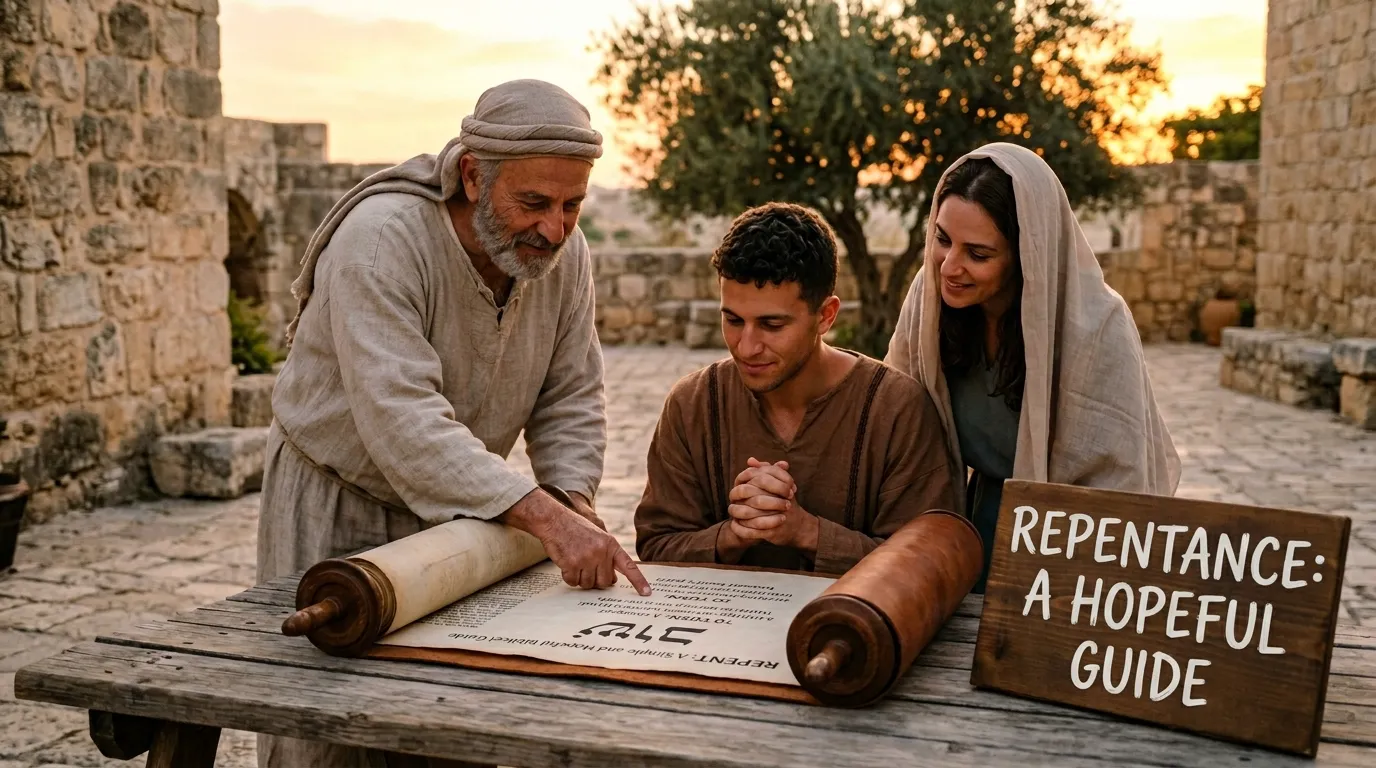
Two men failed Jesus on the same night. Both had walked with Him for years. Both betrayed Him — one with a kiss, one with a curse. Both wept afterward. And their stories ended in opposite places: one in a field, dead by his own hand; the other on a beach, restored over breakfast by the risen Christ. The difference between Judas and Peter is the difference between remorse and repentance — and understanding that difference is understanding what the Bible actually means by “repent.”
The English word “repent” can sound like a synonym for feeling bad. It is not. In Scripture, repentance is not mainly an emotion at all. It is a direction. And the two disciples prove that the direction matters more than the tears: Judas felt the worse regret and ended worse. Peter’s story shows what repentance truly is — and why it is the most hopeful word in the Bible.
The Sorrow That Ended in a Field
Matthew is brutally honest about Judas: “When Judas, his betrayer, saw that Jesus was condemned, he changed his mind and brought back the thirty pieces of silver to the chief priests and the elders, saying, ‘I have sinned by betraying innocent blood'” (Matthew 27:3–4). The old King James says he “repented himself” — and the Greek word there is metamelomai, regret, remorse, the pain of a bad outcome. Judas felt it fully. He confessed — “I have sinned.” He made restitution — he threw the silver back. He did everything remorse knows how to do.
And it was not enough, because remorse looks at the sin while repentance looks at the Savior. Judas took his guilt to the priests, who answered, “What is that to us? See to it yourself” (Matthew 27:4) — the world has no absolution to give. So he took it to himself, and himself condemned him: “he went and hanged himself” (Matthew 27:5). Remorse without God is a courtroom with no defense attorney. It sees the crime clearly and the mercy not at all. Paul names the outcome precisely: “godly grief produces a repentance that leads to salvation without regret, whereas worldly grief produces death” (2 Corinthians 7:10). Judas had worldly grief — real, agonizing, and fatal. Sorrow is not repentance. Sorrow is only repentance’s doorway, and Judas never walked through it.
The Sorrow That Ended at Breakfast
Peter’s failure was, if anything, more personal. He did not sell Jesus for money; he denied Him to a servant girl, then cursed and swore he never knew Him — and “the Lord turned and looked at Peter” (Luke 22:61). That look broke him: “he went out and wept bitterly” (Luke 22:62). Bitter weeping — the same raw material as Judas’s remorse.
But Peter’s grief went somewhere Judas’s never did: toward Jesus. After the resurrection, Peter is fishing when he hears “It is the Lord!” — and he jumps into the sea to get to Him (John 21:7). On the beach, over a charcoal fire, Jesus asks three times, “Do you love me?” — one question for each denial — and each time recommissions him: “Feed my lambs… Tend my sheep… Feed my sheep” (John 21:15–17). No groveling demanded. No probation imposed. Just love confessed and ministry restored. This is repentance’s anatomy: grief that turns — away from the sin and toward the Savior — and is met by grace that restores rather than merely punishes.
The contrast is the whole doctrine. Both men sinned grievously. Both grieved deeply. One turned inward and died; the other turned to Christ and lived. Repentance is not the intensity of your regret. It is the direction of your turning.
What Turning Produces
Scripture describes repentance’s effects the way a doctor describes a cure — by what it produces. Peter’s own sermon gives the first: “Repent therefore, and turn back, that your sins may be blotted out, that times of refreshing may come from the presence of the Lord” (Acts 3:19). Repentance blots and refreshes. The stain is removed; the wasteland is watered. The image is not of a prisoner pardoned but of a desert rained on — refreshing, the return of life.
John the Baptist demanded the evidence: “Bear fruit in keeping with repentance” (Matthew 3:8). Real turning grows things — changed habits, repaired relationships, new obedience. The tax collector Zacchaeus is the exhibit: encountering Jesus, he pledged half his goods to the poor and fourfold restitution to anyone he had cheated (Luke 19:8) — and Jesus announced, “Today salvation has come to this house” (Luke 19:9). The fruit proved the root. And John the apostle gives the maintenance manual: “If we confess our sins, he is faithful and just to forgive us our sins and to cleanse us from all unrighteousness” (1 John 1:9). Confession — the ongoing, honest naming of sin before God — keeps the turning current. Repentance is not a one-time crisis; it is a lifestyle of quick return.
A Door, Not a Cliff
Perhaps the most beautiful thing Scripture says about repentance is who wants it. Not a reluctant God dragged into mercy, but a patient one: “The Lord… is patient toward you, not wishing that any should perish, but that all should reach repentance” (2 Peter 3:9). The delay of judgment is not divine slowness; it is divine longing. Every sunrise is God holding the door.
And heaven treats each return as an event: “there is joy before the angels of God over one sinner who repents” (Luke 15:10). Not solemn approval — joy. Celebration. The repentant are not admitted grudgingly; they are welcomed loudly. Even the church at Ephesus, which had lost its first love, heard not condemnation but invitation: “Remember therefore from where you have fallen; repent, and do the works you did at first” (Revelation 2:5). However far the fall, the way back is one word long.
Nineveh: A City That Turned
The largest repentance in Scripture involved an entire city — and it was the last city anyone expected. Jonah preached eight words in Nineveh: “Yet forty days, and Nineveh shall be overthrown!” (Jonah 3:4). No call to repent. No explanation of grace. Just a deadline and a doom. And “the people of Nineveh believed God. They called for a fast and put on sackcloth, from the greatest of them to the least of them” (Jonah 3:5). The king himself rose from his throne, covered himself in sackcloth, sat in ashes, and decreed that even the animals fast (Jonah 3:6–8).
God’s response is the gospel in miniature: “When God saw what they did, how they turned from their evil way, God relented of the disaster that he had said he would do to them, and he did not do it” (Jonah 3:10). He saw what they did — the turning had visible fruit, the Matthew 3:8 kind. A pagan empire, forty days from annihilation, turned on eight words and lived. Jesus later made Nineveh the church’s rebuke: “The men of Nineveh will rise up at the judgment with this generation and condemn it, for they repented at the preaching of Jonah, and behold, something greater than Jonah is here” (Matthew 12:41). If Nineveh could turn on eight words from a reluctant prophet, what excuse does anyone have before the greater-than-Jonah who preached “repent, for the kingdom of heaven is at hand”?
Nineveh also corrects a common despair: that some people are too far gone. The Ninevites were renowned for cruelty — the ancient world’s terror. Their repentance proves the door has no “too late” sign on the outside, only on the inside of a hardened heart. Forty days was enough. Eight words were enough. The turn is always enough, because the God it turns toward is always merciful.
So the Bible’s “repent” is not “feel worse.” It is not penance, groveling, or self-punishment — Judas tried the emotional version and it killed him. It is the turn: grief that faces Christ instead of fleeing Him, confession that names the sin, and faith that receives the cleansing. “Repent, for the kingdom of heaven is at hand” (Matthew 4:17) — Jesus’ first sermon, and His most hopeful sentence. The kingdom is at hand: close enough to turn toward. The Christian understanding of repentance through the centuries has taken many forms, but its heart never moved: turn from the sin, turn to the Savior, and find — like Peter on the beach — that grace was already cooking breakfast.










