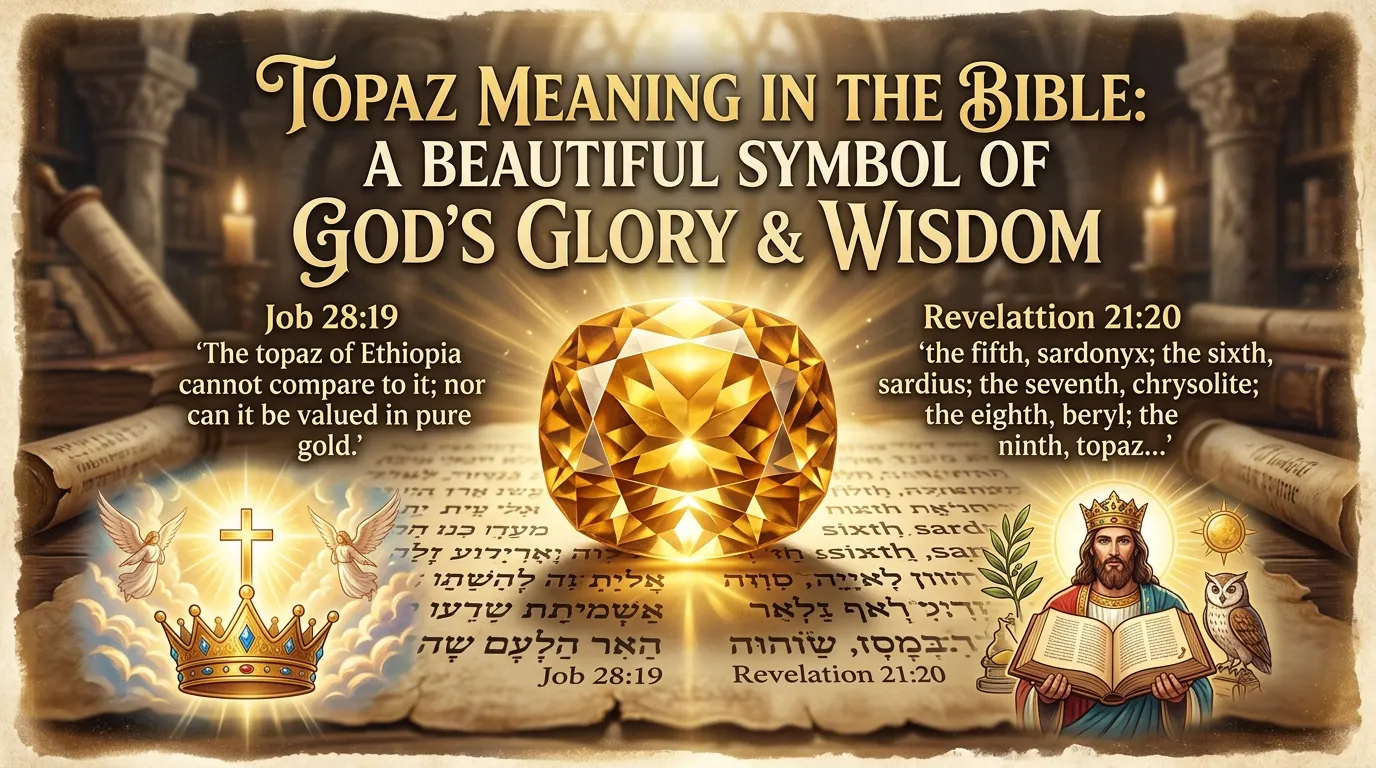
Imagine an auction where the auctioneer holds up the finest treasures of the ancient world, one by one, and the bidding for wisdom opens — and no treasure, however fine, meets the reserve price. Gold of Ophir: insufficient. Onyx and sapphire: insufficient. Coral, crystal, pearls: not to be mentioned. Rubies: outbid. And then, in Job 28:19: “The topaz of Ethiopia shall not equal it.” Topaz — the golden stone of the breastplate’s first row, the jewel of Eden’s inventory, a foundation stone of the New Jerusalem — cannot purchase wisdom. That is topaz’s most important biblical moment: the moment it loses.
The Golden Stone of the First Row
Topaz opens the breastplate’s jeweled ranks. Exodus 28:17: “The first row shall be a sardius, a topaz, and a carbuncle.” First row, second stone — the golden-yellow gem set beside the red sardius and the deep carbuncle, engraved with a tribe’s name, borne over Aaron’s heart.
The Hebrew word is pitdah, and its identification has a curious history. The Greek translators rendered it topazion, which they associated with an island in the Red Sea (Topazios) famous for a golden stone — though the island’s stone was probably peridot, not what modern jewelers call topaz. The name wandered across minerals for two thousand years. What is stable: the biblical pitdah was a golden-yellow precious stone, prized enough for the priest’s chest, and every tradition agrees on its color family if not its chemistry.
Its placement matters. The first row is the row the eye meets first — the topmost stones, nearest the priest’s face, the vanguard of the twelve. If the breastplate’s message is “the tribes carried before God,” the first row announces it: here they are, led by red and gold, sacrifice and glory. Topaz, golden and radiant, is part of that announcement — the tribes presented not in drabness but in splendor, the way God sees His people: precious, luminous, set in gold.
The Jewel of Eden
Ezekiel 28:13 includes topaz in the inventory of Eden’s stones: “every precious stone adorned you” — sardius, topaz, diamond, beryl, onyx, jasper, sapphire, emerald, carbuncle. Whatever the precise referent of the oracle (the king of Tyre, or the darker power behind him), the passage places topaz in the original glory — part of the beauty before pride, the radiance before the fall.
There is a poignancy in finding topaz in Eden. The stone’s golden color is the color of unfallen light — the garden’s glory before shadows. And the oracle’s tragedy is that beauty became the occasion for corruption: “Your heart became proud on account of your beauty” (Ezekiel 28:17). Topaz in Eden preaches the same sermon as every beautiful thing since: glory is a gift to be received with thanks, not a possession to be admired in the mirror. The moment beauty looks at itself instead of through itself to God, Eden begins to fall.
Revelation 21:20 sets topaz as the ninth foundation of the New Jerusalem — the golden stone, washed and reset, load-bearing in the eternal city. From Eden’s adornment to the city’s foundation: what pride corrupted, grace rebuilds. The stone keeps its color; it changes its story.
The Auction of Job 28
Return to the auction. Job 28:19’s verdict — “The topaz of Cush shall not equal it” (modern translations; KJV: “of Ethiopia”) — specifies the finest topaz known: Cushite topaz, the premium source, the stone at its most valuable. And even the best of the best does not equal wisdom.
The chapter’s logic is cumulative and crushing. It does not argue that topaz is worthless — the stone’s presence on the breastplate and in Eden forbids that. It argues that value is relative to the purchase. Topaz can buy anything in the marketplace of things; it cannot buy anything in the economy of wisdom. The categories do not convert. This is not a claim about topaz’s price but about wisdom’s nature: it is not a commodity. It cannot be acquired by acquisition. It can only be received by reverence — “the fear of the Lord, that is wisdom” (Job 28:28).
The specificity — “topaz of Cush” — is the chapter’s rhetorical masterstroke. It does not say “cheap topaz” or “ordinary stones.” It names the premium product, the collector’s grade, the stone at maximum value, and still: not equal. The reader is not allowed the comforting thought that a better treasure might succeed where this one failed. The best fails. That is the point. If the finest topaz on earth cannot buy wisdom, the project of buying wisdom is over, and the posture of receiving it can begin.
What the Golden Stone Teaches About Desire
Topaz’s golden color made it, across cultures, a stone of desire — associated with wealth, favor, and the good life. Scripture neither endorses nor condemns the desire; it redirects it. The breastplate says: your desire for glory is legitimate, and here is glory — the tribes radiant before God. Eden says: your desire for beauty is original, and here is beauty — the garden’s inventory. Job says: your desire for wisdom is the deepest one, and here is the exchange rate — no gold, however fine, converts.
Put together, the topaz passages map the whole economy of human longing:
- Longing for significance: answered at the breastplate — you are engraved, carried, remembered. Significance is given, not achieved.
- Longing for beauty: answered in Eden and the New Jerusalem — beauty is original and eschatological, God’s idea at both ends of history. It is safe to love it when it is received as gift.
- Longing for wisdom: answered only in reverence — the one longing that cannot be satisfied by any stone, however golden. “If any of you lacks wisdom, you should ask God” (James 1:5). Asking, not buying. Receiving, not acquiring.
The golden stone thus becomes an examiner of desires. Hold up what you most want next to topaz: is it a thing to be bought, or a gift to be received? The breastplate honors the first kind of longing. Job 28 corrects the second. Wisdom knows which is which.
The Stone That Lost the Auction — and Won a Better Place
There is a final irony worth savoring. Topaz “lost” the auction of Job 28 — declared insufficient as wisdom’s price. But it won a place the auction never offered: the ninth foundation of the eternal city, the first row of the breastplate, the inventory of Eden. The stone that could not buy wisdom was built into the house of the God who gives it.
That is, in miniature, the gospel’s economics. What we cannot purchase, God provides. What our treasures cannot buy, His grace supplies. The topaz of Cush cannot equal wisdom — but the God who made both the topaz and the wisdom engraves His people’s names in gold and carries them over His heart, and seats the golden stone in the foundations of a city where wisdom dwells bodily. The auction was never the way in. The foundation was.
The Treasure Roads: Cush, Ophir, and Sheba
“The topaz of Cush” (Job 28:19) names a place, and the place matters. Cush — the upper Nile region, roughly modern Sudan — was the ancient world’s southern treasure road, source of gold, ivory, ebony, and precious stones. When Job’s poet specifies Cushite topaz, he is naming the premium import, the stone that traveled furthest and cost most. The ancient luxury trade ran on such roads: Ophir’s gold (1 Kings 9:28), Sheba’s spices and stones.
The Queen of Sheba’s visit to Solomon shows the trade in action: she came “with a very great caravan — with camels carrying spices, large quantities of gold, and precious stones” (1 Kings 10:2). The stones were tribute-grade, fit for the wisest king on earth — and Solomon, who had them all, still wrote that wisdom outranks them (Proverbs 8:11). The man who owned the treasure roads agreed with Job: the finest stones the trade could deliver cannot buy what matters.
This grounds Job 28:19 in economic reality. The poet is not dismissing trinkets; he is dismissing the ancient world’s most expensive imports, the cargo of the great caravans, the wealth of nations — and finding them light against wisdom. The further the stone traveled, the greater its price, the more devastating the verdict. Cushite topaz, the best of the best, the end of the longest road: not equal. The treasure roads all lead to the same dead end, and wisdom’s road — “the fear of the Lord” — starts where they stop.
For the mineral background — aluminum fluorosilicate, the golden varieties, the Brazilian deposits — Wikipedia’s topaz article covers it completely. Scripture’s portrait needs no supplement: the golden stone of the first row, the jewel of Eden, the ninth foundation — and the treasure that taught Israel, once and for all, that the finest thing on earth cannot buy the wisest thing in heaven.










