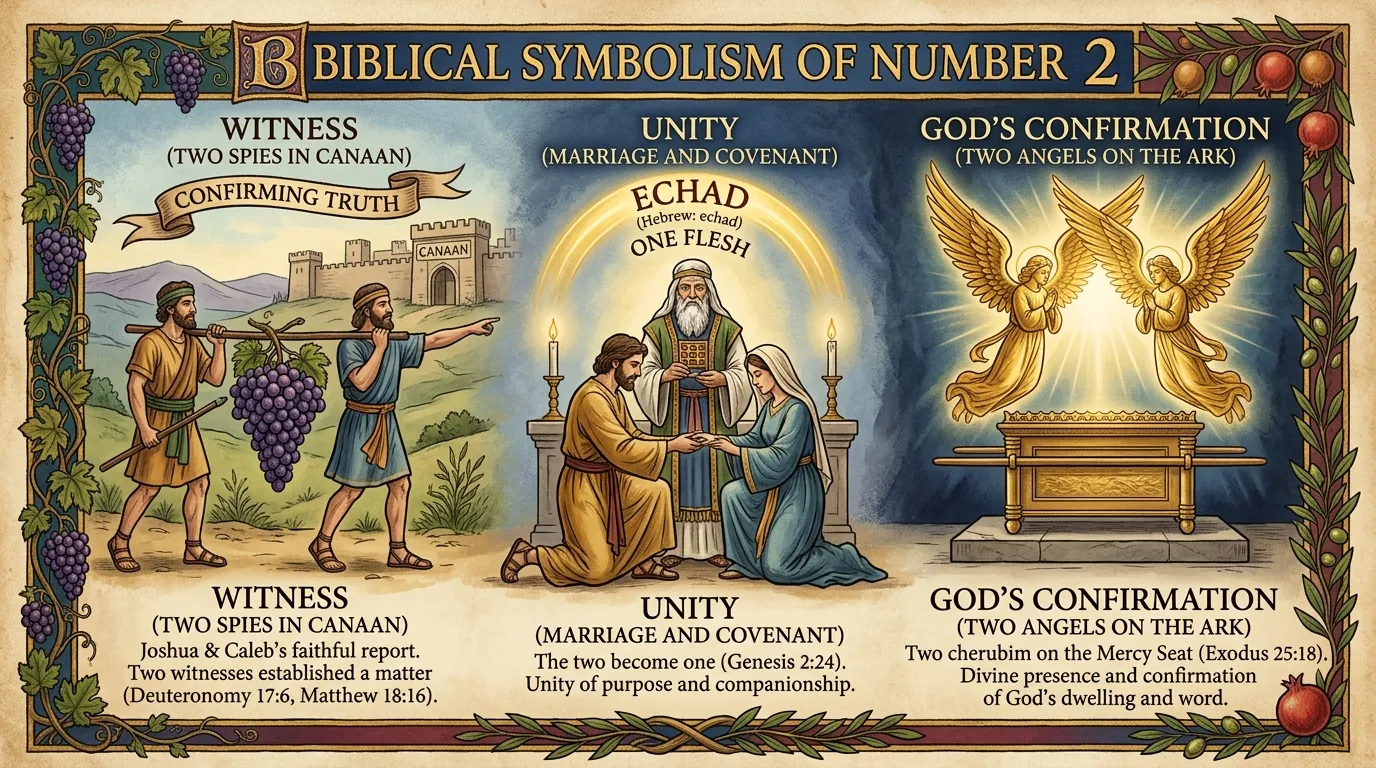
Of all the numbers in Scripture, two may be the most practical. It is the number of partnership and the number of testimony, the number that says “you are not alone” and the number that says “this is confirmed.” Where one is the number of God in His unity, two is the number of God’s world as He designed it: man and woman, heaven and earth, faith and works, the two great commandments, the two tablets of the law. The Bible’s teaching on the number two is less about symbolism and more about structure — about how reality is built.
This article approaches the number two through the principles it embodies rather than through mystical speculation. There is no secret code here. There is something better: a set of patterns that describe how God works, how truth is established, and how human beings flourish.
The Law of the Two Witnesses
The most theologically significant use of two in Scripture is legal. Deuteronomy establishes the principle: “A single witness shall not suffice against a person for any crime… Only on the evidence of two witnesses or of three witnesses shall a charge be established.” One person’s word is not enough. Truth, in God’s justice system, requires confirmation.
The principle runs through both testaments. Jesus applies it to church discipline: take one or two others along, “that every charge may be established by the evidence of two or three witnesses.” Paul cites it to the Corinthians. The two witnesses of Revelation 11 — whether understood as individuals, as the church, or as the Law and the Prophets — stand in this tradition: God’s final testimony to the world will not rest on a single voice.
Why does God work this way? Because He knows human nature. A single witness can be mistaken, biased, or corrupt. Two independent witnesses, agreeing, create a moral certainty that one cannot. The law of two witnesses is God’s built-in protection against both false accusation and false teaching. It is also, theologically, a reflection of something deeper: even God testifies in plurality. The Father testifies to the Son, the Son testifies to the Father, and the Spirit testifies to both. Truth, in the Bible’s vision, is inherently confirmed — never solitary.
Two Are Better Than One
If the courtroom gives us two as confirmation, the Teacher of Ecclesiastes gives us two as companionship: “Two are better than one, because they have a good reward for their toil. For if they fall, one will lift up his fellow. But woe to him who is alone when he falls and has not another to lift him up! Again, if two lie together, they keep warm, but how can one keep warm alone? And though a man might prevail against one who is alone, two will withstand him — a threefold cord is not quickly broken.”
This is the Bible’s philosophy of partnership in four images: shared labor, mutual rescue, shared warmth, and combined strength. It applies to marriage, to friendship, to ministry teams, to business partnerships — to every human endeavor. God designed human beings for twoness. The creation narrative makes this explicit: “It is not good that the man should be alone.” The solution is not independence but companionship — a helper fit for him, a partnership of equals.
Jesus structured His ministry around this principle. He sent the disciples out “two by two.” He appointed the twelve in pairs for mission. The early church followed suit: Paul and Barnabas, Paul and Silas, Priscilla and Aquila — always in company. The lone-ranger model of spirituality is not biblical. It is a modern invention, and a dangerous one. Two are better than one because God made us that way.
The Two Ways: Division and Decision
But two is not only partnership. It is also division — the number of alternatives, of the fork in the road. The Bible constantly presents reality in twos: the tree of life and the tree of the knowledge of good and evil; blessing and curse; the narrow way and the broad way; the wise builder and the foolish builder; sheep and goats; wheat and weeds. Two is the number of moral seriousness. It insists that choices are real and that they matter.
This is the harder teaching of twoness. Partnership is comforting; division is demanding. The two ways mean that neutrality is an illusion. Jesus puts it starkly: “Whoever is not with me is against me.” The Sermon on the Mount is structured as a series of twos — two gates, two trees, two houses — each one forcing the listener to choose. The number two, in this register, is the shape of judgment: reality divides, and we must decide which side we are on.
The pastoral wisdom here is to hold both meanings together. Two means you do not walk alone — and two means you cannot avoid choosing. Comfort and challenge, companionship and decision: the number holds them in tension, as the Christian life does.
Two Natures, Two Covenants, Two Comings
Christian theology itself is structured in twos. Christ has two natures — fully God and fully man — united in one person. There are two covenants — old and new — the first preparing for the second. There are two comings of Christ — the first in humility, the second in glory. The Bible’s storyline moves in pairs: creation and new creation, exodus and return from exile, the first Adam and the last Adam.
This is not numerology. It is the recognition that God’s ways have a rhythm, and the rhythm is often binary: promise and fulfillment, shadow and substance, already and not yet. To think biblically is to think in these pairs — to see the Old Testament as the first half of a sentence the New Testament completes. The number two, theologically, is the shape of a story that comes in two acts.
The Two Tablets
The law itself was given in twos. Moses comes down from Sinai carrying “the two tablets of the testimony, tablets of stone, written with the finger of God.” Tradition has long held that the Ten Commandments were divided between the tablets — the first tablet containing our duties to God, the second our duties to neighbor — a division Jesus Himself confirms when He summarizes the whole law in two commandments: love God, love neighbor.
Whether the commandments were split five and five or written in full on each tablet (ancient treaties were often duplicated, one copy for each party), the twoness of the tablets is suggestive. God’s law is not a monologue. It is a covenant document, with two sides: what we owe Him and what we owe each other. The vertical and the horizontal. Break one tablet and you have broken the set — which is exactly what Moses dramatizes when he shatters them at the sight of the golden calf. The two tablets, broken and then rewritten, tell the whole story of the law: given in grace, broken by sin, restored by mercy.
What Two Teaches the Church Today
The practical applications are immediate. In an age of radical individualism, the Bible’s twoness is a standing rebuke. The Christian who tries to follow Jesus alone — no church, no fellowship, no accountability — is attempting something the Bible never models and always warns against. We need our two: the friend who lifts us when we fall, the witness who confirms the truth, the partner who keeps us warm.
In an age of moral confusion, the Bible’s twoness is a standing clarity. The culture insists that all paths lead to the same place, that truth is a spectrum without edges. Scripture answers with its twos: two ways, two gates, two destinies. Not every division is real — the Bible also knows spectrums and mysteries — but the fundamental divisions are. Love of clarity about the things that matter is not narrowness. It is faithfulness.
And in an age of loneliness — which is also our age — the Bible’s twoness is a promise. “It is not good that the man should be alone” was spoken before the fall, which means companionship is not a remedy for brokenness but part of the original design. God Himself is plural in His unity, and He made us for communion. The God of two witnesses, two tablets, and two disciples on the road is the God who will not leave us as ones.
Readers who want to explore how interpreters have handled numbers across Scripture — carefully and carelessly — will find the survey of biblical numerology a helpful map of both the genuine patterns and the speculative excesses.










