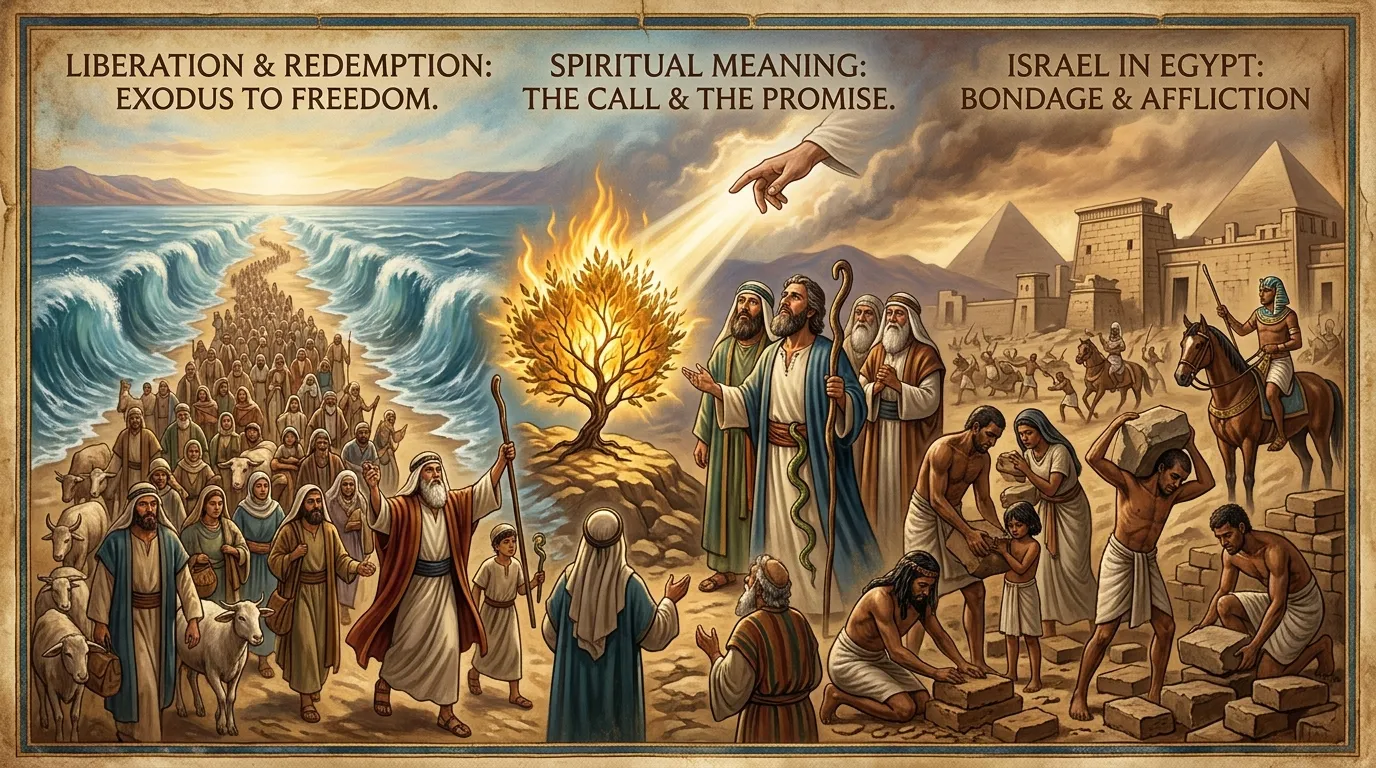
Jacob’s family arrived in Egypt as honoured guests. They left as escaped slaves, pursued by an army, walking through a sea on dry ground. Between those two moments lie four centuries, and the story of Israel in Egypt is the story of how a welcome became a bondage, how a bondage became a cry, and how a cry became a deliverance. It is the founding story of Israel as a nation, the event to which the rest of the Old Testament constantly looks back, and the picture that the New Testament uses to explain what God did in Christ.
The story begins with famine. Jacob’s sons had gone to Egypt to buy grain and discovered that the powerful official controlling the food supply was Joseph, the brother they had sold into slavery twenty years earlier. Joseph forgave them, revealed himself, and invited the whole family to settle in Goshen, the fertile region of the Nile Delta. Pharaoh welcomed them. They were given the best of the land. Jacob, an old man who had spent his life wandering, ended his days in Egypt with his family around him, and his last words were a blessing on his sons and a request to be buried in Canaan. The family that arrived numbered seventy people. The nation that left would number in the hundreds of thousands.
Act One: Favour in Goshen
The first years in Egypt were good. Goshen was well-watered pastureland, ideal for a family of shepherds. The Egyptians regarded shepherds as detestable, which paradoxically worked in Israel’s favour: it kept them separate, settled in their own region, preserving their identity instead of being absorbed into Egyptian culture. Joseph’s position at court protected them. As long as Joseph lived and his memory lasted, Israel was safe.
That separation was not an accident. It was part of God’s plan for a people who would one day need to be distinct. In Goshen, Israel grew. Exodus says the Israelites were fruitful and multiplied greatly, becoming so numerous that the land was filled with them. What had begun as a family was becoming a nation. The promise God had made to Abraham — that his descendants would be as numerous as the stars — was being fulfilled in a foreign land, under a foreign king, in a place that was not the promised land. God was keeping His word in the last place anyone would have expected.
The Goshen years also raise a question that runs through the whole story: why did God let His people stay in Egypt so long? Part of the answer is given in Genesis 15, where God told Abraham that his descendants would be strangers in a country not their own for four hundred years, because “the sin of the Amorites has not yet reached its full measure.” The Canaanites were not yet ripe for judgment. Israel’s sojourn in Egypt was, in part, a waiting period, a long delay in which God was patient with the inhabitants of Canaan even as He prepared Israel to become a nation. The delay was not neglect. It was mercy, extended in two directions at once.
Act Two: A Pharaoh Who Did Not Know Joseph
Then, Exodus says, “a new king, to whom Joseph meant nothing, came to power in Egypt.” That single sentence marks one of the great turning points in the Bible. The new Pharaoh looked at the growing Israelite population and saw a threat rather than a blessing. He feared that in the event of war, the Israelites would join Egypt’s enemies. His response was oppression: he set slave masters over them to afflict them with forced labour, and he ordered them to build the store cities of Pithom and Rameses.
The oppression followed a deliberate escalation. First came the labour: bricks, mortar, and field work, designed to break Israel’s spirit. When the Israelites kept multiplying despite the labour, Pharaoh ordered the Hebrew midwives to kill every newborn boy. When the midwives refused — fearing God more than Pharaoh — Pharaoh ordered every Israelite boy to be thrown into the Nile. The policy moved from exploitation to genocide, and it did so step by step, each cruelty making the next one easier. The Bible’s portrait of Pharaoh is a study in how fear, once given power, hardens into cruelty.
Yet even in this darkness, the text records quiet resistance. The midwives, Shiphrah and Puah, lied to Pharaoh and saved the babies. Moses’ mother hid her son for three months and then set him afloat in a basket on the Nile, where Pharaoh’s own daughter found him and raised him as her own. The oppressor’s household became the deliverer’s nursery. The Bible delights in this irony: the boy who would dismantle Egypt’s power grew up in Pharaoh’s palace, educated in Egypt’s wisdom, and nursed by his own mother. God’s deliverance was being prepared inside the very system that was trying to destroy it.
Act Three: The Plagues and the Passover
Moses spent forty years in Midian after fleeing Egypt for killing an Egyptian taskmaster. Then God appeared to him in a burning bush and called him to lead Israel out. Moses protested that he was not eloquent, not qualified, not the right man. God answered that He would be with him, and gave him signs, a spokesman in Aaron, and a promise. The confrontation that followed was not merely between Moses and Pharaoh. It was between the God of Israel and the gods of Egypt. Each plague struck at something Egypt worshipped: the Nile, the frogs, the livestock, the sun. The plagues were not random disasters. They were a systematic dismantling of Egypt’s theology, demonstrating that the gods of the greatest empire on earth were powerless before the Lord.
Pharaoh’s heart hardened through the plagues, and the Bible describes that hardening in a way that preserves both God’s sovereignty and Pharaoh’s responsibility. Pharaoh hardened his own heart repeatedly; God also hardened it, confirming the choice Pharaoh had already made. The pattern is a warning: persistent refusal to listen eventually becomes inability to listen. By the final plague, the death of the firstborn, Pharaoh had exhausted every opportunity to repent.
The Passover is the heart of the story. On the night of the final plague, each Israelite household slaughtered a lamb, spread its blood on the doorposts, and ate the meal in haste, dressed for travel. The Lord passed over the houses marked with blood, and the firstborn of Egypt died. The Passover became Israel’s defining memorial, celebrated annually, and the meal that Jesus would transform at the Last Supper. The apostle Paul would later write, “Christ, our Passover lamb, has been sacrificed.” The blood on the doorposts in Egypt and the blood on the cross are linked by the same logic: deliverance comes not because the people inside the house are perfect, but because the blood is on the door.
Moses: The Reluctant Deliverer
The deliverance of Israel from Egypt did not come through a willing hero. It came through a man who had fled Egypt as a murderer, spent forty years herding sheep in Midian, and argued with God at the burning bush that he was the wrong man for the job. Moses said he was slow of speech and slow of tongue. He asked God to send someone else. God answered that He would be with Moses’ mouth, and He gave him Aaron as a spokesman. The deliverer of Israel was a reluctant, self-doubting shepherd who needed to be persuaded that God could use him.
Moses’ reluctance is part of the story’s honesty. The Bible does not present its heroes as eager volunteers. It presents them as flawed, frightened people whom God equipped. Moses’ forty years in Midian were not wasted. They taught him the wilderness, the shepherd’s life, and the patience he would need to lead a nation through the desert. The man who fled Egypt as a prince returned as a shepherd, and the shepherd became the lawgiver. God’s preparation of Moses took longer than the exodus itself, and it happened in obscurity, far from the palace and the pyramids.
Leaving Egypt and Learning to Trust
The exodus itself was dramatic: the Red Sea parting, the Egyptian army drowned, the song of Moses on the far shore. But the story of Israel in Egypt does not end at the sea. It ends with a people who had to learn, over forty years in the wilderness, what freedom meant. Slavery had shaped their instincts. They longed for the pots of Egypt when the wilderness grew hard. They built a golden calf while Moses was on the mountain. Freedom, they discovered, was not merely the absence of a master. It was the presence of a covenant, and learning to live under it.
That is why Israel in Egypt remains the Bible’s master story of salvation. It is the story the prophets recalled, the psalmists sang, and the apostles used to explain the gospel. The New Testament presents Jesus as the greater Moses, the cross as the greater Passover, and the Christian’s freedom from sin as the greater exodus. The God who heard the cries of slaves in Egypt is the God who hears the cries of sinners now. The deliverance that began in Goshen and ended at the Red Sea points forward to a deliverance that no Pharaoh can reverse. The Exodus remains one of the most influential narratives in human history, and its account in Scripture continues to shape how people understand freedom, oppression, and divine rescue.










