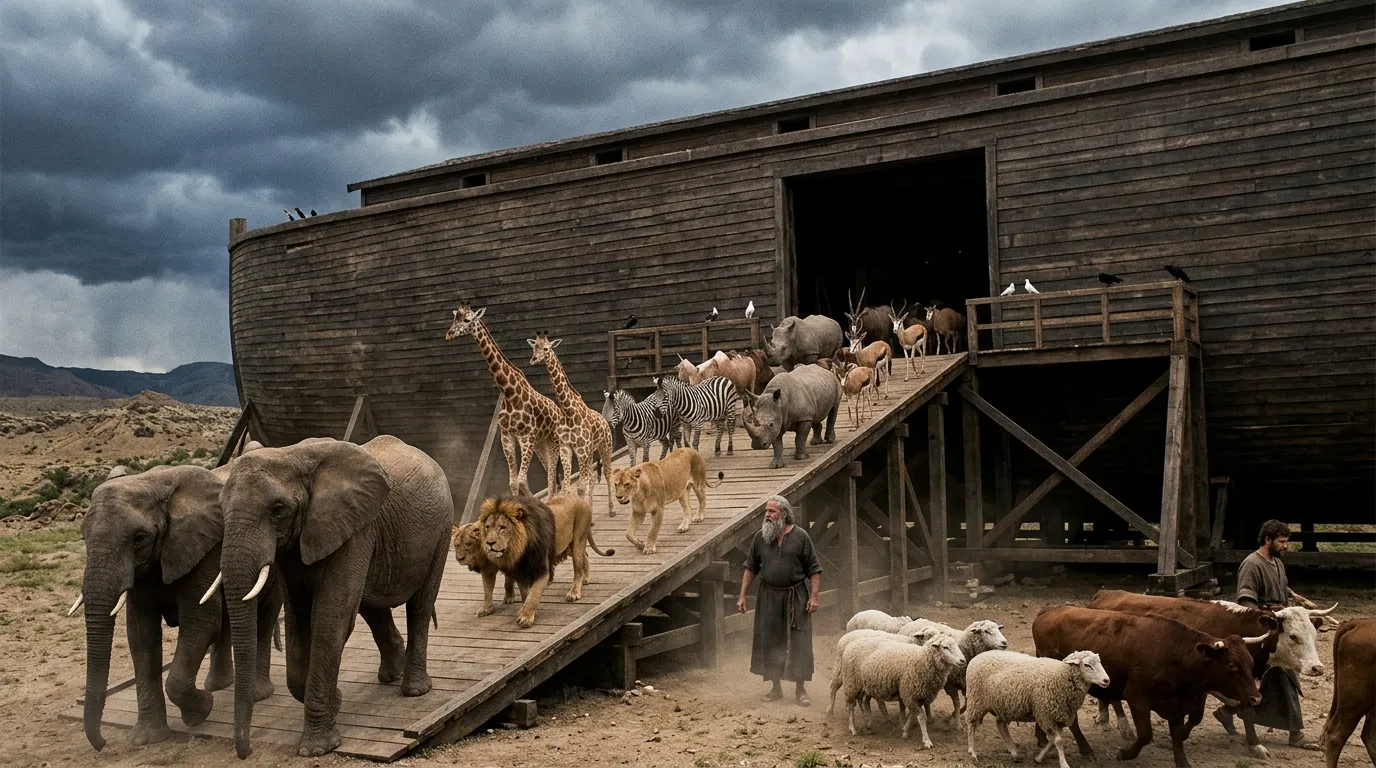
When the flood came, God did not save only people. He saved animals. That fact is easy to overlook in a story most readers know from childhood, but it is one of the most striking details in Genesis. The ark carried representatives of every kind of creature that lived on the land and in the air, and their presence on board was not decorative. It was theological. The animals on Noah’s ark show that God’s judgment and God’s mercy both extend beyond humanity, and that His covenant after the flood was made with “every living creature,” not with people alone.
The instructions God gave Noah were precise. He was to bring two of every kind of animal — a male and a female — into the ark, to keep them alive. For clean animals, and for birds, the number was seven pairs, not one. The distinction matters. Clean animals were those that could be offered in sacrifice and eaten under the later law, and the extra pairs ensured that after the flood, Noah could offer sacrifices without wiping out a species. The numbers reveal a God who plans ahead: He provides for worship and for survival in the same instruction.
Why God Included the Animals at All
The first question the animals raise is why they were on the ark in the first place. The flood was a judgment on human wickedness. Genesis says that the wickedness of man was great on the earth and that every inclination of the thoughts of his heart was only evil continually. The animals had not sinned. Why should they be swept away? And why should they be saved?
Part of the answer lies in the way the Bible understands creation. Human beings were given dominion over the animals, and the fate of the creation is bound up with the fate of its stewards. When humanity fell, creation fell with it — the ground was cursed, the animals were affected, and the whole order groaned. Paul would later write that creation itself waits to be liberated from its bondage to decay. The flood was not merely a punishment aimed at people; it was a cleansing of a corrupted world. And the ark was not merely a lifeboat for Noah’s family; it was a seed of the new world, carrying within it the representatives of every kind of life that would repopulate the earth.
There is also a simpler, more pastoral answer. God cares for animals. The Bible says so repeatedly. He feeds the ravens. He knows when a sparrow falls. The law commands rest for working animals on the Sabbath. Jonah’s story ends with God’s concern for Nineveh, including its many animals. The ark is the earliest and grandest demonstration of that care. When God determined to destroy the world, He made provision for the creatures that had no part in the world’s wickedness. Judgment did not cancel compassion.
Clean and Unclean: The Pattern in the Numbers
The distinction between clean and unclean animals in Genesis 7 is sometimes treated as a puzzle, because the formal law distinguishing them was not given until Sinai, centuries later. But the passage shows that the categories already existed in Noah’s day. Noah evidently knew which animals were clean. Abel’s offering of a lamb, centuries earlier, points in the same direction: the knowledge of clean animals for sacrifice predates Moses.
The practical effect of the distinction was that the ark carried fourteen of each clean kind and two of each unclean kind. After the flood, Noah sacrificed some of the clean animals on an altar, and God responded to the offering with a promise never again to destroy the earth with a flood. The clean animals thus served a double purpose: they repopulated the earth, and they provided the sacrifice that sealed the new beginning. The unclean animals, carried in smaller numbers, served the first purpose only. The ark was not just a shelter. It was a floating temple, stocked for worship as well as survival.
The numbers also answer a common objection: that the ark could not have held every species alive today. Genesis speaks of “kinds,” not of modern species, and the biblical kind is a broader category than the species. The ark did not need to carry every breed of dog or every variety of finch. It needed to carry representatives of each kind, from which the diversity we see today could develop. Whether readers accept that explanation or not, the text itself is clear that the ark’s cargo was organised by kinds, and that the post-flood world diversified from those representatives.
How the Animals Came: God Brought Them
One of the most remarkable details in the story is that Noah did not have to gather the animals. Genesis says, “Of the birds according to their kinds, of all the animals according to their kinds, and of every creature that moves along the ground according to its kind, two of every kind will come to you to keep them alive.” The animals came to Noah. The image is extraordinary: creatures from every direction, walking, flying, and creeping toward the ark, as if drawn by an instinct beyond their own. Noah’s job was to receive them, not to round them up.
That detail changes how the story should be read. The ark was not a project that Noah accomplished by heroic effort alone. It was a project in which God managed the parts Noah could not manage. Noah could build the boat. He could gather the food. He could not summon the animals from across the world. God did that. The story is a picture of partnership: human obedience doing what it can, and divine sovereignty supplying what it cannot. The same pattern runs through the whole Bible. People build, plant, and prepare, and God brings the increase.
The Passenger List: What Kinds Went Aboard
Genesis describes the ark’s animal cargo in broad categories: livestock, birds, and creatures that move along the ground. Within those categories, the text distinguishes between clean and unclean, but it does not list species. The cargo included the domestic animals that would sustain human life after the flood — cattle, sheep, goats — and the wild animals that would repopulate the earth, and the birds that would fill the sky. The ark was a cross-section of the living world, reduced to its representatives.
The absence of sea creatures from the cargo is also worth noting. The flood was a judgment on the land, and the fish of the sea were not brought aboard. The ark carried the creatures that lived on the land and in the air, the creatures whose habitat was destroyed by the flood. The sea creatures remained in the sea, which was their element. The ark’s cargo was thus precisely matched to the judgment: it carried the life that the flood would have destroyed, and it left behind the life that the flood could not touch.
What the Animals Teach About the New World
When the floodwaters receded and Noah opened the ark, the animals went out to repopulate the earth. God’s first command to the survivors echoes the first command to Adam: be fruitful and increase in number and fill the earth. The world was being restarted, and the animals were part of the restart. But something had changed. Before the flood, animals and humans had lived in a peace that Genesis describes in Eden. After the flood, God announced that the fear and dread of humans would fall on the animals. The relationship was altered. The world after the flood would be a world of fear, hunting, and enmity between species — a sign that the flood had not removed the curse, only restrained it.
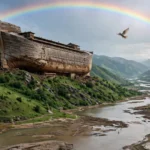
Yet the covenant God made after the flood was explicitly with the animals as well as with Noah. “I now establish my covenant with you and your descendants after you and with every living creature that was with you — the birds, the livestock and all the wild animals.” The rainbow, the sign of that covenant, was given as a promise to all flesh. The animals were not bystanders to the covenant. They were parties to it. That is a remarkable claim, and it places the story of the ark at the foundation of a biblical ethic of creation care. The creatures that shared the ark share the covenant, and the God who saved them expects His people to treat His creation with the same care He showed.
The animals on Noah’s ark thus point in two directions at once. They point backward, to a God who values every creature He made, and forward, to a day when the wolf will live with the lamb and the lion will eat straw like the ox. The ark was a small, floating preview of that day: predators and prey, clean and unclean, wild and tame, all kept alive together under God’s protection. The world that came out of the ark was not yet that world, but the ark carried the promise of it. For the natural history behind the creatures named in the account, the Noah’s Ark article surveys how the story has been understood across traditions.