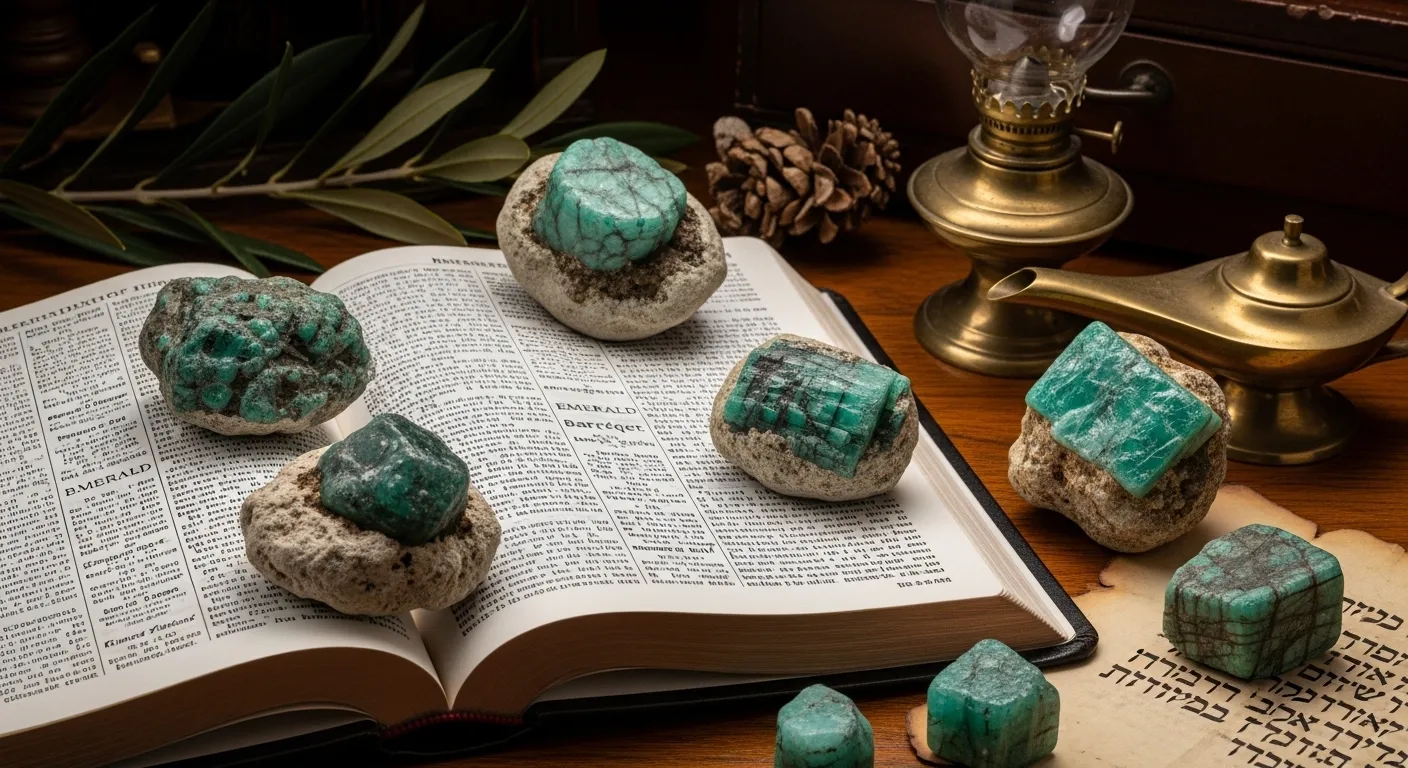
Every rainbow is a sermon. After the flood, God set the bow in the clouds as the sign of His covenant — “Never again will the waters become a flood to destroy all life” (Genesis 9:15). The rainbow means mercy remembered, judgment restrained, promise kept. So when the apostle John looks at the throne of God and sees, encircling it, a rainbow the color of emerald, he is seeing the covenant sign wrapped around the seat of divine power. That single image — Revelation 4:3 — is the key to everything Scripture says about emeralds.
The Emerald Rainbow
“And the one who sat there had the appearance of jasper and ruby. A rainbow that shone like an emerald encircled the throne” (Revelation 4:3).
Consider what this does to our instinctive picture of God’s throne. A throne is a place of authority, and authority in human experience usually means distance — the dais, the guards, the protocol. John’s throne has those elements (lightning, thunder, and twenty-four elders surround it in the verses that follow), but encircling it all is the emerald rainbow: the covenant color, the mercy sign, the promise green.
The color choice is precise. An ordinary rainbow contains every color; John singles out emerald — green, the color of life. Around the throne of the Almighty, the dominant note is not the red of wrath or the white of terror but the green of mercy. Judgment is real — Revelation will spend many chapters on it — but it operates inside a circle of covenant faithfulness. God’s power is fenced by God’s promise. That is what the emerald rainbow preaches, and it is why the stone’s biblical meaning centers on mercy, peace, and God’s keeping of His word.
For the anxious believer, this is medicine. The God on the throne is not barely restraining Himself from destroying you; He has circled His own authority with the sign of His mercy. The rainbow was His idea. The emerald circle is His decoration. Mercy is not the exception to His rule — it is the frame around it.
On the Priest’s Chest, Over the Heart
Emerald also appears in the high priest’s breastplate. Exodus 28:18 places it in the second row (KJV: “an emerald, a sapphire, and a diamond”), engraved with one of the tribes’ names and borne over Aaron’s heart into the Holy Place.
Set beside Revelation 4, the breastplate placement deepens the mercy theme. The priest who carried the emerald was the people’s intercessor — the one who stood between Israel’s sin and God’s holiness on the Day of Atonement. A green stone, the color of the covenant rainbow, resting over the intercessor’s heart while he pleaded for mercy: the symbolism is almost too fitting to be accidental. Intercession itself is a green work — it insists on life where judgment would bring death.
The engraved tribal name adds the personal dimension. Mercy in Scripture is never abstract. The rainbow encircles the throne universally, but the emerald on the breastplate carries a particular name — a specific tribe, a specific people, a specific story. God’s covenant faithfulness is cosmic in scope and personal in application. He keeps His promises to the world, and He keeps them to you, by name.
The Garden Stone and the Warning
Ezekiel 28:13 lists emerald among the precious stones adorning the figure in Eden — “every precious stone adorned you” — in an oracle that moves from the king of Tyre to something older and darker: a being of perfect beauty whose heart grew proud because of it. “Your heart became proud on account of your beauty” (Ezekiel 28:17).
This is the necessary shadow in the emerald’s story. The stone that pictures mercy also adorned pride. Beauty — even beauty given by God, even beauty placed in Eden — becomes the occasion for corruption when it is admired in the mirror instead of received with thanks. The king of Tyre’s story is the perennial human story: blessing curdles into entitlement, gift into grievance, beauty into boast.
The warning applies wherever emeralds appear in a reader’s life — literally or figuratively. Every good thing (and emeralds in Scripture consistently mark good things: mercy, covenant, life) can become a bad thing when it displaces gratitude. The stone is not the problem; the heart admiring itself in the stone’s reflection is. Ezekiel 28 keeps the emerald honest: handle beauty with worship, or it will handle you.
Green as God’s Favorite Answer
Step back and notice how often green answers despair in Scripture. The dove returns to Noah with an olive leaf — green, living, the flood receding (Genesis 8:11). The psalmist’s God makes him lie down in green pastures (Psalm 23:2). The righteous are “like a tree planted by streams of water” — and the tree’s leaf “does not wither” (Psalm 1:3). Jeremiah’s trusting soul is a tree whose “leaves stay green” even in drought (Jeremiah 17:8).
Emerald is that green concentrated into stone — permanent, unwithering, set around the throne and over the priest’s heart. It is God’s favorite answer (“live”) made mineral. Wherever Scripture wants to say that mercy outlasts judgment, that covenant outlasts catastrophe, that life outlasts death, it reaches for green. Emerald is simply green at its most enduring.
This gives the stone a pastoral use that needs no superstition. In seasons of drought — spiritual, emotional, circumstantial — the emerald passages preach Jeremiah 17:8: the roots are deeper than the drought. The rainbow still circles the throne. The covenant has not been revoked. Green is coming back, because the God who promised it does not change His mind.
Living Inside the Emerald Circle
What does a Christian do with all this? Three postures, matching the three appearances:
- Look up with confidence. The throne you approach in prayer (Hebrews 4:16) is circled with mercy. You do not sneak into the throne room hoping God is in a good mood; you enter a room He decorated with His own promise. Boldness in prayer is not presumption — it is literacy. You have read the rainbow.
- Intercede in green. The emerald on the priest’s chest models intercession as life-insistence: standing before God on behalf of people who do not deserve it, carrying their names over your heart. Every believer is now part of “a royal priesthood” (1 Peter 2:9). The emerald is, in a sense, your stone too.
- Receive beauty with open hands. Ezekiel 28’s warning is the guardrail: enjoy the green things — mercy received, beauty given, life restored — without clutching them. Gratitude keeps emerald a sermon; entitlement turns it into Tyre.
The Full Throne-Room Palette
The emerald rainbow does not hang alone. Revelation 4 composes a complete portrait, and each element tunes the others. The One on the throne has “the appearance of jasper and ruby” (4:3) — radiant holiness and the deep red of sacrifice or judgment. Around Him, the emerald rainbow — mercy circling power. Before the throne, “a sea of glass, clear as crystal” (4:6) — chaos stilled, the uncontrollable made transparent. Seven lamps of fire burn before the throne (4:5) — the Spirit’s perfect light. Lightning and thunder proceed from it — power undisguised.
Read the palette together and it preaches the whole character of God in color: the white-fire brilliance of jasper (holiness), the red of sardius (justice, sacrifice), the green of emerald (mercy, covenant), the crystal sea (sovereignty over chaos). No single color dominates because no single attribute does. This is the God Israel met at Sinai — glorious and terrible — now seen from inside the throne room, with mercy visibly encircling all of it.
The twenty-four elders fall down and cast their crowns (4:10) — the only appropriate response to the full palette. Worship, in Revelation, is what happens when the whole spectrum hits at once: holiness that dazzles, justice that awes, mercy that encircles, sovereignty that stills. The emerald rainbow is one band of that spectrum, and its band says: all of this glory, all of this power — circled, framed, and softened by covenant love. The throne is terrible. The rainbow says: come anyway.
Gemologists will tell you emerald is green beryl, colored by chromium or vanadium, famously included and famously fragile despite its beauty — Wikipedia’s emerald entry has the details. Scripture’s portrait is different and deeper: the stone the color of the covenant, set where mercy needed declaring — around the throne, over the intercessor’s heart, in the garden before the fall. Green is God’s answer, and emerald is green that never fades.










