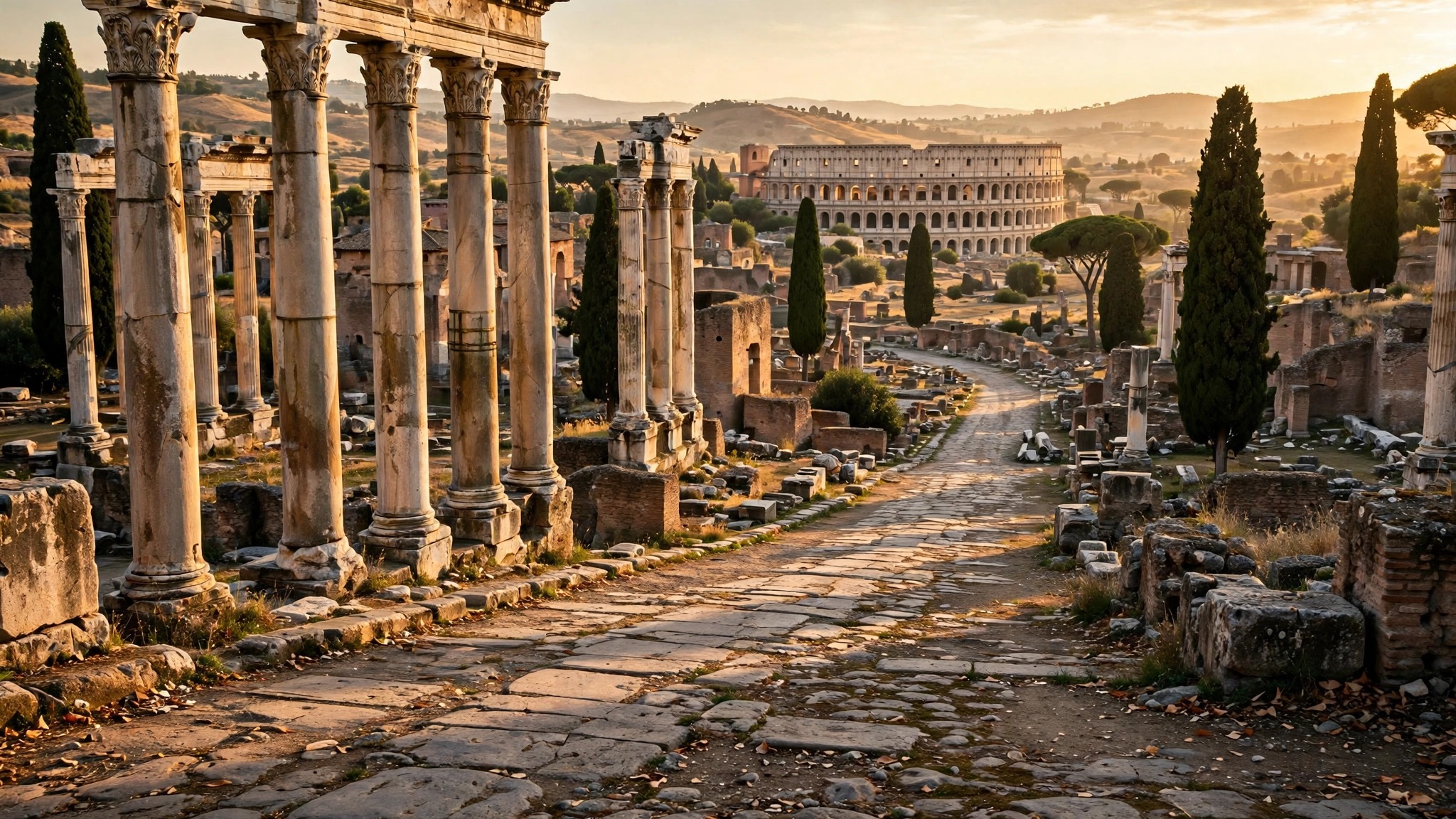
At the time of Jesus, one empire ruled the known world — Rome. Its legions marched from Britain to Egypt, its roads connected continents, and its emperor demanded to be worshiped as a god. Understanding the Roman Empire in Bible times meaning unlocks so much of the New Testament: why Jesus was crucified, why Paul could travel so freely, and why the gospel spread like wildfire across the ancient world. Here is the stunning truth at the heart of it all: the mightiest empire in human history became the unwitting servant of God’s greatest purpose. Rome built roads for its armies; God used them for His apostles. Rome crucified Jesus; God used the cross to save the world. The empire meant for power became the stage for grace.
Rome in the Story: Census, Cross, and Citizenship
Rome appears throughout the New Testament, often quietly, always consequentially.
The census that moved a family. “In those days Caesar Augustus issued a decree that a census should be taken of the entire Roman world” (Luke 2:1). A bureaucratic order from an emperor who never heard of Mary and Joseph forced them to travel to Bethlehem — exactly where the prophet Micah said the Messiah would be born (Micah 5:2). The emperor thought he was counting subjects. God was fulfilling prophecy.
The cross Rome invented. Crucifixion was Rome’s execution method, reserved for slaves and rebels. When the Jewish leaders wanted Jesus dead, they needed Rome’s permission, because Rome alone could execute (John 18:31). Pilate, the Roman governor, sentenced Jesus though he found no basis for a charge (John 18:28–19:16). The sign above the cross — “Jesus of Nazareth, King of the Jews” (John 19:19) — was written in three languages, Rome’s unintentional proclamation of the gospel to the world.
The citizenship that protected Paul. Paul was a Roman citizen, and he used that citizenship strategically. At Philippi he protested his unlawful beating as a Roman citizen (Acts 16:37–38). His appeal to Caesar (Acts 25:11–12) carried him to Rome itself — the empire’s capital became his final mission field. What Rome meant for imprisonment, God meant for proclamation: Paul’s chains advanced the gospel through the whole palace guard (Philippians 1:12–13).
The roads that carried the gospel. Rome’s roads, built for armies and trade, became highways for apostles. The Pax Romana — the Roman peace — made travel safer than it had been for centuries. And a common language, Greek, meant the gospel could be preached from Jerusalem to Rome without interpreters. Jesus came at the set time God had appointed, and Rome was part of that fullness of time.
Daniel Saw It Coming: The Iron Empire
Centuries before Rome existed, Daniel saw it. In Nebuchadnezzar’s dream, a statue of gold, silver, bronze, and iron represented successive empires (Daniel 2). The iron legs — “strong as iron” — were Rome (Daniel 2:40). Daniel’s vision of four beasts (Daniel 7) pointed to the same succession. And Daniel’s most important word was this: “He changes times and seasons; he deposes kings and raises up others” (Daniel 2:21). Rome did not rise because Rome was strong; Rome rose because God raised it. And the stone that would crush the statue — “a kingdom that will never be destroyed” (Daniel 2:44) — was the kingdom of Christ, which arrived in Rome’s shadow and outlasted it.
Daniel’s friends showed what faithfulness looks like under empire. Shadrach, Meshach, and Abednego refused the king’s idol and declared, “Even if God does not rescue us, we will not serve your gods” (Daniel 3:18). The early Christians lived the same way under Rome: honoring the emperor (1 Peter 2:17) while refusing to worship him, obeying the authorities (Romans 13:1–7) while obeying God first when the two conflicted (Acts 5:29).
God’s Sovereignty Over Human Empires
The Bible’s teaching about Rome is part of a larger truth: God rules the rulers. “The king’s heart is in the hand of the Lord; he directs it like a watercourse wherever he pleases” (Proverbs 21:1). “The Most High is sovereign over all kingdoms on earth” (Daniel 4:17). Pilate thought he held Jesus’ life in his hands; Jesus told him, “You would have no power over me if it were not given to you from above” (John 19:11). Herod and Pilate and the nations raged against God’s Anointed — but they “did what your power and will had decided beforehand should happen” (Acts 4:28). Even the empire’s worst act, the crucifixion, was folded into God’s plan: through the cross, Christ “disarmed the powers and authorities” (Colossians 2:15).
This is not fatalism; it is freedom. If God can use an empire that does not know Him, He can use the circumstances of your life — even the unjust ones, even the painful ones — for His purposes. What was meant for evil, God can turn for good. The cross is the proof.
Rome as a Picture: The World’s Power vs. God’s Kingdom
In Scripture, Rome functions as a symbol of the world’s power at its peak — impressive, efficient, brutal, and ultimately temporary. Revelation pictures the empire’s spirit as Babylon: “Fallen! Fallen is Babylon the Great!” (Revelation 18:2), and “Mystery: Babylon the Great, the mother of prostitutes” (Revelation 17:5). The message is not that Rome alone was evil; it is that every human empire that demands what belongs to God — worship, absolute loyalty, the right to define truth — is Babylon in some form. And every Babylon falls.
Against Rome’s iron stands another kingdom. Rome’s citizens boasted, “I am a citizen of Rome.” Paul told believers, “Our citizenship is in heaven” (Philippians 3:20). Rome’s emperor was called “lord” and “savior.” Christians confessed, “Jesus is Lord” (Romans 10:9) — a quiet act of treason that eventually outlasted the empire. Rome built monuments to its own glory; God built a kingdom of forgiven sinners that has now outlived Rome by fifteen centuries. “The kingdom of the world has become the kingdom of our Lord and of his Messiah, and he will reign for ever and ever” (Revelation 11:15).
How the First Christians Lived Under Rome
The New Testament’s instructions for life under empire are strikingly practical. Honor the emperor (1 Peter 2:17). Pay taxes (Romans 13:6–7). Pray for rulers (1 Timothy 2:1–2). Live such good lives among unbelievers that even hostile officials have nothing true to accuse you of. And when the empire demands what belongs to God alone — worship, silence about Christ, disobedience to His commands — obey God rather than men (Acts 5:29). The early church did not march on Rome; it out-loved Rome, out-served Rome, and out-died Rome. Martyrs forgave their executioners. Believers rescued abandoned infants, fed the hungry during plagues, and buried the dead of pagans and Christians alike. The empire that killed them could not stop them, because their King had already conquered death.
What Rome Teaches Us Today
Do not fear the powers. The empire that crucified Jesus is gone. The kingdom He founded remains. Whatever power frightens you — a government, a corporation, a cultural tide — it is iron in God’s hand, not a rival to His throne.
Do not trust the powers. Rome looked eternal. It fell. Every human institution will disappoint you if you make it your savior. Build your hope on the kingdom that cannot be shaken (Hebrews 12:28).
Use the roads God provides. Rome’s roads carried the gospel; your roads are the internet, the workplace, the neighborhood, the school gate. God has given you a Pax — a moment of relative peace and unprecedented connection — and He expects you to use it. “Be wise in the way you act toward outsiders; make the most of every opportunity” (Colossians 4:5).
Remember that your citizenship is in heaven. You may love your country and serve it faithfully — the first Christians did — but your ultimate allegiance is elsewhere. The empire’s census counted you as a subject; heaven’s book counts you as a citizen. Live like it.
Questions People Ask
Was Rome the beast of Revelation? Revelation’s imagery certainly evokes Rome — the seven hills, the persecuting power, the demand for worship — and its first readers would have heard it that way. But the book’s message is bigger than one empire: every world power that opposes God shares Babylon’s spirit, and every one of them falls.
Why did God let Rome persecute the church? Scripture does not answer every “why” of suffering, but it does show the fruit: persecution scattered believers, purified the church, and demonstrated that the gospel cannot be killed. The blood of the martyrs became the seed of the church. God did not author Rome’s cruelty, but He overruled it for His glory — just as He overruled the cross.
Conclusion: The Empire Falls; the Kingdom Stands
Rome had the legions, the roads, the laws, and the lions. It had everything — except permanence. The empire that counted the world in a census, executed its King, and imprisoned its apostles is now a subject for archaeologists. The kingdom that King founded is now the largest movement in human history. That is the Roman Empire in Bible times meaning: the world’s greatest power became the backdrop for God’s greatest act, and the backdrop faded while the act remains. So take heart. The powers that frighten you today will pass. The kingdom that called you will not. “Of the greatness of his government and peace there will be no end” (Isaiah 9:7). Rome fell. Christ reigns. And if you belong to Him, you are a citizen of the kingdom that will outlast them all. A fuller account of Rome’s rise and fall can be found in the Wikipedia article on the Roman Empire.










