The Hebrew word is kaphar, and its most basic sense is to cover. The same word describes Noah coating the ark with pitch — covering the wood so the waters of judgment could not get through (Genesis 6:14). Hold that picture, because it is the seed of everything the Bible means by atonement: a covering placed between sin and judgment, so that the guilty are sheltered and the relationship survives. From the animal skins God made for Adam and Eve to the cross outside Jerusalem, Scripture tells one long story of God providing the covering Himself — because the breach was too wide for sinners to cover on their own.
The English word “atonement” famously breaks into “at-one-ment” — the state of being at one with God. That is the goal: reconciliation, restored relationship. But the biblical path to that goal runs through the covering. Sin must be dealt with — covered, purged, borne away — before fellowship can be restored. Atonement is therefore not God pretending the sin never happened; it is God dealing with the sin so completely that the sinner can come home. The covering is real, the cost is real, and the welcome is real.
Kaphar: The Covering in the Old Testament
Do not miss the Passover either — the night the firstborn of Israel lived because blood marked the doorposts: “when I see the blood, I will pass over you” (Exodus 12:13). The blood was a covering in the most literal sense — judgment saw the mark and passed by. Every Jewish family that kept Passover for the next fourteen centuries was rehearsing kaphar: sheltered by blood, spared by a substitute. When John called Jesus “the Lamb of God,” every Passover-keeping listener heard the resonance instantly.
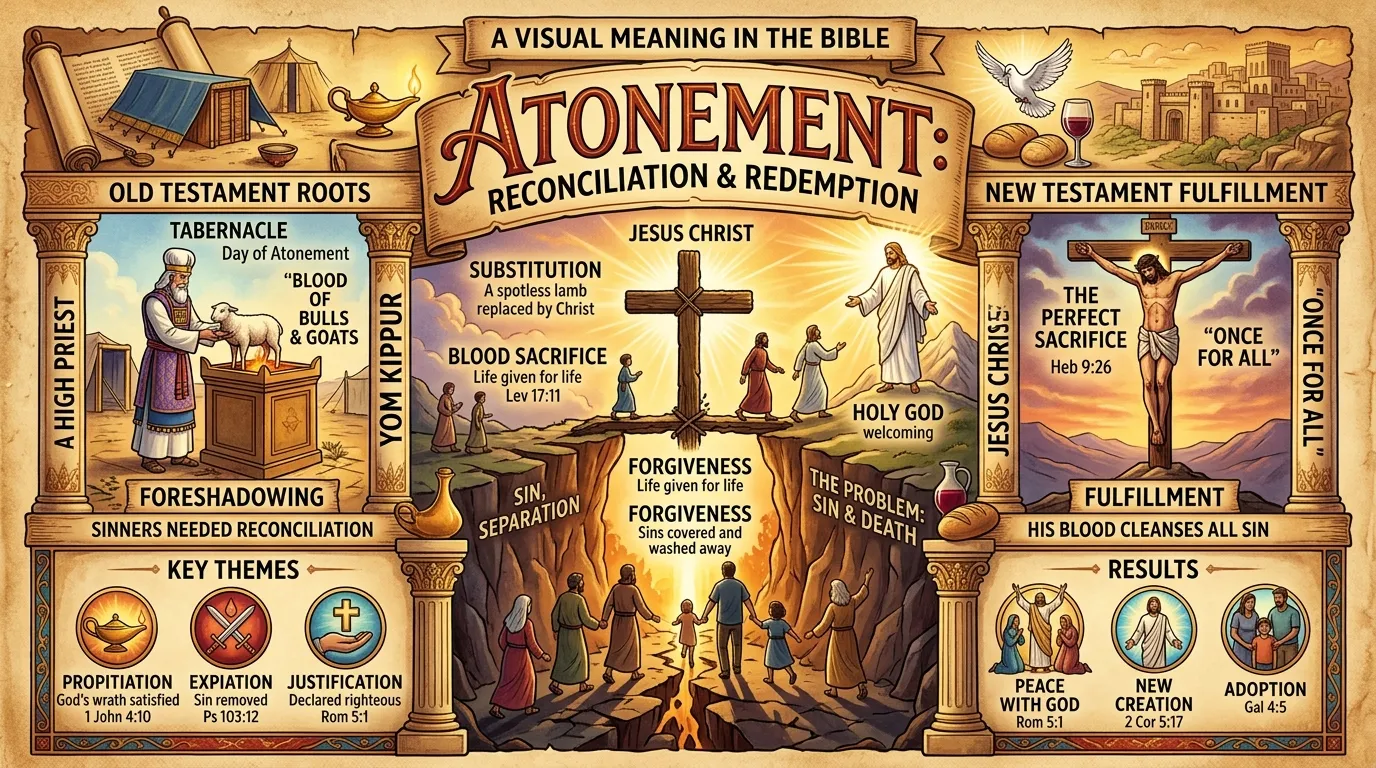
Under the Law of Moses, kaphar became the technical word for what the sacrifices accomplished. The worshiper brought an animal, laid a hand on its head — identifying with it, transferring the guilt in symbol — and the animal died in the worshiper’s place. Leviticus gives the logic plainly: “the life of the flesh is in the blood, and I have given it for you on the altar to make atonement for your souls” (Leviticus 17:11). Life for life. Sin costs life; God accepts a substitute’s life as the covering. The ritual said in acted form what words alone could not carry: this is how serious sin is, and this is how merciful God is.
But the Old Testament itself insisted the animal coverings were not the final answer. The prophets thundered against sacrifices offered by unrepentant hearts — “I desire steadfast love and not sacrifice,” God said through Hosea (Hosea 6:6), a text Jesus quoted twice. David, after his great sin, understood: “you will not delight in sacrifice… The sacrifices of God are a broken spirit; a broken and contrite heart, O God, you will not despise” (Psalm 51:16-17). The system was a signpost, not a destination — a centuries-long acted parable teaching Israel to look for the covering that would actually finish the work. Every lamb on every altar whispered the same question: when will the true Lamb come?
The Two Goats: Atonement’s Great Drama
The Day of Atonement (Leviticus 16) staged the doctrine as drama. Once a year, the high priest entered the Most Holy Place — behind the veil, into the presence — to make atonement for the whole nation. At the center stood two goats, and between them they pictured both halves of what atonement accomplishes. The first goat was sacrificed; its blood was carried inside and sprinkled on the mercy seat. This was propitiation — the covering of guilt before God’s holiness, the satisfaction of righteous judgment. Sin was dealt with by sacrifice.
Then the second goat — the azazel, the scapegoat. The high priest laid both hands on its head, confessed over it all the sins of Israel, and sent it away into the wilderness, “and the goat shall bear all their iniquities on itself to a remote area” (Leviticus 16:22). This was expiation — the removal of sin from the people, carried away where it could never return. The two goats preached together: sin covered before God, sin removed from us. The psalmist sang the result: “as far as the east is from the west, so far does he remove our transgressions from us” (Psalm 103:12). Not merely forgiven — removed. Carried into the wilderness. Gone.
Imagine being an Israelite watching that goat disappear over the horizon, bells fading, carrying the year’s sins into nowhere. The visual sermon was unmistakable: your sins have been taken away, and they are not coming back. Every Day of Atonement was a rehearsal — and like all rehearsals, it pointed to a performance. The author of Hebrews would later make the connection explicit: these were “a shadow of the good things to come” (Hebrews 10:1). The goats were real, the covering was real, but the completion was still future.
The Covering Completed: The Lamb and the Torn Veil
Isaiah 53 is the theological bridge between the shadows and the substance — written seven centuries before the cross, yet describing it with startling precision: “he was pierced for our transgressions; he was crushed for our iniquities; upon him was the chastisement that brought us peace, and with his wounds we are healed” (Isaiah 53:5). Pierced for our transgressions. The prophet saw what the sacrifices meant: substitution — the innocent bearing what the guilty deserved. “The LORD has laid on him the iniquity of us all” (Isaiah 53:6). Every kaphar covering in the old system was a promissory note; Isaiah 53 announced that the payment was coming in person.
“Behold, the Lamb of God, who takes away the sin of the world!” (John 1:29). John the Baptist’s cry gathers the Passover lamb, the daily sacrifices, and the two goats of the Day of Atonement into a single person. Jesus did not merely bring a sacrifice; He became one. At the Last Supper He took the cup: “this is my blood of the covenant, which is poured out for many for the forgiveness of sins” (Matthew 26:28). On the cross, both goats’ work was finished at once: His death covered guilt before God and carried sin away — “he bore our sins in his body on the tree” (1 Peter 2:24).
And then the veil tore. “The curtain of the temple was torn in two, from top to bottom” (Matthew 27:51) — from top to bottom: torn by God, not by man. The barrier that had kept everyone but the high priest out of the Most Holy Place, and him only once a year, was ripped open at the moment of Christ’s death. The symbolism is exact: the covering has been made; the way is open. Hebrews draws the conclusion: “we have confidence to enter the holy places by the blood of Jesus, by the new and living way that he opened for us through the curtain” (Hebrews 10:19-20). No more annual waiting. No more distance. The atonement accomplished what the Day of Atonement only rehearsed: sinners brought at one with God, permanently.
Living Under the Covering: What Atonement Does Today
Atonement is not only a doctrine to believe but a covering to live under — and living under it changes three things. First, guilt. The believer’s conscience is not managed by self-punishment or by pretending; it is cleansed by the blood that actually covered the sin. “How much more will the blood of Christ… purify our conscience from dead works to serve the living God” (Hebrews 9:14). The covering is complete, which means the guilt-trip is over — not because sin was small, but because the sacrifice was sufficient. Second, assurance. “There is therefore now no condemnation for those who are in Christ Jesus” (Romans 8:1). No condemnation. The covering holds. The east will never meet the west; the sins carried into the wilderness are not coming back.
Third, mission. “God was reconciling the world to himself in Christ… and entrusting to us the message of reconciliation. Therefore, we are ambassadors for Christ” (2 Corinthians 5:19-20). Those who live under the covering become its announcers. The atoned become the atonement’s witnesses — not because they are worthy, but because they are covered. Every forgiven sinner is a walking Day of Atonement, a living demonstration that the breach can be mended and the far country left behind.
From Noah’s pitch-covered ark to the two goats of Leviticus 16, through Isaiah’s pierced Servant to the torn veil and the Lamb who takes away the sin of the world, the Bible tells one story about atonement: God Himself provides the covering, the covering is complete, and the way home is open. The breach sin made, grace has mended — at the cost of blood, to the gain of reconciliation. The covered sinner need not hide like Adam among the trees; he can walk, forgiven and uncondemned, straight into the Father’s presence. For the history of how Christians have understood this central doctrine, see the article on atonement in Christianity.