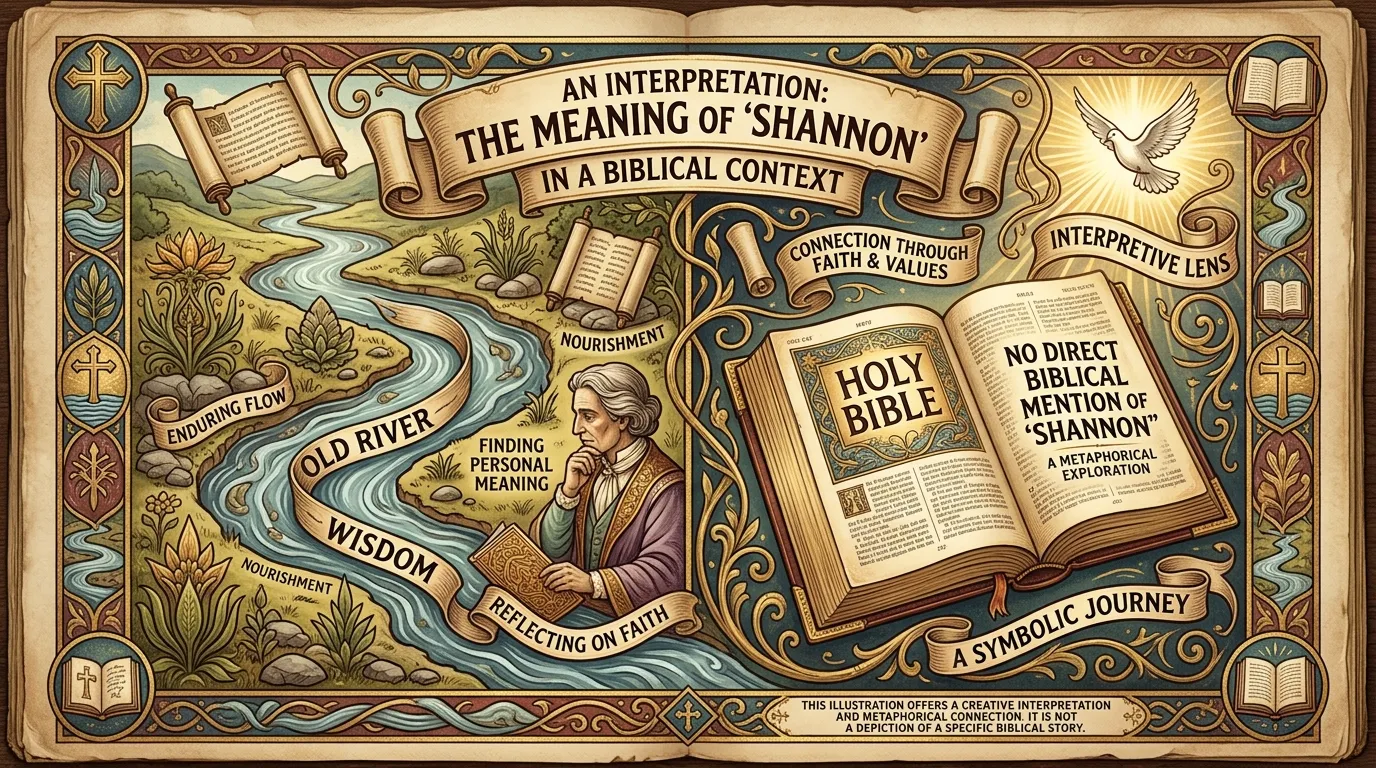
Stand on the bank of a river and watch it for a while. It does not hurry, yet it is never still. It finds a way around every rock, wears down what it cannot move, and arrives — always arrives — at the sea. There is a kind of wisdom in that: patient, persistent, unshowy. The name Shannon carries exactly this picture. It comes from Irish roots — from Sionainn, the name of Ireland’s great river — and is commonly understood to mean “wise river” or “old river.” Honesty first: Shannon does not appear in the Bible. It is an Irish name, not a Hebrew one, and no concordance will produce it. But the two words inside it — wise and river — are among Scripture’s favorite images, and following them leads into deep biblical water.
“Old River”: What Rivers Mean in Scripture
The Bible thinks in rivers. Eden was watered by a river that parted into four (Genesis 2:10) — the source of paradise itself flowing outward. The Jordan carried Israel from wilderness to promise. Ezekiel saw a river flowing from the temple, ankle-deep, then knee-deep, then uncrossable, bringing life to everything it touched: “everything will live where the river goes” (Ezekiel 47:9). And Revelation’s final vision brings the image full circle: “the river of the water of life, bright as crystal, flowing from the throne of God and of the Lamb” (Revelation 22:1).
What do rivers do in these pictures? Three things, and each one preaches. Rivers give life. The psalmist’s blessed man is “like a tree planted by streams of water that yields its fruit in its season” (Psalm 1:3) — the river is the difference between flourishing and withering. Rivers refresh. David’s Shepherd leads him “beside still waters” and “restores my soul” (Psalm 23:2-3); the river is where exhaustion ends. Rivers move. They go somewhere — toward the sea, toward the nations, toward the future. Stagnant water breeds disease; moving water brings life. A name meaning “river” is, in biblical terms, a name about life-giving movement: not a pond that keeps, but a river that gives.
Jesus made the image personal: “Whoever believes in me… ‘Out of his heart will flow rivers of living water'” (John 7:38). The believer becomes a river-source — the life received from Christ flowing outward to others. That is the trajectory hidden in the name Shannon: may this life not stagnate; may it flow, refresh, and give life wherever it goes.
Three Rivers Worth Remembering
Scripture’s rivers are not interchangeable scenery; each one teaches something distinct, and together they fill out the name’s meaning. The Jordan is the river of transition. Israel crossed it to enter the promise (Joshua 3-4) — the waters parting as the priests’ feet touched them, twelve memorial stones raised on the far bank. Naaman the Syrian dipped in it seven times and watched his leprosy wash away (2 Kings 5). The Jordan says: rivers mark new beginnings; what was impossible on this bank becomes possible on the other. The river of Ezekiel’s vision is the river of deepening. It starts ankle-deep at the temple threshold and grows — knee-deep, waist-deep, “a river that could not be passed through” (Ezekiel 47:5). The spiritual life is meant to deepen the same way: what begins as a wade becomes a swim, and the swim carries you. The river of life in Revelation 22 is the river of completion — flowing from the throne, lined with the tree of life whose leaves are “for the healing of the nations.” Every river in Scripture is flowing toward something: promise, depth, healing, home.
A “wise river,” then, is a life that knows where it is flowing. Not drifting — directed. The wisdom is in the direction: toward the sea of God’s purposes, deepening as it goes, bringing healing to the banks it passes. That is a worthy meaning to carry, whether the name is Irish, Hebrew, or anything else.
“Wise”: The Other Half of the Name
If “river” is the picture, “wise” is the character — and Scripture’s wisdom literature gives the word its full weight. Biblical wisdom (hokmah) is not primarily intellectual brilliance; it is skill in living — the practical art of navigating life according to God’s design. “The fear of the LORD is the beginning of wisdom” (Proverbs 9:10): wisdom starts not with information but with orientation, with knowing who God is and living accordingly.
Proverbs personifies wisdom as a woman calling out in the streets, offering life to all who listen (Proverbs 8). James describes the wisdom from above as “first pure, then peaceable, gentle, open to reason, full of mercy and good fruits, impartial and sincere” (James 3:17) — notice how unlike mere cleverness that is. Worldly wisdom wins arguments; godly wisdom makes peace. Worldly wisdom accumulates; godly wisdom gives mercy. The “wise” in “wise river” is this kind of wisdom: not the sharpness that cuts, but the depth that nourishes.
Put the two halves together and the name becomes a small portrait of spiritual maturity: a wise river is a life that flows with discernment — moving forward like water, but not recklessly; finding a way around obstacles like a river around rocks, but never stagnating; bringing refreshment to others, but with the steadiness that wisdom gives. Rivers without wisdom flood and destroy. Wisdom without flow becomes a stagnant pool of unused knowledge. The name holds the two together, and so should the life.
The Wise River in Practice: What It Looks Like Daily
Abstractions need flesh, so picture the “wise river” in ordinary life. She is the peacemaker — the one who, when the family argument rises, speaks the gentle answer that turns away wrath (Proverbs 15:1), finding a way around the rock instead of crashing into it. She is the listener — “quick to hear, slow to speak” (James 1:19), the river that receives before it flows, gathering the waters of others’ stories before offering its own. She is the patient one — not stagnant, never stuck, but unhurried; trusting that steady flow accomplishes what frantic rushing cannot. The farmer does not hurry the river to the sea. He simply keeps the channel clear.
And she is the one who deepens. Remember Ezekiel’s river: ankle, knee, waist, uncrossable. The wise river is not content with the shallows of first faith. She wades deeper — into harder obedience, costlier forgiveness, quieter prayer — until the water carries her rather than she the water. That is the trajectory of every maturing believer, and it is the quiet promise inside the name: you were made to deepen. Rivers that stop deepening start drying. Keep moving. Keep deepening. The sea is ahead.
Carrying an Irish Name With Biblical Resonance
There is something worth saying about names that come from outside Scripture. The Bible itself is full of them: many New Testament believers carried Greek and Latin names — Priscilla, Felix, Claudia — and their faith was not diminished by the etymology. God’s people have always lived in cultures with their own naming traditions, and a name’s worth is measured by the life lived under it, not by its language of origin. An Irish river-name can carry biblical meaning just as surely as a Hebrew one, because meaning is made by resonance and by living, not merely by roots.
For parents who chose Shannon, the name is a prayer in two words: may she be wise; may she flow. Pray it specifically. Pray for the wisdom that is pure and peaceable rather than the cleverness that is sharp and cold. Pray for the river-life that refreshes others rather than the drivenness that merely rushes. There is biblical precedent for treating a child’s name as a spoken blessing: when Hannah named her son Samuel (“heard of God”), the name itself was a testimony she would repeat for the rest of her life (1 Samuel 1:20). Every “Shannon!” called across a playground can be, for the praying parent, a quiet renewal of the hope: wise, and flowing, and bringing life. And for those named Shannon reading this: your name preaches every time it is spoken. Let it preach truly. Be the person who, like the river of Ezekiel’s vision, brings life to everything touched — the calm presence in the anxious room, the wise voice in the confused conversation, the steady flow when everything else is either flooding or dry.
The old Irish river has run for millennia, patient and persistent, wearing down rock and reaching the sea at last. Scripture’s rivers do the same work in the soul: they picture the life God gives — moving, refreshing, wise. Shannon is not a biblical name, but it is a name the Bible would understand well: the wise river, flowing toward the sea of God’s purposes, bringing life where it goes, now and always. For the history of the name and its famous river, see the article on Shannon as a given name.