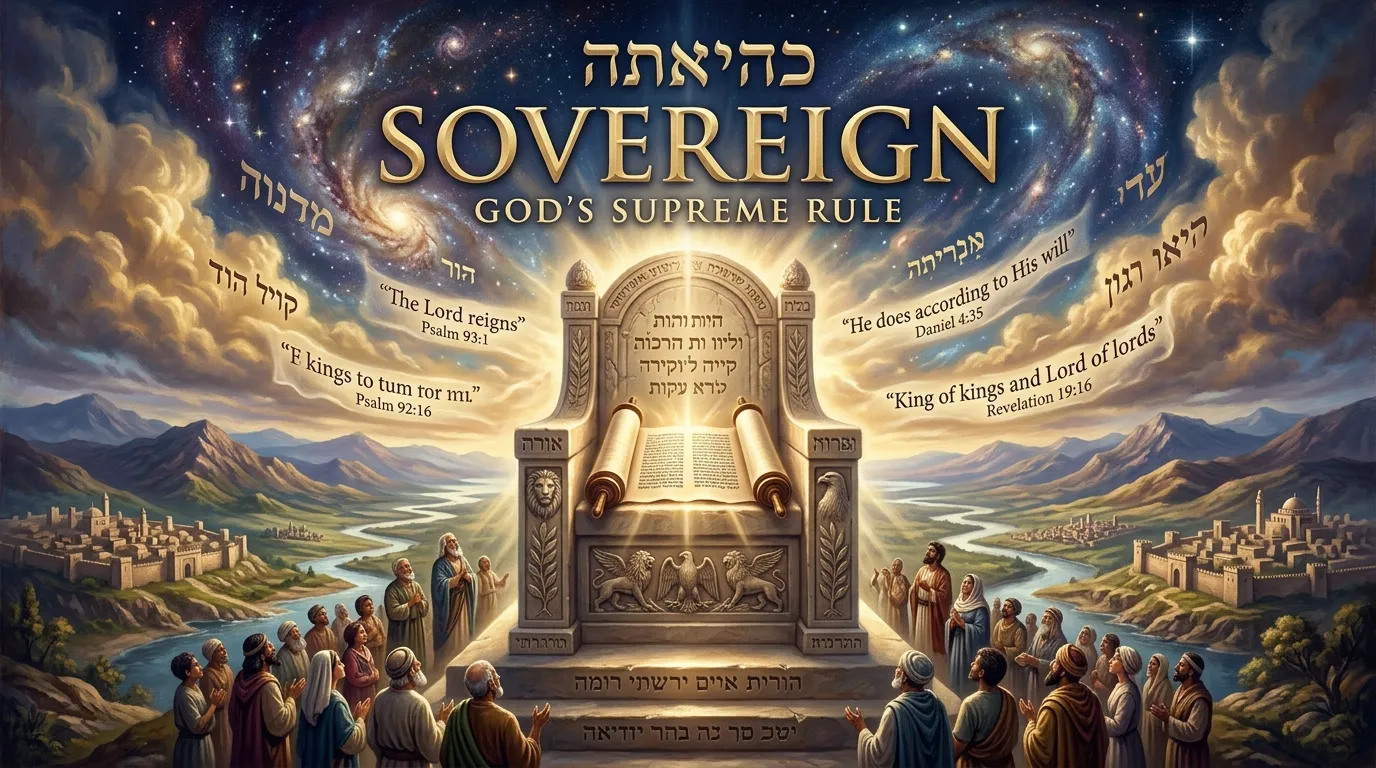
He had been the most powerful man on earth — and he lost his mind and ate grass like an ox. Nebuchadnezzar, king of Babylon, had conquered nations and built a golden empire, and one morning he looked out over it all and said, “Is not this great Babylon, which I have built by my mighty power as a royal residence and for the glory of my majesty?” (Daniel 4:30). Before the sentence was finished, a voice from heaven answered: his kingdom was taken, his reason fled, and for seven years the emperor grazed in the fields. When his sanity returned, the most powerful man on earth issued the most humbling confession in Scripture: “the Most High rules the kingdom of men and gives it to whom he will” (Daniel 4:32). That sentence is the Bible’s doctrine of sovereignty in miniature: God reigns. Really reigns. Over everything, including kings.
The word “sovereign” means a supreme ruler — one whose authority has no higher court of appeal. When the Bible applies it to God, it is making the most comprehensive claim possible: there is no circumstance, no power, no person, and no event outside His rule. “Our God is in the heavens; he does all that he pleases” (Psalm 115:3). “He does according to his will among the host of heaven and among the inhabitants of the earth; and none can stay his hand” (Daniel 4:35). This is not one doctrine among many; it is the atmosphere in which all the other doctrines breathe. Every promise in Scripture — every “I will be with you,” every “all things work together for good” — stands on the ground of sovereignty. If God were not sovereign, His promises would be wishes.
The King Who Learned: Daniel 4 and the Education of Nebuchadnezzar
Nebuchadnezzar’s story is Scripture’s great object lesson in sovereignty, and it is told at unusual length precisely because the lesson is so hard for the powerful — and the proud in all of us — to learn. Daniel had warned him: “break off your sins by practicing righteousness… that there may perhaps be a lengthening of your prosperity” (Daniel 4:27). The king ignored the warning for a full year. Then came the boast, the voice, the madness, the grass. Seven years of beast-like existence for the man who had called himself the head of gold.
But the story does not end in the field; it ends in restoration with understanding. “At the end of the days I, Nebuchadnezzar, lifted my eyes to heaven, and my reason returned to me, and I blessed the Most High, and praised and honored him who lives forever” (Daniel 4:34). He lifted his eyes to heaven. The cure for his madness was not therapy but theology — seeing rightly who rules. His confession is worth memorizing: God’s dominion is everlasting, His kingdom endures from generation to generation, “all the inhabitants of the earth are accounted as nothing, and he does according to his will” (Daniel 4:35). The proudest king in history became sovereignty’s greatest witness. God will be acknowledged as sovereign — willingly, in worship, or unwillingly, in judgment. Nebuchadnezzar learned it the hard way so that readers for three millennia could learn it from a book.
Daniel 4 remains Scripture’s standing word to every age’s strongmen — and its standing comfort to everyone living under them: thrones are temporary, but the Most High’s rule is not. Empires rise and fall on His schedule; the boastful are humbled in His time; and no ruler, however absolute he seems, operates outside the permission of heaven. That is either terrifying or wonderful, depending on which side of pride you stand.
Sovereignty in Joseph’s Story: The Long View
If Daniel 4 shows sovereignty confronting pride, Joseph’s story shows it comforting the afflicted. Sold by his brothers, falsely accused by his master’s wife, forgotten in prison for years — Joseph’s life reads like a catalogue of injustice. Yet the closing sentence of Genesis reframes everything: “As for you, you meant evil against me, but God meant it for good, to bring it about that many people should be kept alive” (Genesis 50:20). God meant it. The same events, two intentions: the brothers’ evil and God’s good, woven into a single history. Joseph does not say his suffering was an illusion or that God merely made the best of a bad situation. He says God meant it — purposed it, steered it — for the saving of many lives.
This is sovereignty as the believer’s anchor in suffering. It does not explain why each particular pain was permitted — Joseph never received a itemized explanation either. What it gives is something better than explanation: the assurance that no pain is wasted and no evil gets the final word. The brothers’ malice was real and they were accountable for it; God’s sovereignty does not excuse their sin. But above their scheming ran a deeper purpose, and that purpose prevailed. Every believer who has lived long enough to look back on a painful chapter and see God’s hand in it has lived a small Genesis 50:20. Sovereignty means your story is being written by an Author who wastes nothing — not even the chapters you would have skipped.
The Mystery Held Honestly: Sovereignty and Human Responsibility
Honest teaching must name the tension: Scripture affirms God’s complete sovereignty and genuine human responsibility, without explaining exactly how they fit together. Joseph’s brothers were truly guilty though God truly purposed the outcome. Judas betrayed Christ “by the definite plan and foreknowledge of God,” yet Peter still charged the crowd: “you crucified and killed” Him (Acts 2:23). Paul urges believers to “work out your own salvation with fear and trembling, for it is God who works in you” (Philippians 2:12-13) — your working and God’s working, in the same breath, without embarrassment.
Christians have debated the mechanics of this for centuries, and this article will not pretend the debate is settled — but the pastoral posture is clear. Never use sovereignty to excuse passivity (“God’s will be done, so why pray?”) — Scripture commands prayer, effort, and obedience as the very means God uses. Never use human responsibility to shrink God (“He’s doing His best with a messy world”) — Scripture will not allow a small, surprised, or thwarted God. Hold both truths the way the Bible holds them: pray like everything depends on God, work like everything depends on you, and trust like everything depends on the One who ordered both. Mystery is not the enemy of faith here; it is its proper atmosphere. A God we could fully diagram would not be worth worshiping.
The Comfort of the Throne: What Sovereignty Does for Today
So what does this great doctrine do — on a Tuesday, in a hospital waiting room, when the diagnosis is bad or the prodigal is still gone? Three things. First, it steadies prayer. We pray because God is sovereign, not despite it. A God who cannot act is not worth asking; a God who rules all things is worth asking about everything. Sovereignty does not make prayer pointless — it makes prayer powerful. Second, it quiets anxiety. “All things work together for good for those who love God” (Romans 8:28) is not a platitude; it is a sovereignty text. All things. The promise is not that all things are good, but that the sovereign God works them toward good. The difference is everything.
Third, it fuels mission. When Paul was discouraged in Corinth, the Lord told him in a vision: “Do not be afraid, but go on speaking… for I have many in this city who are my people” (Acts 18:9-10). Paul’s evangelism was not a desperate gamble that might fail; it was the means by which the sovereign God would call His own. Sovereignty has always been the church’s missionary doctrine: because God rules, the gospel cannot ultimately fail; because He has a people in every city, preaching is never wasted. William Carey, the father of modern missions, sailed for India armed with precisely this conviction. The throne is not only a comfort for sufferers — it is a launchpad for witnesses.
Fourth, it humbles pride and lifts despair in the same motion. To the proud — to every Nebuchadnezzar surveying his Babylon — sovereignty says: your kingdom is on loan. To the despairing — to every Joseph in a prison that seems forgotten — sovereignty says: your story is being written by a good Author. The same throne that terrifies the arrogant comforts the afflicted. That is why the Bible’s sovereignty passages so often appear as worship: “Yours, O LORD, is the greatness and the power and the glory… for all that is in the heavens and in the earth is yours. Yours is the kingdom, O LORD” (1 Chronicles 29:11). David prayed that at the height of his own power — the rare king who learned Nebuchadnezzar’s lesson without eating grass. The wisest response to sovereignty was never argument. It was always adoration. For the broader concept of supreme authority across history and thought, see the article on sovereignty.